
期刊文章
过刊浏览
- Volumes 108-119 (2025)
-
Volumes 96-107 (2025)
-
Volume 107
Pages 1-376 (December 2025)
-
Volume 106
Pages 1-336 (November 2025)
-
Volume 105
Pages 1-356 (October 2025)
-
Volume 104
Pages 1-332 (September 2025)
-
Volume 103
Pages 1-314 (August 2025)
-
Volume 102
Pages 1-276 (July 2025)
-
Volume 101
Pages 1-166 (June 2025)
-
Volume 100
Pages 1-256 (May 2025)
-
Volume 99
Pages 1-242 (April 2025)
-
Volume 98
Pages 1-288 (March 2025)
-
Volume 97
Pages 1-256 (February 2025)
-
Volume 96
Pages 1-340 (January 2025)
-
Volume 107
-
Volumes 84-95 (2024)
-
Volume 95
Pages 1-392 (December 2024)
-
Volume 94
Pages 1-400 (November 2024)
-
Volume 93
Pages 1-376 (October 2024)
-
Volume 92
Pages 1-316 (September 2024)
-
Volume 91
Pages 1-378 (August 2024)
-
Volume 90
Pages 1-580 (July 2024)
-
Volume 89
Pages 1-278 (June 2024)
-
Volume 88
Pages 1-350 (May 2024)
-
Volume 87
Pages 1-338 (April 2024)
-
Volume 86
Pages 1-312 (March 2024)
-
Volume 85
Pages 1-334 (February 2024)
-
Volume 84
Pages 1-308 (January 2024)
-
Volume 95
-
Volumes 72-83 (2023)
-
Volume 83
Pages 1-258 (December 2023)
-
Volume 82
Pages 1-204 (November 2023)
-
Volume 81
Pages 1-188 (October 2023)
-
Volume 80
Pages 1-202 (September 2023)
-
Volume 79
Pages 1-172 (August 2023)
-
Volume 78
Pages 1-146 (July 2023)
-
Volume 77
Pages 1-152 (June 2023)
-
Volume 76
Pages 1-176 (May 2023)
-
Volume 75
Pages 1-228 (April 2023)
-
Volume 74
Pages 1-200 (March 2023)
-
Volume 73
Pages 1-138 (February 2023)
-
Volume 72
Pages 1-144 (January 2023)
-
Volume 83
-
Volumes 60-71 (2022)
-
Volume 71
Pages 1-108 (December 2022)
-
Volume 70
Pages 1-106 (November 2022)
-
Volume 69
Pages 1-122 (October 2022)
-
Volume 68
Pages 1-124 (September 2022)
-
Volume 67
Pages 1-102 (August 2022)
-
Volume 66
Pages 1-112 (July 2022)
-
Volume 65
Pages 1-138 (June 2022)
-
Volume 64
Pages 1-186 (May 2022)
-
Volume 63
Pages 1-124 (April 2022)
-
Volume 62
Pages 1-104 (March 2022)
-
Volume 61
Pages 1-120 (February 2022)
-
Volume 60
Pages 1-124 (January 2022)
-
Volume 71
- Volumes 54-59 (2021)
- Volumes 48-53 (2020)
- Volumes 42-47 (2019)
- Volumes 36-41 (2018)
- Volumes 30-35 (2017)
- Volumes 24-29 (2016)
- Volumes 18-23 (2015)
- Volumes 12-17 (2014)
- Volume 11 (2013)
- Volume 10 (2012)
- Volume 9 (2011)
- Volume 8 (2010)
- Volume 7 (2009)
- Volume 6 (2008)
- Volume 5 (2007)
- Volume 4 (2006)
- Volume 3 (2005)
- Volume 2 (2004)
- Volume 1 (2003)
Volume 116
Effective thermal conductivity of packed bed of porous biochar particles (Open Access)
Nicole Vorhauer-Huget a 1, Zahra Ghasemi Monfared b 1, Neda Kazemi a, Eduardo Arango Durango b, Evangelos Tsotsas a, Kentaro Umeki b *
a Otto von Guericke University Magdeburg, Thermal Process Engineering, Universitätsplatz 2, 39106, Magdeburg, Germany
b Luleå University of Technology, Division of Energy Science, Laboratorievägen 14, 971 87, Luleå, Sweden
10.1016/j.partic.2026.06.036
Volume 116,
September 2026,
Pages 437-447
Received 27 January 2026, Revised 19 June 2026, Accepted 29 June 2026, Available online 10 July 2026, Version of Record 16 July 2026.
E-mail:
kentaro.umeki@ltu.se
Highlights
• Densified biochar particles with various particle size and packed bed porosity.
• X-ray tomography used to access the particle structure.
• Assessment of experimental data with a modified Zehner-Bauer-Schlünder model.
• Dispersed biochar particles appeared to have no significant thermal contact.
• Effective thermal conductivity as a function of particle size and packed bed porosity.
Abstract
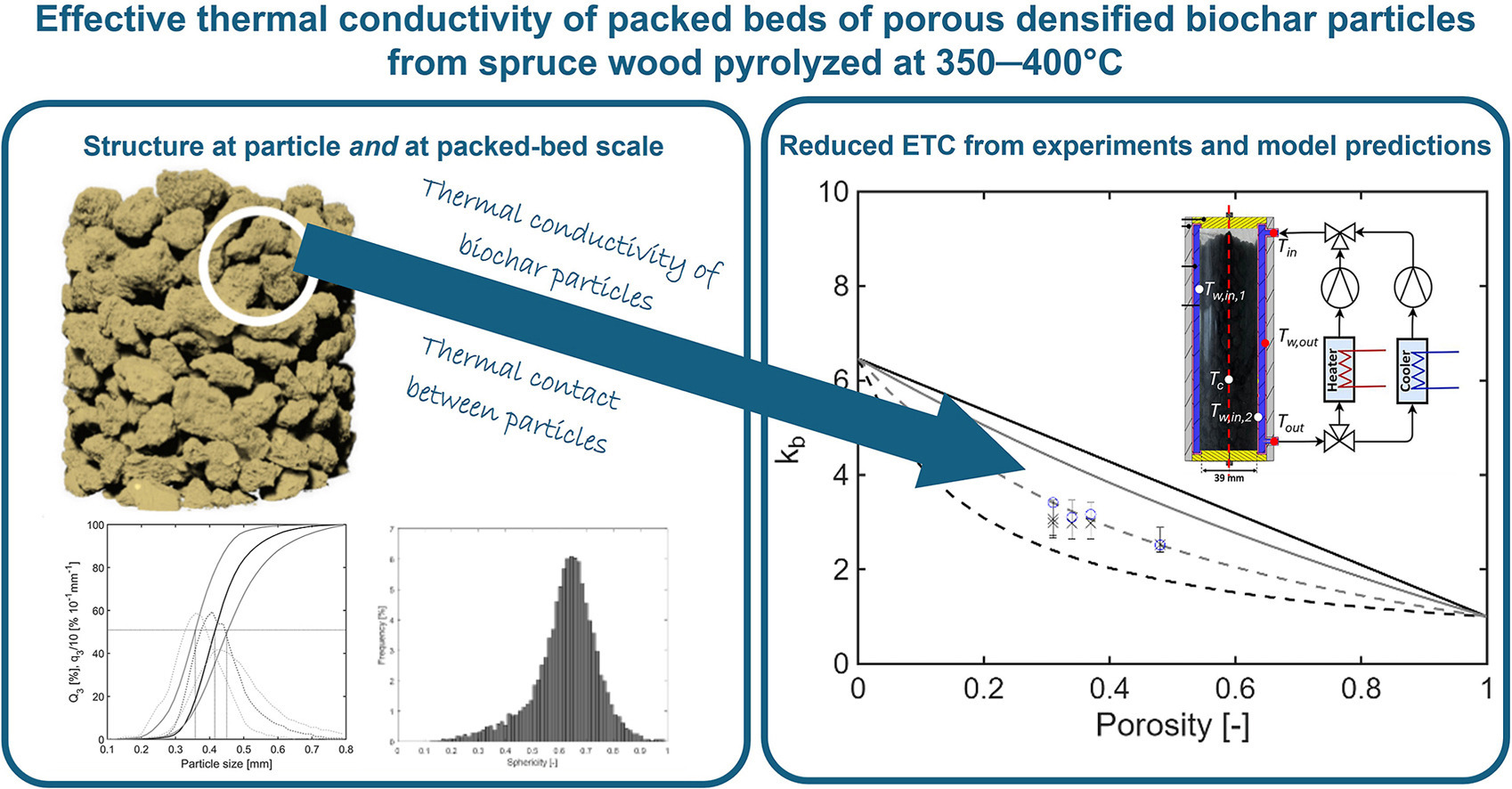
In metallurgical processes, packed beds of biochar are subjected to thermal gradients and heterogeneous reactions. In addition, densified biochar particles emerge as a promising carbon-negative insulation solution for building constructions. This makes the effective thermal conductivity (ETC) a critical parameter, but the ETC of biochar particles has not been systematically investigated in dependence of particle size, shape and packed bed porosity. This work aims to partially fill this gap by using densified biochar from spruce bark. The ETC is derived from experiments under non-reactive conditions and numerical analysis including the Zehner–Bauer–Schlünder (ZBS) model. X-ray microtomography was used to quantify particle structure, including sphericity and void fraction. Thermal properties were measured experimentally, and ETC was determined for various particle size fractions between 0.315 and 6.3 mm. The smaller particle fractions exhibited similar bed porosities and ETCs, whereas the largest particle fraction (4-6.3 mm) showed slightly lower ETC and higher bed porosity. Analysis with the ZBS model revealed the need to include an additional thermal resistance in the gap between the irregular particles due to the imperfect contact of particles. The results highlight the importance of manipulating inter-particle thermal contacts in altering the ETC of packed beds of irregular particles.
Graphical abstract
Keywords
Experimental determination of ETC; ZBS model; Particle geometry; X-ray tomography
文章导读