
期刊文章
过刊浏览
- Volumes 108-119 (2025)
-
Volumes 96-107 (2025)
-
Volume 107
Pages 1-376 (December 2025)
-
Volume 106
Pages 1-336 (November 2025)
-
Volume 105
Pages 1-356 (October 2025)
-
Volume 104
Pages 1-332 (September 2025)
-
Volume 103
Pages 1-314 (August 2025)
-
Volume 102
Pages 1-276 (July 2025)
-
Volume 101
Pages 1-166 (June 2025)
-
Volume 100
Pages 1-256 (May 2025)
-
Volume 99
Pages 1-242 (April 2025)
-
Volume 98
Pages 1-288 (March 2025)
-
Volume 97
Pages 1-256 (February 2025)
-
Volume 96
Pages 1-340 (January 2025)
-
Volume 107
-
Volumes 84-95 (2024)
-
Volume 95
Pages 1-392 (December 2024)
-
Volume 94
Pages 1-400 (November 2024)
-
Volume 93
Pages 1-376 (October 2024)
-
Volume 92
Pages 1-316 (September 2024)
-
Volume 91
Pages 1-378 (August 2024)
-
Volume 90
Pages 1-580 (July 2024)
-
Volume 89
Pages 1-278 (June 2024)
-
Volume 88
Pages 1-350 (May 2024)
-
Volume 87
Pages 1-338 (April 2024)
-
Volume 86
Pages 1-312 (March 2024)
-
Volume 85
Pages 1-334 (February 2024)
-
Volume 84
Pages 1-308 (January 2024)
-
Volume 95
-
Volumes 72-83 (2023)
-
Volume 83
Pages 1-258 (December 2023)
-
Volume 82
Pages 1-204 (November 2023)
-
Volume 81
Pages 1-188 (October 2023)
-
Volume 80
Pages 1-202 (September 2023)
-
Volume 79
Pages 1-172 (August 2023)
-
Volume 78
Pages 1-146 (July 2023)
-
Volume 77
Pages 1-152 (June 2023)
-
Volume 76
Pages 1-176 (May 2023)
-
Volume 75
Pages 1-228 (April 2023)
-
Volume 74
Pages 1-200 (March 2023)
-
Volume 73
Pages 1-138 (February 2023)
-
Volume 72
Pages 1-144 (January 2023)
-
Volume 83
-
Volumes 60-71 (2022)
-
Volume 71
Pages 1-108 (December 2022)
-
Volume 70
Pages 1-106 (November 2022)
-
Volume 69
Pages 1-122 (October 2022)
-
Volume 68
Pages 1-124 (September 2022)
-
Volume 67
Pages 1-102 (August 2022)
-
Volume 66
Pages 1-112 (July 2022)
-
Volume 65
Pages 1-138 (June 2022)
-
Volume 64
Pages 1-186 (May 2022)
-
Volume 63
Pages 1-124 (April 2022)
-
Volume 62
Pages 1-104 (March 2022)
-
Volume 61
Pages 1-120 (February 2022)
-
Volume 60
Pages 1-124 (January 2022)
-
Volume 71
- Volumes 54-59 (2021)
- Volumes 48-53 (2020)
- Volumes 42-47 (2019)
- Volumes 36-41 (2018)
- Volumes 30-35 (2017)
- Volumes 24-29 (2016)
- Volumes 18-23 (2015)
- Volumes 12-17 (2014)
- Volume 11 (2013)
- Volume 10 (2012)
- Volume 9 (2011)
- Volume 8 (2010)
- Volume 7 (2009)
- Volume 6 (2008)
- Volume 5 (2007)
- Volume 4 (2006)
- Volume 3 (2005)
- Volume 2 (2004)
- Volume 1 (2003)
Volume 116
Recycled Arabic gum as a replacement for starch in self-reducing mill scale-based briquettes (Open Access)
Sara Scolari *, Luca Tosarello, Davide Mombelli, Gianluca Dall’Osto, Carlo Mapelli
Politecnico di Milano, Dipartimento di Meccanica, Via Privata Giuseppe La Masa 1, 20156, Milano, Italy
10.1016/j.partic.2026.06.039
Volume 116,
September 2026,
Pages 448-466
Received 9 April 2026, Revised 29 June 2026, Accepted 30 June 2026, Available online 11 July 2026, Version of Record 16 July 2026.
E-mail:
sara.scolari@polimi.it
Highlights
• Arabic gum increases the IRI and thermal stability of each mixture.
• Viscosity of the binder affects particles orientation during briquetting.
• No alteration of chemical composition and microstructure after reduction.
• Arabic gum can cover up to 46% of briquettes production.
Abstract
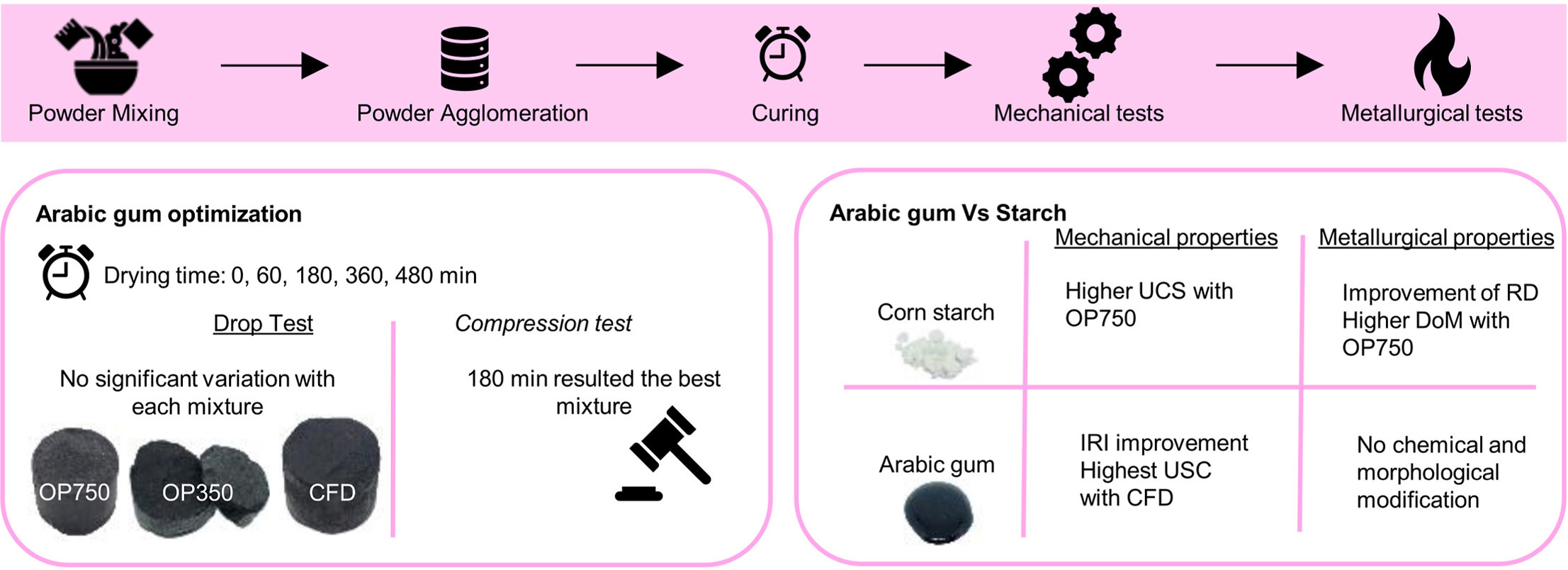
Steelmaking produces large quantities of iron-rich by-products and their recycling improves resource efficiency and reduces waste generation. This work investigates the potential for utilizing mill scale to produce self-reducing briquettes assessing the effectiveness of recycled Arabic gum as a sustainable binder compared to conventional starch. The briquettes were produced by combining the mill scale with different reducing agents: olive pomace biochar pyrolyzed at 750 (OP750) and 350 °C (OP350), and cupola furnace dust (CFD). By using Arabic gum instead of starch, an improved resistance to impact was observed for each mixture (1000 for OP750 and CFD versus 767 and 191, respectively). Recycled Arabic gum, also, limited the swelling of each mixture and promoted the sintering of the briquettes. On the contrary, the starch favored an increase in volume (maximum 153.62%) until 1200 °C. Furthermore, the Arabic gum enhanced the reduction capacity of the mixture while preventing chemical or morphological variations in the reduction products and leading to an increase of up to 9.06% in the degree of metallization with OP350. Overall, most the results obtained using Recycled Arabic gum exceeded the industrial benchmark, confirming the feasibility of its usage as a substitute for starch in self-reducing briquettes.
Graphical abstract
Keywords
Self-reducing briquettes; Arabic gum; Starch; Mechanical properties; Metallurgical properties
文章导读