
期刊文章
过刊浏览
- Volumes 108-119 (2025)
-
Volumes 96-107 (2025)
-
Volume 107
Pages 1-376 (December 2025)
-
Volume 106
Pages 1-336 (November 2025)
-
Volume 105
Pages 1-356 (October 2025)
-
Volume 104
Pages 1-332 (September 2025)
-
Volume 103
Pages 1-314 (August 2025)
-
Volume 102
Pages 1-276 (July 2025)
-
Volume 101
Pages 1-166 (June 2025)
-
Volume 100
Pages 1-256 (May 2025)
-
Volume 99
Pages 1-242 (April 2025)
-
Volume 98
Pages 1-288 (March 2025)
-
Volume 97
Pages 1-256 (February 2025)
-
Volume 96
Pages 1-340 (January 2025)
-
Volume 107
-
Volumes 84-95 (2024)
-
Volume 95
Pages 1-392 (December 2024)
-
Volume 94
Pages 1-400 (November 2024)
-
Volume 93
Pages 1-376 (October 2024)
-
Volume 92
Pages 1-316 (September 2024)
-
Volume 91
Pages 1-378 (August 2024)
-
Volume 90
Pages 1-580 (July 2024)
-
Volume 89
Pages 1-278 (June 2024)
-
Volume 88
Pages 1-350 (May 2024)
-
Volume 87
Pages 1-338 (April 2024)
-
Volume 86
Pages 1-312 (March 2024)
-
Volume 85
Pages 1-334 (February 2024)
-
Volume 84
Pages 1-308 (January 2024)
-
Volume 95
-
Volumes 72-83 (2023)
-
Volume 83
Pages 1-258 (December 2023)
-
Volume 82
Pages 1-204 (November 2023)
-
Volume 81
Pages 1-188 (October 2023)
-
Volume 80
Pages 1-202 (September 2023)
-
Volume 79
Pages 1-172 (August 2023)
-
Volume 78
Pages 1-146 (July 2023)
-
Volume 77
Pages 1-152 (June 2023)
-
Volume 76
Pages 1-176 (May 2023)
-
Volume 75
Pages 1-228 (April 2023)
-
Volume 74
Pages 1-200 (March 2023)
-
Volume 73
Pages 1-138 (February 2023)
-
Volume 72
Pages 1-144 (January 2023)
-
Volume 83
-
Volumes 60-71 (2022)
-
Volume 71
Pages 1-108 (December 2022)
-
Volume 70
Pages 1-106 (November 2022)
-
Volume 69
Pages 1-122 (October 2022)
-
Volume 68
Pages 1-124 (September 2022)
-
Volume 67
Pages 1-102 (August 2022)
-
Volume 66
Pages 1-112 (July 2022)
-
Volume 65
Pages 1-138 (June 2022)
-
Volume 64
Pages 1-186 (May 2022)
-
Volume 63
Pages 1-124 (April 2022)
-
Volume 62
Pages 1-104 (March 2022)
-
Volume 61
Pages 1-120 (February 2022)
-
Volume 60
Pages 1-124 (January 2022)
-
Volume 71
- Volumes 54-59 (2021)
- Volumes 48-53 (2020)
- Volumes 42-47 (2019)
- Volumes 36-41 (2018)
- Volumes 30-35 (2017)
- Volumes 24-29 (2016)
- Volumes 18-23 (2015)
- Volumes 12-17 (2014)
- Volume 11 (2013)
- Volume 10 (2012)
- Volume 9 (2011)
- Volume 8 (2010)
- Volume 7 (2009)
- Volume 6 (2008)
- Volume 5 (2007)
- Volume 4 (2006)
- Volume 3 (2005)
- Volume 2 (2004)
- Volume 1 (2003)
Volume 118
Experimental study on hydrodynamic characteristics of tapered-in risers
Feng Cheng a, Shutong Jin a, Jian Li a, Shuangzhu Kong a, Mengxi Liu a *, Yiping Fan a, Chunxi Lu a, Weiyu Song b
a State Key Laboratory of Heavy Oil Processing, China University of Petroleum Beijing, Beijing, 102249, China
b China University of Petroleum Beijing at Karamay, Karamay, 834000, China
10.1016/j.partic.2026.08.008
Volume 118,
November 2026,
Pages 1-15
Received 8 June 2026, Revised 5 August 2026, Accepted 9 August 2026, Available online 22 August 2026, Version of Record 31 August 2026.
E-mail:
mengxiliu@sina.com; liumx@cup.edu.cn
Highlights
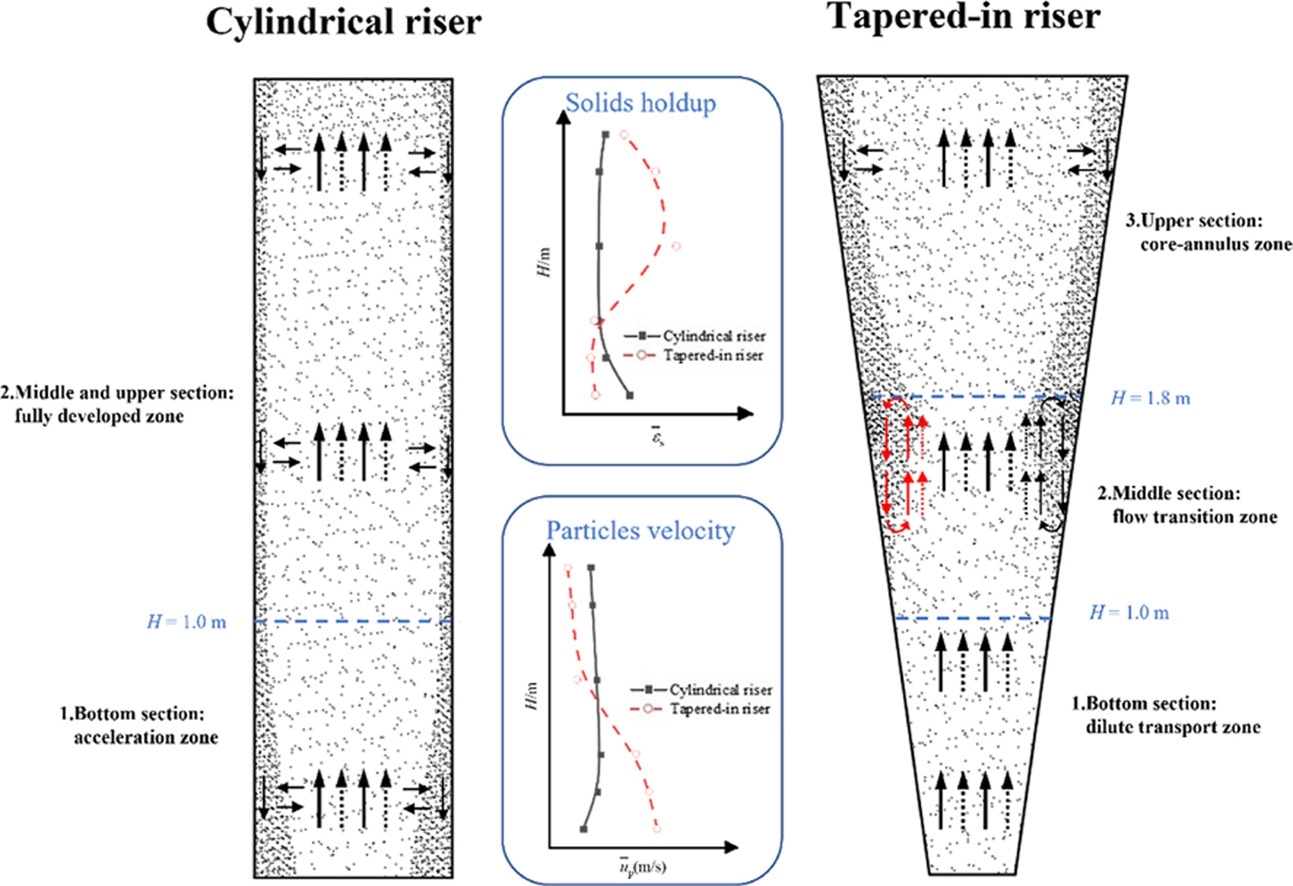
• Tapered-in risers exhibit an S-shaped axial solids-holdup profile and continuously decreasing particle velocity.
• The middle section acts as the main flow-transition region, with back-mixing and internal circulation.
• The core–annulus structure weakens axially in cylindrical risers but develops from bottom to upper sections in tapered-in risers.
• Kutta–Joukowski transverse force analysis provides a mechanical interpretation for radial solids-holdup non-uniformity.
• Mesoscale analysis reveals denser and more persistent near-wall clusters in tapered-in risers.
Abstract
A cold-model circulating fluidized bed is used to investigate gas–solid flow behavior in tapered-in risers with inclined angles of 0.3°, 0.5°, and 0.7°, with a conventional cylindrical riser as a reference. Local solids holdup and particle velocity are measured using optical fiber probes. The tapered-in risers exhibit a distinct S-shaped axial solids holdup profile and a continuously decreasing particle velocity along the axial direction, in contrast to the typical C-shaped solids holdup profile and bottom particle-acceleration region observed in the cylindrical riser. The bottom section of the tapered-in riser remains in a dilute fast-transport state because of the high local gas velocity, whereas the middle section becomes the main flow-transition region. In this region, the decrease in local gas velocity caused by cross-sectional expansion is not followed immediately by particle deceleration, leading to near-wall accumulation, back-mixing, local internal circulation, and the highest solids holdup. Radially, the cylindrical riser shows a core–annulus structure that weakens after the bottom acceleration region, while the tapered-in risers develop stronger core–annulus structures in the middle and upper sections. A mechanistic analysis based on the Kutta–Joukowski (K-J) force further indicates that the radial non-uniformity of local solids holdup is closely related to the K-J force acting on particles. The K-J force analysis helps explain the development of near-wall solids accumulation and core–annulus structures, and its magnitude is jointly affected by slip velocity and particle-velocity gradient. Mesoscale analysis further shows that near-wall clusters in the middle and upper sections of the tapered-in riser are denser and more persistent, although their occurrence frequency is lower. These results clarify the geometry-induced flow restructuring in tapered-in risers and provide hydrodynamic guidance for the design of tapered-in riser–turbulent bed coupled reactors for PDH.
Graphical abstract
Keywords
Tapered-in riser; Circulating fluidized bed; Gas-solid hydrodynamics; Propane dehydrogenation reactor
文章导读