
期刊文章
过刊浏览
- Volumes 108-119 (2025)
-
Volumes 96-107 (2025)
-
Volume 107
Pages 1-376 (December 2025)
-
Volume 106
Pages 1-336 (November 2025)
-
Volume 105
Pages 1-356 (October 2025)
-
Volume 104
Pages 1-332 (September 2025)
-
Volume 103
Pages 1-314 (August 2025)
-
Volume 102
Pages 1-276 (July 2025)
-
Volume 101
Pages 1-166 (June 2025)
-
Volume 100
Pages 1-256 (May 2025)
-
Volume 99
Pages 1-242 (April 2025)
-
Volume 98
Pages 1-288 (March 2025)
-
Volume 97
Pages 1-256 (February 2025)
-
Volume 96
Pages 1-340 (January 2025)
-
Volume 107
-
Volumes 84-95 (2024)
-
Volume 95
Pages 1-392 (December 2024)
-
Volume 94
Pages 1-400 (November 2024)
-
Volume 93
Pages 1-376 (October 2024)
-
Volume 92
Pages 1-316 (September 2024)
-
Volume 91
Pages 1-378 (August 2024)
-
Volume 90
Pages 1-580 (July 2024)
-
Volume 89
Pages 1-278 (June 2024)
-
Volume 88
Pages 1-350 (May 2024)
-
Volume 87
Pages 1-338 (April 2024)
-
Volume 86
Pages 1-312 (March 2024)
-
Volume 85
Pages 1-334 (February 2024)
-
Volume 84
Pages 1-308 (January 2024)
-
Volume 95
-
Volumes 72-83 (2023)
-
Volume 83
Pages 1-258 (December 2023)
-
Volume 82
Pages 1-204 (November 2023)
-
Volume 81
Pages 1-188 (October 2023)
-
Volume 80
Pages 1-202 (September 2023)
-
Volume 79
Pages 1-172 (August 2023)
-
Volume 78
Pages 1-146 (July 2023)
-
Volume 77
Pages 1-152 (June 2023)
-
Volume 76
Pages 1-176 (May 2023)
-
Volume 75
Pages 1-228 (April 2023)
-
Volume 74
Pages 1-200 (March 2023)
-
Volume 73
Pages 1-138 (February 2023)
-
Volume 72
Pages 1-144 (January 2023)
-
Volume 83
-
Volumes 60-71 (2022)
-
Volume 71
Pages 1-108 (December 2022)
-
Volume 70
Pages 1-106 (November 2022)
-
Volume 69
Pages 1-122 (October 2022)
-
Volume 68
Pages 1-124 (September 2022)
-
Volume 67
Pages 1-102 (August 2022)
-
Volume 66
Pages 1-112 (July 2022)
-
Volume 65
Pages 1-138 (June 2022)
-
Volume 64
Pages 1-186 (May 2022)
-
Volume 63
Pages 1-124 (April 2022)
-
Volume 62
Pages 1-104 (March 2022)
-
Volume 61
Pages 1-120 (February 2022)
-
Volume 60
Pages 1-124 (January 2022)
-
Volume 71
- Volumes 54-59 (2021)
- Volumes 48-53 (2020)
- Volumes 42-47 (2019)
- Volumes 36-41 (2018)
- Volumes 30-35 (2017)
- Volumes 24-29 (2016)
- Volumes 18-23 (2015)
- Volumes 12-17 (2014)
- Volume 11 (2013)
- Volume 10 (2012)
- Volume 9 (2011)
- Volume 8 (2010)
- Volume 7 (2009)
- Volume 6 (2008)
- Volume 5 (2007)
- Volume 4 (2006)
- Volume 3 (2005)
- Volume 2 (2004)
- Volume 1 (2003)
Volume 118
Cellulose triacetate microparticles via electrospraying and their antibacterial applications
Chaimaà El Kouali a, Khadija El Kalaaoui a b, Aicha Boukhriss c, Mohamed El Messoudi a, Siham Slassi a *, Latifa Hajji a, Mohamed Ait Chaoui a, Said Gmouh a
a Laboratory LIMAT, Faculty of Sciences Ben M'Sick, Hassan II University of Casablanca, Morocco
b The Multi Laboratory LC2A, N°182, Zone Industrielle, Mohammedia, Morocco
c Cluster Valbium Morocco IMM RIHAB, 6ème étage APPT 21, Oujda, 6000, Morocco
10.1016/j.partic.2026.07.023
Volume 118,
November 2026,
Pages 30-42
Received 17 February 2026, Revised 1 July 2026, Accepted 23 July 2026, Available online 18 August 2026, Version of Record 1 September 2026.
E-mail:
siham.slassi@etu.univh2c.ma
Highlights
• Sustainable electrospraying enabled novel CTA microparticles from cotton-derived cellulose waste.
• Precise conditions (10% CTA, rotating collector) achieved uniform, stable microparticle formation.
• BAC-loaded CTA microparticles showed potent antibacterial activity against S. aureus and E. coli.
• Biphasic release enabled rapid action followed by sustained antimicrobial delivery over 48 h.
• Eco-friendly BAC/CTA system shows strong potential for advanced antimicrobial applications.
Abstract
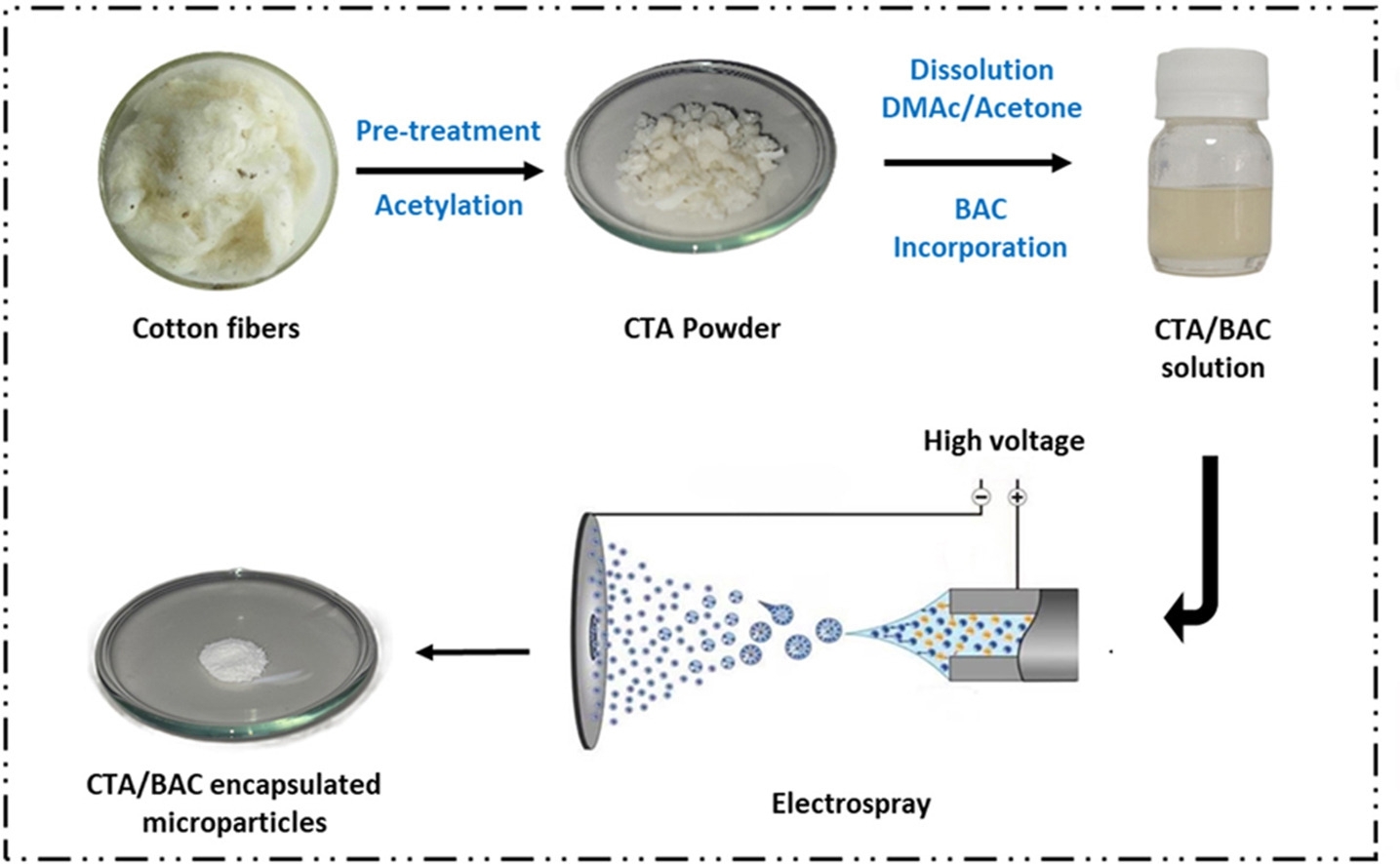
Antimicrobial materials are increasingly sought to prevent bacterial contamination and infection, particularly in biomedical and hygienic applications. In this study, homogeneous cellulose triacetate (CTA) microparticles were successfully fabricated via the electrospray technique using CTA regenerated from cotton shells. The optimization of polymer concentration and processing parameters revealed that a 10% CTA solution provided the most homogeneous and structurally stable microparticles. Benzalkonium chloride (BAC), a quaternary ammonium compound with known antibacterial activity, was effectively incorporated into the CTA matrix to produce antimicrobial microparticles. Morphological analysis by SEM confirmed the successful integration of BAC, while the XRD and FTIR results indicated that the polymer's semi-crystalline structure was preserved after incorporation. The antibacterial activity was evaluated using both disk diffusion method and liquid medium MIC assays. The formulations exhibited distinct zones against Staphylococcus aureus (Gram-positive) and Escherichia coli (Gram-negative), with low MIC values that confirm strong antibacterial efficacy. Furthermore, release studies revealed a biphasic diffusion profile with an initial burst phase (0–5 h) followed by sustained release up to 48 h. These results highlight the potential of electrosprayed CTA/BAC microparticles as efficient and controllable antibacterial delivery systems for future biomedical and surface protection applications.
Graphical abstract
Keywords
Cellulose triacetate; Electrospray; Benzalkonium chloride; Drug encapsulation; Antibacterial activity; Sustained release
文章导读