
期刊文章
过刊浏览
- Volumes 108-119 (2025)
-
Volumes 96-107 (2025)
-
Volume 107
Pages 1-376 (December 2025)
-
Volume 106
Pages 1-336 (November 2025)
-
Volume 105
Pages 1-356 (October 2025)
-
Volume 104
Pages 1-332 (September 2025)
-
Volume 103
Pages 1-314 (August 2025)
-
Volume 102
Pages 1-276 (July 2025)
-
Volume 101
Pages 1-166 (June 2025)
-
Volume 100
Pages 1-256 (May 2025)
-
Volume 99
Pages 1-242 (April 2025)
-
Volume 98
Pages 1-288 (March 2025)
-
Volume 97
Pages 1-256 (February 2025)
-
Volume 96
Pages 1-340 (January 2025)
-
Volume 107
-
Volumes 84-95 (2024)
-
Volume 95
Pages 1-392 (December 2024)
-
Volume 94
Pages 1-400 (November 2024)
-
Volume 93
Pages 1-376 (October 2024)
-
Volume 92
Pages 1-316 (September 2024)
-
Volume 91
Pages 1-378 (August 2024)
-
Volume 90
Pages 1-580 (July 2024)
-
Volume 89
Pages 1-278 (June 2024)
-
Volume 88
Pages 1-350 (May 2024)
-
Volume 87
Pages 1-338 (April 2024)
-
Volume 86
Pages 1-312 (March 2024)
-
Volume 85
Pages 1-334 (February 2024)
-
Volume 84
Pages 1-308 (January 2024)
-
Volume 95
-
Volumes 72-83 (2023)
-
Volume 83
Pages 1-258 (December 2023)
-
Volume 82
Pages 1-204 (November 2023)
-
Volume 81
Pages 1-188 (October 2023)
-
Volume 80
Pages 1-202 (September 2023)
-
Volume 79
Pages 1-172 (August 2023)
-
Volume 78
Pages 1-146 (July 2023)
-
Volume 77
Pages 1-152 (June 2023)
-
Volume 76
Pages 1-176 (May 2023)
-
Volume 75
Pages 1-228 (April 2023)
-
Volume 74
Pages 1-200 (March 2023)
-
Volume 73
Pages 1-138 (February 2023)
-
Volume 72
Pages 1-144 (January 2023)
-
Volume 83
-
Volumes 60-71 (2022)
-
Volume 71
Pages 1-108 (December 2022)
-
Volume 70
Pages 1-106 (November 2022)
-
Volume 69
Pages 1-122 (October 2022)
-
Volume 68
Pages 1-124 (September 2022)
-
Volume 67
Pages 1-102 (August 2022)
-
Volume 66
Pages 1-112 (July 2022)
-
Volume 65
Pages 1-138 (June 2022)
-
Volume 64
Pages 1-186 (May 2022)
-
Volume 63
Pages 1-124 (April 2022)
-
Volume 62
Pages 1-104 (March 2022)
-
Volume 61
Pages 1-120 (February 2022)
-
Volume 60
Pages 1-124 (January 2022)
-
Volume 71
- Volumes 54-59 (2021)
- Volumes 48-53 (2020)
- Volumes 42-47 (2019)
- Volumes 36-41 (2018)
- Volumes 30-35 (2017)
- Volumes 24-29 (2016)
- Volumes 18-23 (2015)
- Volumes 12-17 (2014)
- Volume 11 (2013)
- Volume 10 (2012)
- Volume 9 (2011)
- Volume 8 (2010)
- Volume 7 (2009)
- Volume 6 (2008)
- Volume 5 (2007)
- Volume 4 (2006)
- Volume 3 (2005)
- Volume 2 (2004)
- Volume 1 (2003)
Volume 118
Granular matter as a measurable model system for macroscopic state evolution: A transition-centred perspective (Open Access)
Jan Diviš *, Jiří Rozbroj, Jakub Hlosta, David Žurovec, Jiří Dobiáš, Leo Kasperčík, Jiří Zegzulka, Jan Nečas
VSB-TU Ostrava, Faculty of Mining and Geology, Department of Mining Engineering and Safety, 17. listopadu 15/2172, Ostrava-Poruba, 708 33, Czech Republic
10.1016/j.partic.2026.08.022
Volume 118,
November 2026,
Pages 43-55
Received 7 July 2026, Revised 17 August 2026, Accepted 26 August 2026, Available online 26 August 2026, Version of Record 1 September 2026.
E-mail:
jan.divis@vsb.cz
Highlights
• Five analytical descriptors organize granular state evolution around transitions.
• Admissible trajectories are distinguished from the realized pathway.
• Rearrangement cost links path-dependent mechanical work and dissipation.
• Experiments and DEM connect internal structure with macroscopic regime change.
• Self-gravitating granular bodies provide the strongest physical extension.
Abstract
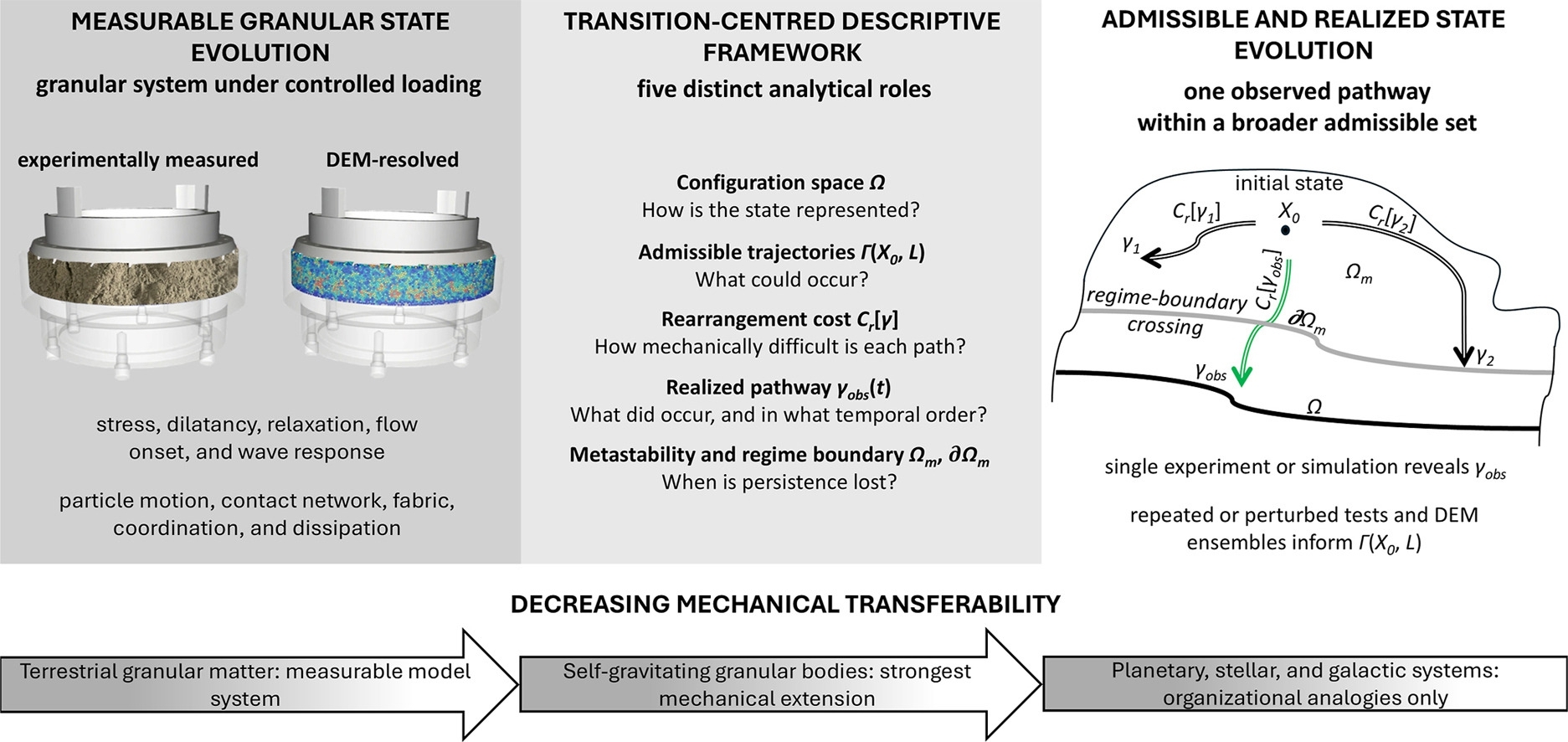
Granular matter provides an experimentally accessible system for studying how macroscopic behaviour emerges from constrained rearrangement in discrete many-particle assemblies. Quantities such as the angle of internal friction, dilatancy, particle rearrangement, relaxation, and flow onset are often treated as related but partly separate descriptors of shear response. In this article, we argue that they can be interpreted as coupled manifestations of macroscopic state evolution.
We propose a review-based framework organized around five concepts: configuration space, admissible trajectories, rearrangement cost, relaxation pathway, and metastability or regime boundary. Rather than introducing new state variables or a new theory of jamming, the contribution lies in assigning distinct analytical roles to five established concepts and in mapping measurable experimental and discrete element method (DEM) resolved observables onto these roles within a common transition-centred description. The framework links measurable quantities from shear experiments, bulk-solids characterization, and DEM simulations to the evolution of particulate systems between stable, metastable, yielding, and flowing regimes. Its purpose is not to introduce a universal constitutive law, but to provide a physically grounded vocabulary for describing how granular assemblies lose stability, reorganize their internal structure, dissipate energy, and enter new modes of motion.
The strongest extension of this framework concerns self-gravitating granular bodies, such as rubble-pile asteroids and regolith-dominated aggregates, where contact mechanics, friction, porosity, and rearrangement remain physically relevant. Broader comparisons with planetary, stellar, or galactic systems are treated only as weaker organizational analogies and are used to clarify the limits of transferability. We therefore identify granular matter as a measurable model system for particulate state evolution and as a reference system for cautious comparison with related discrete many-body systems.
Graphical abstract
Keywords
Particle rearrangement; Granular flow; Discrete element method; Shear response; Metastability; State evolution
文章导读