
期刊文章
过刊浏览
- Volumes 108-119 (2025)
-
Volumes 96-107 (2025)
-
Volume 107
Pages 1-376 (December 2025)
-
Volume 106
Pages 1-336 (November 2025)
-
Volume 105
Pages 1-356 (October 2025)
-
Volume 104
Pages 1-332 (September 2025)
-
Volume 103
Pages 1-314 (August 2025)
-
Volume 102
Pages 1-276 (July 2025)
-
Volume 101
Pages 1-166 (June 2025)
-
Volume 100
Pages 1-256 (May 2025)
-
Volume 99
Pages 1-242 (April 2025)
-
Volume 98
Pages 1-288 (March 2025)
-
Volume 97
Pages 1-256 (February 2025)
-
Volume 96
Pages 1-340 (January 2025)
-
Volume 107
-
Volumes 84-95 (2024)
-
Volume 95
Pages 1-392 (December 2024)
-
Volume 94
Pages 1-400 (November 2024)
-
Volume 93
Pages 1-376 (October 2024)
-
Volume 92
Pages 1-316 (September 2024)
-
Volume 91
Pages 1-378 (August 2024)
-
Volume 90
Pages 1-580 (July 2024)
-
Volume 89
Pages 1-278 (June 2024)
-
Volume 88
Pages 1-350 (May 2024)
-
Volume 87
Pages 1-338 (April 2024)
-
Volume 86
Pages 1-312 (March 2024)
-
Volume 85
Pages 1-334 (February 2024)
-
Volume 84
Pages 1-308 (January 2024)
-
Volume 95
-
Volumes 72-83 (2023)
-
Volume 83
Pages 1-258 (December 2023)
-
Volume 82
Pages 1-204 (November 2023)
-
Volume 81
Pages 1-188 (October 2023)
-
Volume 80
Pages 1-202 (September 2023)
-
Volume 79
Pages 1-172 (August 2023)
-
Volume 78
Pages 1-146 (July 2023)
-
Volume 77
Pages 1-152 (June 2023)
-
Volume 76
Pages 1-176 (May 2023)
-
Volume 75
Pages 1-228 (April 2023)
-
Volume 74
Pages 1-200 (March 2023)
-
Volume 73
Pages 1-138 (February 2023)
-
Volume 72
Pages 1-144 (January 2023)
-
Volume 83
-
Volumes 60-71 (2022)
-
Volume 71
Pages 1-108 (December 2022)
-
Volume 70
Pages 1-106 (November 2022)
-
Volume 69
Pages 1-122 (October 2022)
-
Volume 68
Pages 1-124 (September 2022)
-
Volume 67
Pages 1-102 (August 2022)
-
Volume 66
Pages 1-112 (July 2022)
-
Volume 65
Pages 1-138 (June 2022)
-
Volume 64
Pages 1-186 (May 2022)
-
Volume 63
Pages 1-124 (April 2022)
-
Volume 62
Pages 1-104 (March 2022)
-
Volume 61
Pages 1-120 (February 2022)
-
Volume 60
Pages 1-124 (January 2022)
-
Volume 71
- Volumes 54-59 (2021)
- Volumes 48-53 (2020)
- Volumes 42-47 (2019)
- Volumes 36-41 (2018)
- Volumes 30-35 (2017)
- Volumes 24-29 (2016)
- Volumes 18-23 (2015)
- Volumes 12-17 (2014)
- Volume 11 (2013)
- Volume 10 (2012)
- Volume 9 (2011)
- Volume 8 (2010)
- Volume 7 (2009)
- Volume 6 (2008)
- Volume 5 (2007)
- Volume 4 (2006)
- Volume 3 (2005)
- Volume 2 (2004)
- Volume 1 (2003)
Volume 118
Transient evolution of non-local rheology and force chain reconstruction mechanisms in dense granular systems under annular shear
Xuejie Zhang a *, Xiaolong Lin a, Honghui Xu a, Xuehui Chen a b, Jiawei Ji a, Wei Liu a
a School of Mechanical and Electrical Engineering, Anhui Jianzhu University, Hefei, 230601, China
b Anhui Provincial Key Laboratory of Key Friction Pairs for High-End Equipment, Hefei, 230601, China
10.1016/j.partic.2026.08.021
Volume 118,
November 2026,
Pages 56-74
Received 30 June 2026, Revised 7 August 2026, Accepted 18 August 2026, Available online 25 August 2026, Version of Record 2 September 2026.
E-mail:
ejiezhang0218@163.com
Highlights
• Four-stage evolution governs transient non-local flow under annular shear.
• Flow penetration and creep attenuation respond oppositely to inertia.
• Stress homogenization coexists with persistent flow localization.
• Inertia shifts load transfer from distributed to concentrated pathways.
• Normal force anisotropy dominates and remains nearly coaxial with stress.
Abstract
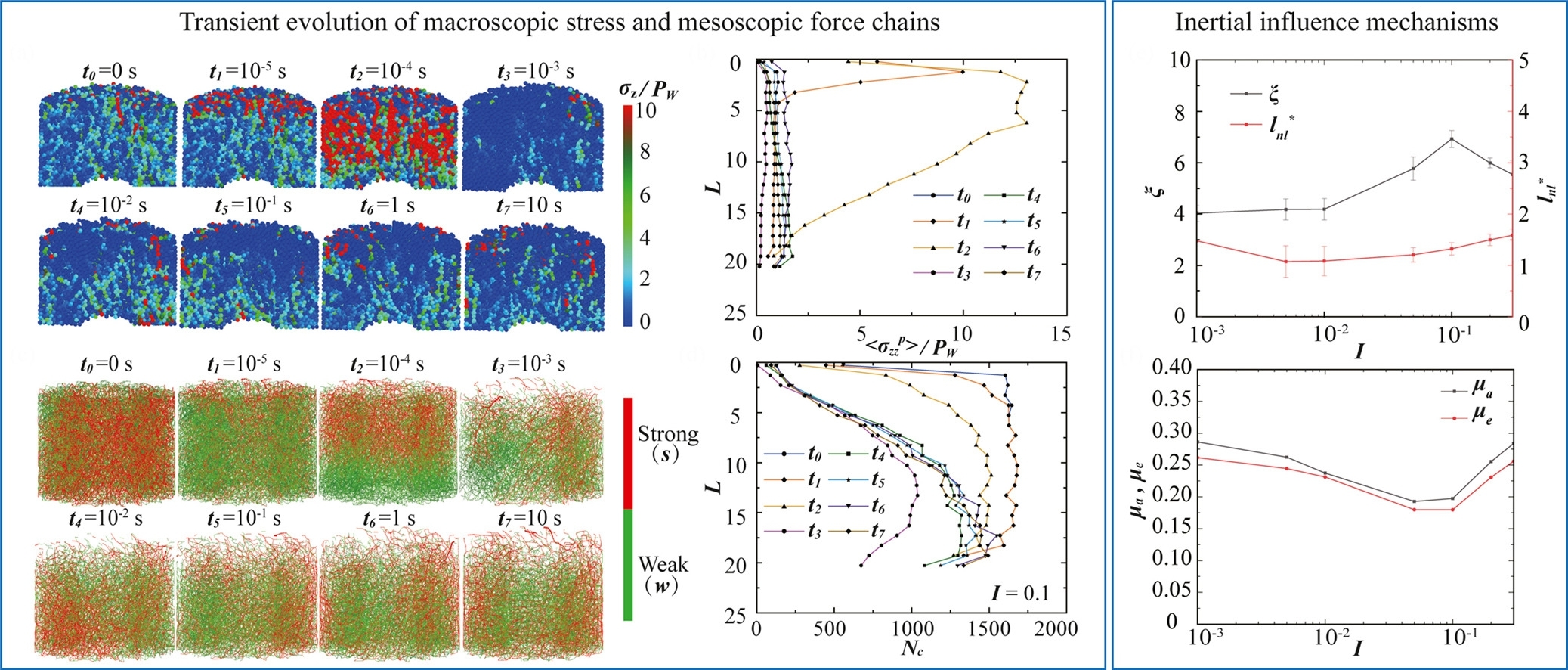
Transient non-local rheology in dense granular systems is governed by the coupled evolution of flow localization, dilation, stress transmission, and contact network structure. A 3D discrete element model of annular shear is used to investigate the complete transition from shear start-up to statistically steady flow over a range of inertial numbers. Boundary-driven motion evolves through boundary nucleation, dilation-driven expansion, structural adjustment, and steady localization. During start-up, the localized flowing layer expands while broadly distributed weak motion contracts into a shorter creeping tail. At steady state, the flow penetration depth first increases and then decreases with inertial number, whereas the non-local decay length shows the opposite trend, confirming that appreciable flow penetration and creep attenuation characterize complementary aspects of non-local propagation. Axial stress undergoes near-surface concentration, dilation-induced release, and force chain mediated recovery, while the velocity field remains localized even after stress homogenization. Dilation transforms the initially dense contact network into a sparse and spatially differentiated load-bearing structure. Strong contacts carry the dominant and nearly constant share of the normal load and govern stress transmission and shear resistance, whereas weak contacts maintain geometric connectivity and buffer disturbances in the creeping bulk. Normal force anisotropy is dominant and remains nearly coaxial with the deviatoric stress, while geometric fabric anisotropy shifts from the creeping skeleton toward the localized flowing layer as inertia increases. These findings provide a micromechanical basis for non-local constitutive models incorporating compressibility, dynamic fabric, and the differentiated roles of localized flow and creep.
Graphical abstract
Keywords
Annular shear; Non-local rheology; Flow localization; Creep attenuation; Force chain reconstruction
文章导读