
期刊文章
过刊浏览
- Volumes 108-119 (2025)
-
Volumes 96-107 (2025)
-
Volume 107
Pages 1-376 (December 2025)
-
Volume 106
Pages 1-336 (November 2025)
-
Volume 105
Pages 1-356 (October 2025)
-
Volume 104
Pages 1-332 (September 2025)
-
Volume 103
Pages 1-314 (August 2025)
-
Volume 102
Pages 1-276 (July 2025)
-
Volume 101
Pages 1-166 (June 2025)
-
Volume 100
Pages 1-256 (May 2025)
-
Volume 99
Pages 1-242 (April 2025)
-
Volume 98
Pages 1-288 (March 2025)
-
Volume 97
Pages 1-256 (February 2025)
-
Volume 96
Pages 1-340 (January 2025)
-
Volume 107
-
Volumes 84-95 (2024)
-
Volume 95
Pages 1-392 (December 2024)
-
Volume 94
Pages 1-400 (November 2024)
-
Volume 93
Pages 1-376 (October 2024)
-
Volume 92
Pages 1-316 (September 2024)
-
Volume 91
Pages 1-378 (August 2024)
-
Volume 90
Pages 1-580 (July 2024)
-
Volume 89
Pages 1-278 (June 2024)
-
Volume 88
Pages 1-350 (May 2024)
-
Volume 87
Pages 1-338 (April 2024)
-
Volume 86
Pages 1-312 (March 2024)
-
Volume 85
Pages 1-334 (February 2024)
-
Volume 84
Pages 1-308 (January 2024)
-
Volume 95
-
Volumes 72-83 (2023)
-
Volume 83
Pages 1-258 (December 2023)
-
Volume 82
Pages 1-204 (November 2023)
-
Volume 81
Pages 1-188 (October 2023)
-
Volume 80
Pages 1-202 (September 2023)
-
Volume 79
Pages 1-172 (August 2023)
-
Volume 78
Pages 1-146 (July 2023)
-
Volume 77
Pages 1-152 (June 2023)
-
Volume 76
Pages 1-176 (May 2023)
-
Volume 75
Pages 1-228 (April 2023)
-
Volume 74
Pages 1-200 (March 2023)
-
Volume 73
Pages 1-138 (February 2023)
-
Volume 72
Pages 1-144 (January 2023)
-
Volume 83
-
Volumes 60-71 (2022)
-
Volume 71
Pages 1-108 (December 2022)
-
Volume 70
Pages 1-106 (November 2022)
-
Volume 69
Pages 1-122 (October 2022)
-
Volume 68
Pages 1-124 (September 2022)
-
Volume 67
Pages 1-102 (August 2022)
-
Volume 66
Pages 1-112 (July 2022)
-
Volume 65
Pages 1-138 (June 2022)
-
Volume 64
Pages 1-186 (May 2022)
-
Volume 63
Pages 1-124 (April 2022)
-
Volume 62
Pages 1-104 (March 2022)
-
Volume 61
Pages 1-120 (February 2022)
-
Volume 60
Pages 1-124 (January 2022)
-
Volume 71
- Volumes 54-59 (2021)
- Volumes 48-53 (2020)
- Volumes 42-47 (2019)
- Volumes 36-41 (2018)
- Volumes 30-35 (2017)
- Volumes 24-29 (2016)
- Volumes 18-23 (2015)
- Volumes 12-17 (2014)
- Volume 11 (2013)
- Volume 10 (2012)
- Volume 9 (2011)
- Volume 8 (2010)
- Volume 7 (2009)
- Volume 6 (2008)
- Volume 5 (2007)
- Volume 4 (2006)
- Volume 3 (2005)
- Volume 2 (2004)
- Volume 1 (2003)
Volume 118
Study on draw resistance of tobacco-shred packed rods based on structural parameters using machine learning
Congjian Guo a, Xiaojiong Wu b, Licheng Fan b, Xuesong Hu a, Qifeng Shen a, Naiping Gao a *
a College of Automotive and Energy Engineering, Tongji University, Shanghai, 201804, China
b Shanghai Tobacco Group Co., Ltd., Technology Center, Shanghai, 200082, China
10.1016/j.partic.2026.08.025
Volume 118,
November 2026,
Pages 75-87
Received 2 July 2026, Revised 20 August 2026, Accepted 26 August 2026, Available online 26 August 2026, Version of Record 2 September 2026.
E-mail:
gaonaiping@tongji.edu.cn
Highlights
• CT-guided machine learning improved prediction accuracy and identified key resistance factors.
• Pore size distribution alone enabled accurate draw resistance prediction.
• Porosity, average pore diameter, and the pore size distribution ratio Q90/Q10 were the dominant predictors.
• Adding Q90/Q10 improved permeability model performance by up to 26.6%.
Abstract
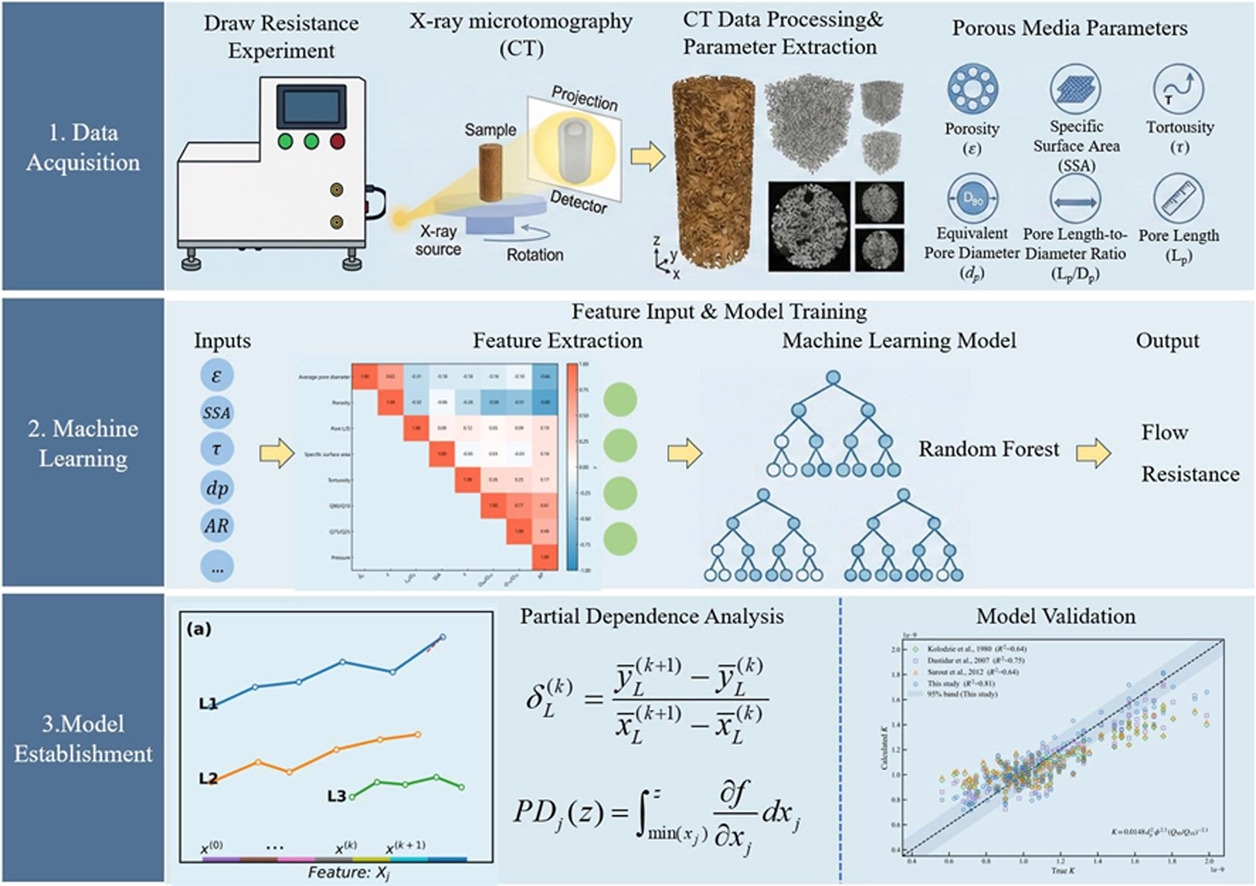
The cigarette rod is a typical porous medium, and its complex internal pore structure has a significant influence on draw resistance. Conventional permeability models, such as the Kozeny–Carman (K–C) model, primarily rely on bulk structural parameters and idealized assumptions. They have limited ability to characterize the heterogeneous pore networks and pore size distributions of cigarette rods, making it difficult to accurately predict draw resistance. To accurately predict cigarette draw resistance, this study used computed tomography (CT) to reconstruct the three-dimensional (3D) pore structure of cigarette rods. A machine learning (ML) model was then developed based on the extracted pore structure parameters, followed by interpretability analysis to reveal their relationship with draw resistance. First, draw resistance was measured for 12 types of cigarette samples. Then, 12 cigarettes from each category were scanned by CT to reconstruct the 3D pore structure and extract porosity, specific surface area (SSA), tortuosity, pore-scale structure parameters, including average pore diameter and pore length-to-diameter ratio, and pore size distribution parameters. Based on these data, a random forest (RF) model was developed to map pore structure features to draw resistance, and feature importance analysis with ablation studies was used to evaluate the effect of different feature combinations on prediction accuracy. The results show that, compared with the traditional K–C model, the RF method significantly improved the prediction accuracy of cigarette draw resistance. After introducing pore-scale structure parameters, the model performance was further improved. The R2 of the selected multi-parameter model reached 0.925. Further interpretability analysis indicated that average pore diameter, porosity, and the pore size distribution parameter Q90/Q10 were the key structural factors affecting draw resistance. Accordingly, incorporating Q90/Q10 into the traditional permeability model effectively improved the prediction accuracy by up to 26.6%. This study reveals the relationship between pore structure and draw resistance using an ML method, providing an effective approach for predicting cigarette draw resistance.
Graphical abstract
Keywords
Draw resistance; Porous media; CT-based three-dimensional reconstruction; Machine learning; Permeability model
文章导读