
期刊文章
过刊浏览
- Volumes 108-119 (2025)
-
Volumes 96-107 (2025)
-
Volume 107
Pages 1-376 (December 2025)
-
Volume 106
Pages 1-336 (November 2025)
-
Volume 105
Pages 1-356 (October 2025)
-
Volume 104
Pages 1-332 (September 2025)
-
Volume 103
Pages 1-314 (August 2025)
-
Volume 102
Pages 1-276 (July 2025)
-
Volume 101
Pages 1-166 (June 2025)
-
Volume 100
Pages 1-256 (May 2025)
-
Volume 99
Pages 1-242 (April 2025)
-
Volume 98
Pages 1-288 (March 2025)
-
Volume 97
Pages 1-256 (February 2025)
-
Volume 96
Pages 1-340 (January 2025)
-
Volume 107
-
Volumes 84-95 (2024)
-
Volume 95
Pages 1-392 (December 2024)
-
Volume 94
Pages 1-400 (November 2024)
-
Volume 93
Pages 1-376 (October 2024)
-
Volume 92
Pages 1-316 (September 2024)
-
Volume 91
Pages 1-378 (August 2024)
-
Volume 90
Pages 1-580 (July 2024)
-
Volume 89
Pages 1-278 (June 2024)
-
Volume 88
Pages 1-350 (May 2024)
-
Volume 87
Pages 1-338 (April 2024)
-
Volume 86
Pages 1-312 (March 2024)
-
Volume 85
Pages 1-334 (February 2024)
-
Volume 84
Pages 1-308 (January 2024)
-
Volume 95
-
Volumes 72-83 (2023)
-
Volume 83
Pages 1-258 (December 2023)
-
Volume 82
Pages 1-204 (November 2023)
-
Volume 81
Pages 1-188 (October 2023)
-
Volume 80
Pages 1-202 (September 2023)
-
Volume 79
Pages 1-172 (August 2023)
-
Volume 78
Pages 1-146 (July 2023)
-
Volume 77
Pages 1-152 (June 2023)
-
Volume 76
Pages 1-176 (May 2023)
-
Volume 75
Pages 1-228 (April 2023)
-
Volume 74
Pages 1-200 (March 2023)
-
Volume 73
Pages 1-138 (February 2023)
-
Volume 72
Pages 1-144 (January 2023)
-
Volume 83
-
Volumes 60-71 (2022)
-
Volume 71
Pages 1-108 (December 2022)
-
Volume 70
Pages 1-106 (November 2022)
-
Volume 69
Pages 1-122 (October 2022)
-
Volume 68
Pages 1-124 (September 2022)
-
Volume 67
Pages 1-102 (August 2022)
-
Volume 66
Pages 1-112 (July 2022)
-
Volume 65
Pages 1-138 (June 2022)
-
Volume 64
Pages 1-186 (May 2022)
-
Volume 63
Pages 1-124 (April 2022)
-
Volume 62
Pages 1-104 (March 2022)
-
Volume 61
Pages 1-120 (February 2022)
-
Volume 60
Pages 1-124 (January 2022)
-
Volume 71
- Volumes 54-59 (2021)
- Volumes 48-53 (2020)
- Volumes 42-47 (2019)
- Volumes 36-41 (2018)
- Volumes 30-35 (2017)
- Volumes 24-29 (2016)
- Volumes 18-23 (2015)
- Volumes 12-17 (2014)
- Volume 11 (2013)
- Volume 10 (2012)
- Volume 9 (2011)
- Volume 8 (2010)
- Volume 7 (2009)
- Volume 6 (2008)
- Volume 5 (2007)
- Volume 4 (2006)
- Volume 3 (2005)
- Volume 2 (2004)
- Volume 1 (2003)
Volume 118
Optimized transition metal layer structures induced by Ti4+ doping for stabilizing O3-type sodium-ion battery cathodes
Yang Zhang a b 1, Haiqiang Bai a 1 *, Jingwen Huang a b, Ling Kang a b, Zhenle Kang a b, ChaoFeng Zhi a b, Junfeng Wen c, Yunhua Xu a b
a College of New Energy, Yulin University, Yulin, 719000, China
b School of Material Science and Engineering, Xi'an University of Technology, Xi'an, 710048, China
c School of Chemistry and Chemical Engineering, Yulin University, Yulin, 719000, China
10.1016/j.partic.2026.08.026
Volume 118,
November 2026,
Pages 100-110
Received 10 July 2026, Revised 17 August 2026, Accepted 27 August 2026, Available online 28 August 2026, Version of Record 9 September 2026.
E-mail:
baihaiqiang0107@163.com
Highlights
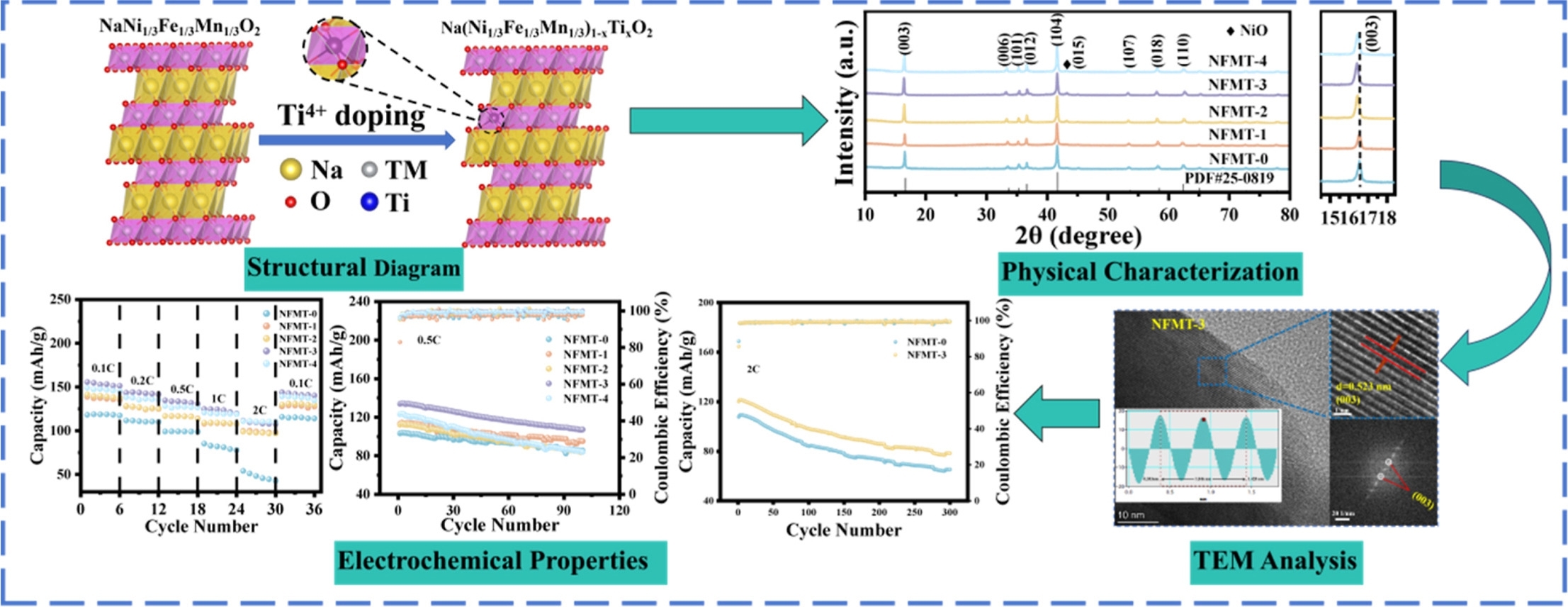
• Ti4+ doping functions as structural pillars, Jahn-Teller suppressor, and electronic regulator in O3-type cathodes.
• Optimized Ti4+ doping delivers 155.68 mAh/g at 0.1C and retains 65.1% after 300 cycles at 2C.
• Established full correlation: Ti substitution → charge balance → enlarged interlayer spacing → enhanced performance.
Abstract
O3-type NaNi1/3Fe1/3Mn1/3O2 layered oxide is a low-cost, high-capacity cathode material for sodium-ion batteries, yet its practical deployment is hindered by sluggish sodium-ion transport and irreversible structural transformation during cycling. Herein, trace Ti4+ ions are introduced into transition-metal sites through solid-state sintering to enhance structural robustness. Possessing an ionic radius close to those of Ni2+, Fe3+ and Mn3+, Ti4+ readily occupies transition-metal lattice positions. Strong Ti–O covalent bonds rigidify the transition-metal layer framework and subtly alter local crystal geometry, which in turn widens interlayer channels for sodium-ion diffusion. Such structural modification accelerates Na+ insertion/extraction kinetics and alleviates electrochemical polarization. At a doping level of 7500 ppm, the NaNi1/3Fe1/3Mn1/3O2 material delivers a reversible specific capacity of 155.68 mAh g−1 at 0.1 C, and retains 111.43 mAh g−1 at 2 C. The capacity retention reaches 80.5% after 100 cycles at 0.5 C, and remains at 65.1% after 300 cycles at 2 C. This work clarifies how Ti4+ doping stabilizes layered lattices and offers a straightforward route to improve the electrochemical performance of layered oxide cathodes.
Graphical abstract
Keywords
Sodium-ion batteries; O3-type layered oxides; Ti4+ doping; Structural stability; Kinetic performance
文章导读