
期刊文章
过刊浏览
- Volumes 108-119 (2025)
-
Volumes 96-107 (2025)
-
Volume 107
Pages 1-376 (December 2025)
-
Volume 106
Pages 1-336 (November 2025)
-
Volume 105
Pages 1-356 (October 2025)
-
Volume 104
Pages 1-332 (September 2025)
-
Volume 103
Pages 1-314 (August 2025)
-
Volume 102
Pages 1-276 (July 2025)
-
Volume 101
Pages 1-166 (June 2025)
-
Volume 100
Pages 1-256 (May 2025)
-
Volume 99
Pages 1-242 (April 2025)
-
Volume 98
Pages 1-288 (March 2025)
-
Volume 97
Pages 1-256 (February 2025)
-
Volume 96
Pages 1-340 (January 2025)
-
Volume 107
-
Volumes 84-95 (2024)
-
Volume 95
Pages 1-392 (December 2024)
-
Volume 94
Pages 1-400 (November 2024)
-
Volume 93
Pages 1-376 (October 2024)
-
Volume 92
Pages 1-316 (September 2024)
-
Volume 91
Pages 1-378 (August 2024)
-
Volume 90
Pages 1-580 (July 2024)
-
Volume 89
Pages 1-278 (June 2024)
-
Volume 88
Pages 1-350 (May 2024)
-
Volume 87
Pages 1-338 (April 2024)
-
Volume 86
Pages 1-312 (March 2024)
-
Volume 85
Pages 1-334 (February 2024)
-
Volume 84
Pages 1-308 (January 2024)
-
Volume 95
-
Volumes 72-83 (2023)
-
Volume 83
Pages 1-258 (December 2023)
-
Volume 82
Pages 1-204 (November 2023)
-
Volume 81
Pages 1-188 (October 2023)
-
Volume 80
Pages 1-202 (September 2023)
-
Volume 79
Pages 1-172 (August 2023)
-
Volume 78
Pages 1-146 (July 2023)
-
Volume 77
Pages 1-152 (June 2023)
-
Volume 76
Pages 1-176 (May 2023)
-
Volume 75
Pages 1-228 (April 2023)
-
Volume 74
Pages 1-200 (March 2023)
-
Volume 73
Pages 1-138 (February 2023)
-
Volume 72
Pages 1-144 (January 2023)
-
Volume 83
-
Volumes 60-71 (2022)
-
Volume 71
Pages 1-108 (December 2022)
-
Volume 70
Pages 1-106 (November 2022)
-
Volume 69
Pages 1-122 (October 2022)
-
Volume 68
Pages 1-124 (September 2022)
-
Volume 67
Pages 1-102 (August 2022)
-
Volume 66
Pages 1-112 (July 2022)
-
Volume 65
Pages 1-138 (June 2022)
-
Volume 64
Pages 1-186 (May 2022)
-
Volume 63
Pages 1-124 (April 2022)
-
Volume 62
Pages 1-104 (March 2022)
-
Volume 61
Pages 1-120 (February 2022)
-
Volume 60
Pages 1-124 (January 2022)
-
Volume 71
- Volumes 54-59 (2021)
- Volumes 48-53 (2020)
- Volumes 42-47 (2019)
- Volumes 36-41 (2018)
- Volumes 30-35 (2017)
- Volumes 24-29 (2016)
- Volumes 18-23 (2015)
- Volumes 12-17 (2014)
- Volume 11 (2013)
- Volume 10 (2012)
- Volume 9 (2011)
- Volume 8 (2010)
- Volume 7 (2009)
- Volume 6 (2008)
- Volume 5 (2007)
- Volume 4 (2006)
- Volume 3 (2005)
- Volume 2 (2004)
- Volume 1 (2003)
Volume 118
Fractal-continuum mechanics for shear behavior of impact-grown powdery layers: Mapping from fractal to continuum spaces
Wen Yang a, Yunshan Dong a *, Weigang Guo b c, Jiajing Liu a
a School of Energy and Power, Jiangsu University of Science and Technology, Zhenjiang, 212100, China
b China Coal (Zhoushan) Power Generation Co., Ltd., Zhoushan, 316100, China
c China National Coal Group Corp, Beijing, 100120, China
10.1016/j.partic.2026.08.023
Volume 118,
November 2026,
Pages 111-127
Received 17 June 2026, Revised 13 August 2026, Accepted 26 August 2026, Available online 28 August 2026, Version of Record 11 September 2026.
E-mail:
ysh_dong@just.edu.cn
Highlights
• A fractal-continuum framework for shear mechanics of impact-grown powdery layers was proposed.
• A precise expression of continuum mechanics for ash powdery layers was derived.
• Fractal coordinates enabled explicit mapping from fractal to continuum spaces.
• Empirical correlations were established using harmonic index and position-dependent intercepts.
Abstract
In a powdery layer, the shear mechanical response to impact dictates whether particles roll, slide, deposit. Existing engineering models struggle to balance computational efficiency with physical fidelity, whereas DEM remains computationally prohibitive. To address this challenge, this study develops a macroscopic constitutive model for the shear mechanical response of impact-grown powdery layers based on fractal continuum-based mechanics. Through fractal coordinate transformation, the discrete fractal layer is mapped into an equivalent continuum, from which a linear elastic constitutive relation is derived. In this model, directional codimensions ζi, harmonic index p and position-dependent intercept term F0 serve as key links between microstructure and macroscopic response, with their evolution calibrated via DEM simulations. Results show that ζi declines from 0.9 to 0.7 with increasing relative layer height. The harmonic index p, calibrated via least-squares optimization, exhibits high sensitivity and decreases with layer height. The intercept term F0 increases with relative layer height and load position factor, reflecting the position-dependent initial shear resistance. Validation against DEM data confirms the model's accuracy in capturing shear force-deflection behavior across varying particle sizes (20–90 μm), layer heights, loading positions, and material types (copper and glass). Small particles show near-linear force-deflection relationships, while large particles exhibit rapid initial stiffening followed by nonlinear hardening. This framework provides theoretical and practical tools for macro-scale analysis of ash deposit stability under flue gas shear stress, offering a theoretical basis for predicting crack initiation and spalling.
Graphical abstract
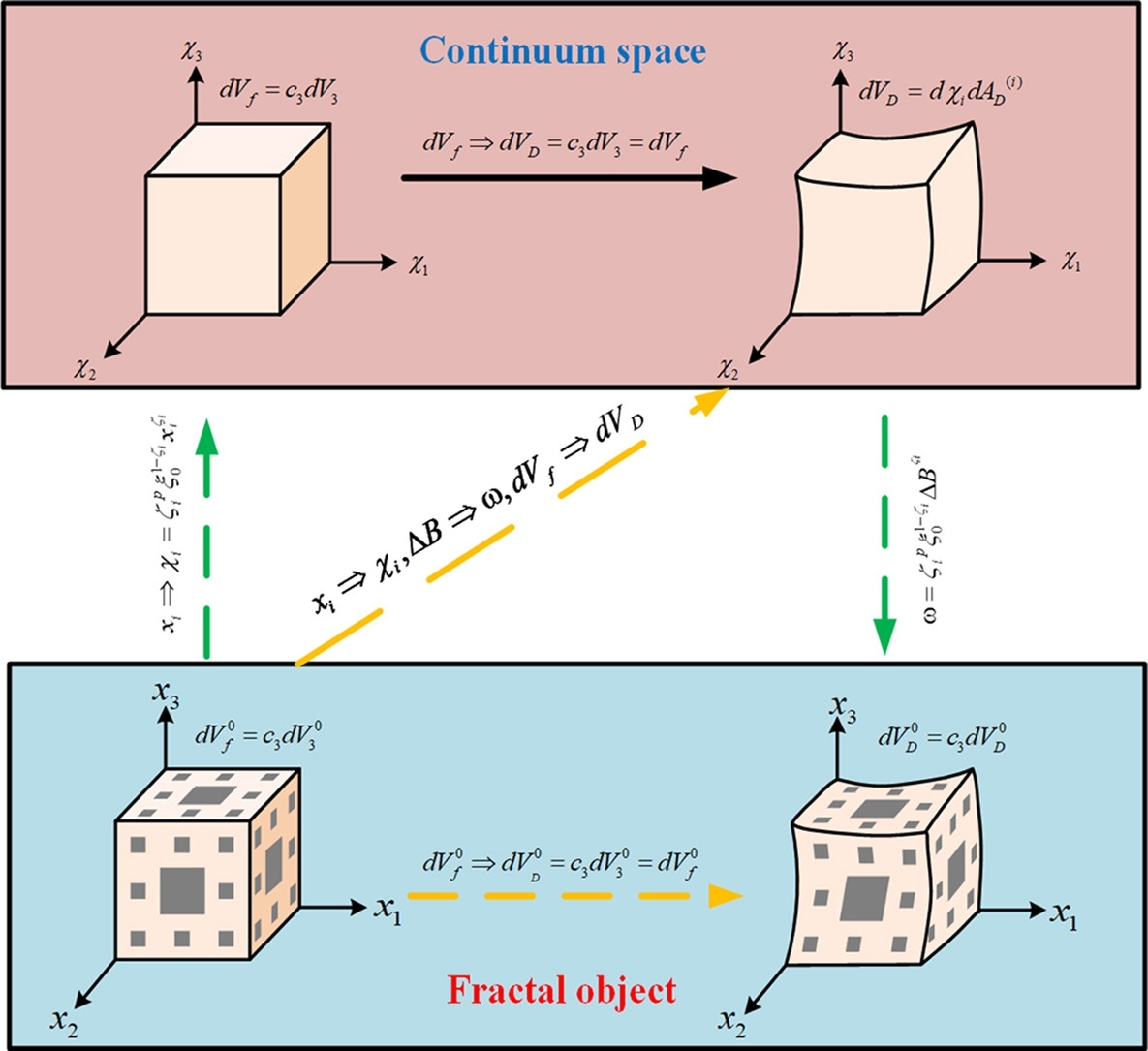
Keywords
Ash powdery layer; Fractal-continuum mechanics; Shear behavior; Fractal space; DEM
文章导读