
期刊文章
过刊浏览
- Volumes 108-119 (2025)
-
Volumes 96-107 (2025)
-
Volume 107
Pages 1-376 (December 2025)
-
Volume 106
Pages 1-336 (November 2025)
-
Volume 105
Pages 1-356 (October 2025)
-
Volume 104
Pages 1-332 (September 2025)
-
Volume 103
Pages 1-314 (August 2025)
-
Volume 102
Pages 1-276 (July 2025)
-
Volume 101
Pages 1-166 (June 2025)
-
Volume 100
Pages 1-256 (May 2025)
-
Volume 99
Pages 1-242 (April 2025)
-
Volume 98
Pages 1-288 (March 2025)
-
Volume 97
Pages 1-256 (February 2025)
-
Volume 96
Pages 1-340 (January 2025)
-
Volume 107
-
Volumes 84-95 (2024)
-
Volume 95
Pages 1-392 (December 2024)
-
Volume 94
Pages 1-400 (November 2024)
-
Volume 93
Pages 1-376 (October 2024)
-
Volume 92
Pages 1-316 (September 2024)
-
Volume 91
Pages 1-378 (August 2024)
-
Volume 90
Pages 1-580 (July 2024)
-
Volume 89
Pages 1-278 (June 2024)
-
Volume 88
Pages 1-350 (May 2024)
-
Volume 87
Pages 1-338 (April 2024)
-
Volume 86
Pages 1-312 (March 2024)
-
Volume 85
Pages 1-334 (February 2024)
-
Volume 84
Pages 1-308 (January 2024)
-
Volume 95
-
Volumes 72-83 (2023)
-
Volume 83
Pages 1-258 (December 2023)
-
Volume 82
Pages 1-204 (November 2023)
-
Volume 81
Pages 1-188 (October 2023)
-
Volume 80
Pages 1-202 (September 2023)
-
Volume 79
Pages 1-172 (August 2023)
-
Volume 78
Pages 1-146 (July 2023)
-
Volume 77
Pages 1-152 (June 2023)
-
Volume 76
Pages 1-176 (May 2023)
-
Volume 75
Pages 1-228 (April 2023)
-
Volume 74
Pages 1-200 (March 2023)
-
Volume 73
Pages 1-138 (February 2023)
-
Volume 72
Pages 1-144 (January 2023)
-
Volume 83
-
Volumes 60-71 (2022)
-
Volume 71
Pages 1-108 (December 2022)
-
Volume 70
Pages 1-106 (November 2022)
-
Volume 69
Pages 1-122 (October 2022)
-
Volume 68
Pages 1-124 (September 2022)
-
Volume 67
Pages 1-102 (August 2022)
-
Volume 66
Pages 1-112 (July 2022)
-
Volume 65
Pages 1-138 (June 2022)
-
Volume 64
Pages 1-186 (May 2022)
-
Volume 63
Pages 1-124 (April 2022)
-
Volume 62
Pages 1-104 (March 2022)
-
Volume 61
Pages 1-120 (February 2022)
-
Volume 60
Pages 1-124 (January 2022)
-
Volume 71
- Volumes 54-59 (2021)
- Volumes 48-53 (2020)
- Volumes 42-47 (2019)
- Volumes 36-41 (2018)
- Volumes 30-35 (2017)
- Volumes 24-29 (2016)
- Volumes 18-23 (2015)
- Volumes 12-17 (2014)
- Volume 11 (2013)
- Volume 10 (2012)
- Volume 9 (2011)
- Volume 8 (2010)
- Volume 7 (2009)
- Volume 6 (2008)
- Volume 5 (2007)
- Volume 4 (2006)
- Volume 3 (2005)
- Volume 2 (2004)
- Volume 1 (2003)
Volume 118
Particle morphology effects on compaction behaviour of OGFC mixtures: Smart aggregate monitoring and DEM analysis (Open Access)
Ning Wang a b, Ye Wei a b, Qiang Li a b, Jiaqing Wang a b, Bishenghui Tao d, Chao Zhang c *
a College of Civil Engineering, Nanjing Forestry University, Nanjing, 210037, China
b Jiangsu Province Engineering Research Center for Highway Intelligent Detection and Low Carbon Maintenance, Nanjing Forestry University, Nanjing, 210037, China
c School of Engineering, Newcastle University, Newcastle upon Tyne, NE1 7RU, United Kingdom
d School of Science and Technology, Hong Kong Metropolitan University, Hong Kong, China
10.1016/j.partic.2026.08.030
Volume 118,
November 2026,
Pages 143-162
Received 24 June 2026, Revised 21 August 2026, Accepted 29 August 2026, Available online 31 August 2026, Version of Record 12 September 2026.
E-mail:
chao.zhang@newcastle.ac.uk
Highlights
• Particle morphology affects contact behaviour during gyratory compaction.
• Smart aggregate monitoring captures local force and rotational responses.
• DEM reveals morphology-dependent kinetic response, contact composition, and fabric anisotropy.
Abstract
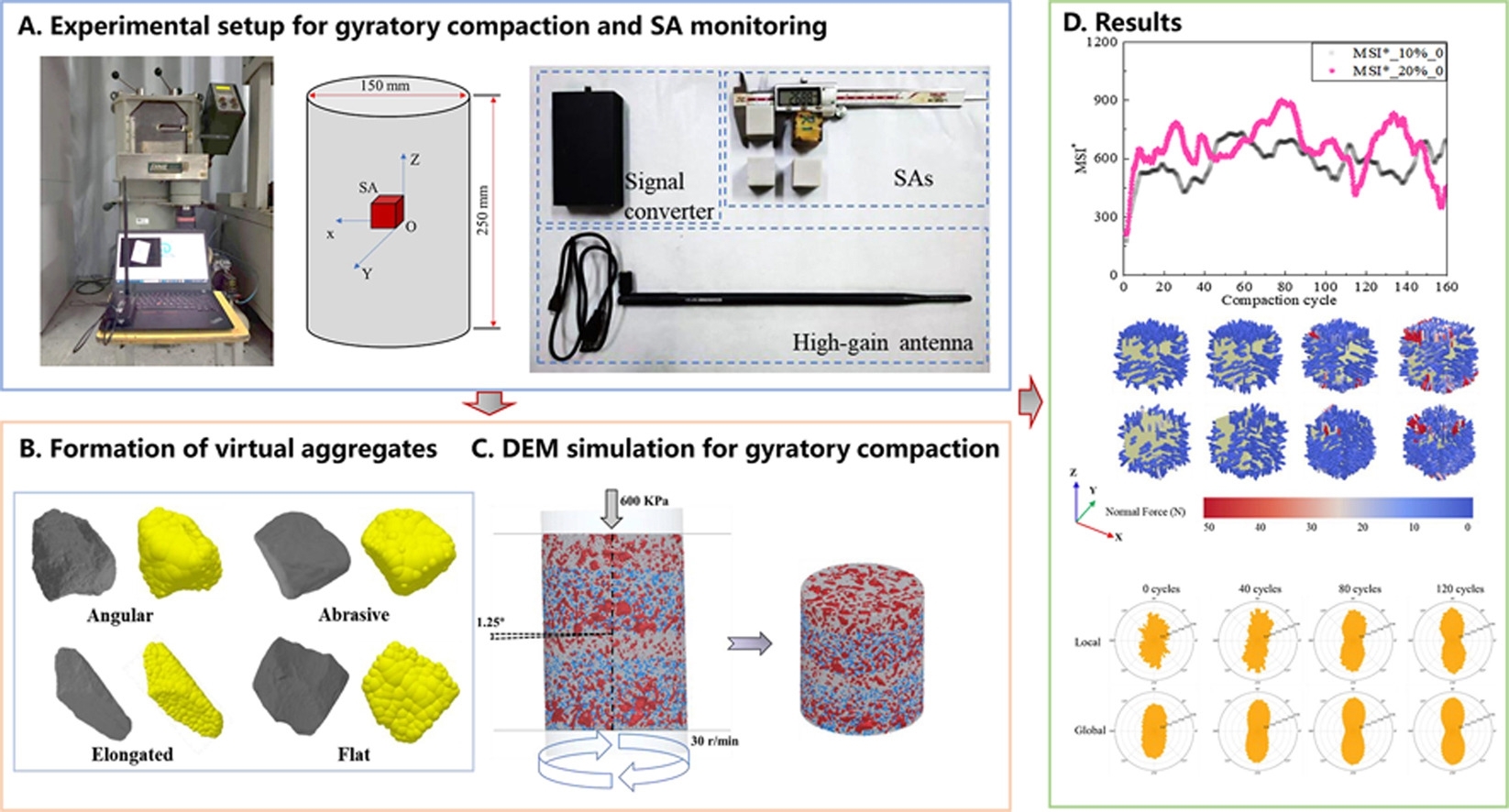
This study combines Smart Aggregate (SA) monitoring and Discrete Element Method (DEM) simulations to investigate how particle morphology affects the compaction behaviour of open-graded friction course (OGFC) asphalt mixtures during gyratory compaction. Specimens were prepared by varying flat-elongated particle content and abrasion level of angular aggregates. The embedded SA sensor recorded three-directional force and rotational responses, from which a Mesoscopic Stability Index (MSI∗) was introduced to compare local force-rotation stability around the sensor. DEM specimens with various particle morphologies were used to analyse SA kinetic energy, velocity fields, contact composition, contact force, and local/global fabric anisotropy. Results show that increasing flat-elongated particle content reduces compactability by restricting particle motion and alignment, whereas abrasion improves compaction efficiency by weakening angular interlocking and promoting rearrangement. MSI∗ results suggest that moderate flat-elongated content produces a more constrained local response, while excessive content causes stronger fluctuations related to unstable local rearrangement. DEM analysis indicates that angular particles generate higher kinetic energy due to stronger interlocking, whereas elongated and flat particles influence force transmission mainly through indirect geometric constraints. The similar evolution of local and global anisotropy suggests qualitative consistency between SA response and aggregate skeleton contact-network development.
Graphical abstract
Keywords
Smart aggregate; Particle morphology; OGFC asphalt mixture; Gyratory compaction; Discrete element method
文章导读