
期刊文章
过刊浏览
- Volumes 108-119 (2025)
-
Volumes 96-107 (2025)
-
Volume 107
Pages 1-376 (December 2025)
-
Volume 106
Pages 1-336 (November 2025)
-
Volume 105
Pages 1-356 (October 2025)
-
Volume 104
Pages 1-332 (September 2025)
-
Volume 103
Pages 1-314 (August 2025)
-
Volume 102
Pages 1-276 (July 2025)
-
Volume 101
Pages 1-166 (June 2025)
-
Volume 100
Pages 1-256 (May 2025)
-
Volume 99
Pages 1-242 (April 2025)
-
Volume 98
Pages 1-288 (March 2025)
-
Volume 97
Pages 1-256 (February 2025)
-
Volume 96
Pages 1-340 (January 2025)
-
Volume 107
-
Volumes 84-95 (2024)
-
Volume 95
Pages 1-392 (December 2024)
-
Volume 94
Pages 1-400 (November 2024)
-
Volume 93
Pages 1-376 (October 2024)
-
Volume 92
Pages 1-316 (September 2024)
-
Volume 91
Pages 1-378 (August 2024)
-
Volume 90
Pages 1-580 (July 2024)
-
Volume 89
Pages 1-278 (June 2024)
-
Volume 88
Pages 1-350 (May 2024)
-
Volume 87
Pages 1-338 (April 2024)
-
Volume 86
Pages 1-312 (March 2024)
-
Volume 85
Pages 1-334 (February 2024)
-
Volume 84
Pages 1-308 (January 2024)
-
Volume 95
-
Volumes 72-83 (2023)
-
Volume 83
Pages 1-258 (December 2023)
-
Volume 82
Pages 1-204 (November 2023)
-
Volume 81
Pages 1-188 (October 2023)
-
Volume 80
Pages 1-202 (September 2023)
-
Volume 79
Pages 1-172 (August 2023)
-
Volume 78
Pages 1-146 (July 2023)
-
Volume 77
Pages 1-152 (June 2023)
-
Volume 76
Pages 1-176 (May 2023)
-
Volume 75
Pages 1-228 (April 2023)
-
Volume 74
Pages 1-200 (March 2023)
-
Volume 73
Pages 1-138 (February 2023)
-
Volume 72
Pages 1-144 (January 2023)
-
Volume 83
-
Volumes 60-71 (2022)
-
Volume 71
Pages 1-108 (December 2022)
-
Volume 70
Pages 1-106 (November 2022)
-
Volume 69
Pages 1-122 (October 2022)
-
Volume 68
Pages 1-124 (September 2022)
-
Volume 67
Pages 1-102 (August 2022)
-
Volume 66
Pages 1-112 (July 2022)
-
Volume 65
Pages 1-138 (June 2022)
-
Volume 64
Pages 1-186 (May 2022)
-
Volume 63
Pages 1-124 (April 2022)
-
Volume 62
Pages 1-104 (March 2022)
-
Volume 61
Pages 1-120 (February 2022)
-
Volume 60
Pages 1-124 (January 2022)
-
Volume 71
- Volumes 54-59 (2021)
- Volumes 48-53 (2020)
- Volumes 42-47 (2019)
- Volumes 36-41 (2018)
- Volumes 30-35 (2017)
- Volumes 24-29 (2016)
- Volumes 18-23 (2015)
- Volumes 12-17 (2014)
- Volume 11 (2013)
- Volume 10 (2012)
- Volume 9 (2011)
- Volume 8 (2010)
- Volume 7 (2009)
- Volume 6 (2008)
- Volume 5 (2007)
- Volume 4 (2006)
- Volume 3 (2005)
- Volume 2 (2004)
- Volume 1 (2003)
Volume 118
A note on various tensorial descriptors of anisotropy in granular materials by DEM simulations
Ashkan Ghollasimood, Mehdi Veiskarami *, Mojtaba Jahanandish
School of Engineering, Shiraz University, Shiraz, Iran
10.1016/j.partic.2026.08.032
Volume 118,
November 2026,
Pages 185-207
Received 9 July 2026, Revised 24 August 2026, Accepted 31 August 2026, Available online 2 September 2026, Version of Record 16 September 2026.
E-mail:
mveiskarami@shirazu.ac.ir
Highlights
• DEM triaxial simulations with a flexible membrane boundary reproduce the macroscopic response of three benchmark sands.
• Rolling resistance parameters calibrated in the literature transfer to an independent model without any re-calibration.
• The force-direction contact fabric remains coaxial with stress, whereas the void-based fabric remains nearly orthogonal.
• A single scalar coefficient of about 2.6 links stress anisotropy to fabric across all sands and confining pressures.
Abstract
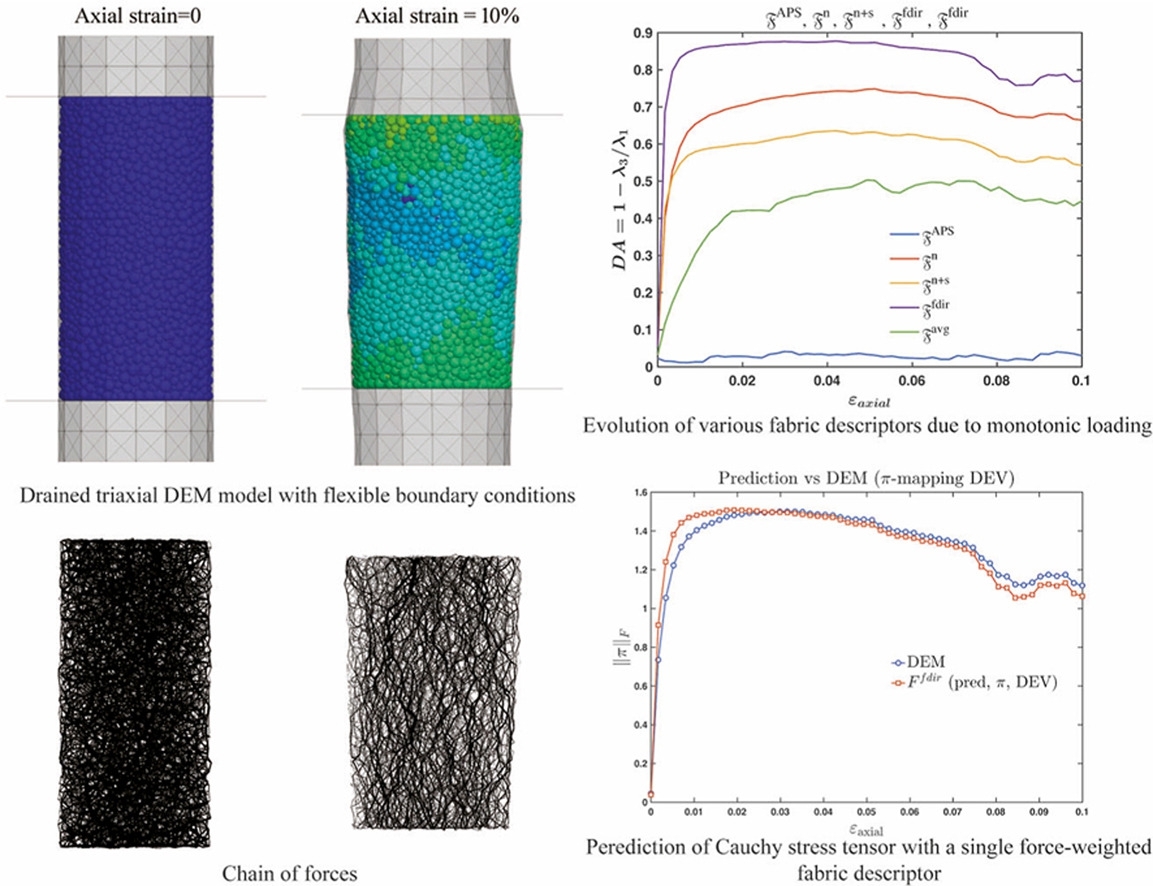
Various descriptors have been introduced to describe and predict the anisotropy of granular materials. Among many, common descriptors often related to the microstructure of granular materials, are typically based on the particles orientation, the void spaces and the contact force. In addition, the evolution of anisotropy, also called the induced anisotropy, is primarily related to the stress state. At least, such a relation is more desirable for practical purposes when the original state and the stress path are known. Since experimental measurements on the evolution of anisotropy are very difficult, often accompanied by errors, the widely accepted and practically applied DEM simulation has been implemented in this work to study the intensity and trends of induced anisotropy captured by the void-based and contact-based fabrics due to axial loading. The coaxiality of various descriptors with the stress tensor along with the evolution of the anisotropy of the granular materials have been studied and compared based on some available experimental data on renowned sands. Results indicated that contact-based descriptors are closely coaxial with the stress tensor while the void-based descriptor is orthogonal, i.e. a particular type of coaxiality. A linear mapping from the contact-based descriptors to the stress tensor has been conducted to clarify their relationship and evaluate if they can estimate the anisotropy with sufficient accuracy.
Graphical abstract
Keywords
Anisotropy; DEM; Fabric tensor; Granular materials; Microstructure; Sand
文章导读