
期刊文章
过刊浏览
- Volumes 108-119 (2025)
-
Volumes 96-107 (2025)
-
Volume 107
Pages 1-376 (December 2025)
-
Volume 106
Pages 1-336 (November 2025)
-
Volume 105
Pages 1-356 (October 2025)
-
Volume 104
Pages 1-332 (September 2025)
-
Volume 103
Pages 1-314 (August 2025)
-
Volume 102
Pages 1-276 (July 2025)
-
Volume 101
Pages 1-166 (June 2025)
-
Volume 100
Pages 1-256 (May 2025)
-
Volume 99
Pages 1-242 (April 2025)
-
Volume 98
Pages 1-288 (March 2025)
-
Volume 97
Pages 1-256 (February 2025)
-
Volume 96
Pages 1-340 (January 2025)
-
Volume 107
-
Volumes 84-95 (2024)
-
Volume 95
Pages 1-392 (December 2024)
-
Volume 94
Pages 1-400 (November 2024)
-
Volume 93
Pages 1-376 (October 2024)
-
Volume 92
Pages 1-316 (September 2024)
-
Volume 91
Pages 1-378 (August 2024)
-
Volume 90
Pages 1-580 (July 2024)
-
Volume 89
Pages 1-278 (June 2024)
-
Volume 88
Pages 1-350 (May 2024)
-
Volume 87
Pages 1-338 (April 2024)
-
Volume 86
Pages 1-312 (March 2024)
-
Volume 85
Pages 1-334 (February 2024)
-
Volume 84
Pages 1-308 (January 2024)
-
Volume 95
-
Volumes 72-83 (2023)
-
Volume 83
Pages 1-258 (December 2023)
-
Volume 82
Pages 1-204 (November 2023)
-
Volume 81
Pages 1-188 (October 2023)
-
Volume 80
Pages 1-202 (September 2023)
-
Volume 79
Pages 1-172 (August 2023)
-
Volume 78
Pages 1-146 (July 2023)
-
Volume 77
Pages 1-152 (June 2023)
-
Volume 76
Pages 1-176 (May 2023)
-
Volume 75
Pages 1-228 (April 2023)
-
Volume 74
Pages 1-200 (March 2023)
-
Volume 73
Pages 1-138 (February 2023)
-
Volume 72
Pages 1-144 (January 2023)
-
Volume 83
-
Volumes 60-71 (2022)
-
Volume 71
Pages 1-108 (December 2022)
-
Volume 70
Pages 1-106 (November 2022)
-
Volume 69
Pages 1-122 (October 2022)
-
Volume 68
Pages 1-124 (September 2022)
-
Volume 67
Pages 1-102 (August 2022)
-
Volume 66
Pages 1-112 (July 2022)
-
Volume 65
Pages 1-138 (June 2022)
-
Volume 64
Pages 1-186 (May 2022)
-
Volume 63
Pages 1-124 (April 2022)
-
Volume 62
Pages 1-104 (March 2022)
-
Volume 61
Pages 1-120 (February 2022)
-
Volume 60
Pages 1-124 (January 2022)
-
Volume 71
- Volumes 54-59 (2021)
- Volumes 48-53 (2020)
- Volumes 42-47 (2019)
- Volumes 36-41 (2018)
- Volumes 30-35 (2017)
- Volumes 24-29 (2016)
- Volumes 18-23 (2015)
- Volumes 12-17 (2014)
- Volume 11 (2013)
- Volume 10 (2012)
- Volume 9 (2011)
- Volume 8 (2010)
- Volume 7 (2009)
- Volume 6 (2008)
- Volume 5 (2007)
- Volume 4 (2006)
- Volume 3 (2005)
- Volume 2 (2004)
- Volume 1 (2003)
Volume 118
Top-coal flow behavior and caving process optimization in extra-thick coal seam LTCC based on 3D discrete element method
Xiangyi Zhu a b *, Haojie Song a b, Hongwei Li a
a School of Hydraulic and Ocean Engineering, Changsha University of Science & Technology, Changsha, 410114, China
b Key Laboratory of Water-Sediment Sciences and Water Disaster Prevention of Hunan Province, Changsha, 410114, China
10.1016/j.partic.2026.08.029
Volume 118,
November 2026,
Pages 246-259
Received 8 July 2026, Revised 24 August 2026, Accepted 29 August 2026, Available online 31 August 2026, Version of Record 17 September 2026.
E-mail:
zhuxiangyi1990@163.com
Highlights
• A 3D discrete element model for top-coal drawing is developed and validated against field data from an extra-thick coal seam.
• Pressure arch height exhibits a logarithmic growth with cumulative draw volume, revealing dynamic load transfer mechanism.
• Velocity attenuation coefficient is identified as a key indicator linking caving step distance to recovery efficiency.
• Interval drawing outperforms sequential drawing in improving top-coal recovery by promoting more favorable flow conditions.
• Whole-layer caving achieves a significantly higher stable recovery ratio than slice caving, offering greater efficiency.
Abstract
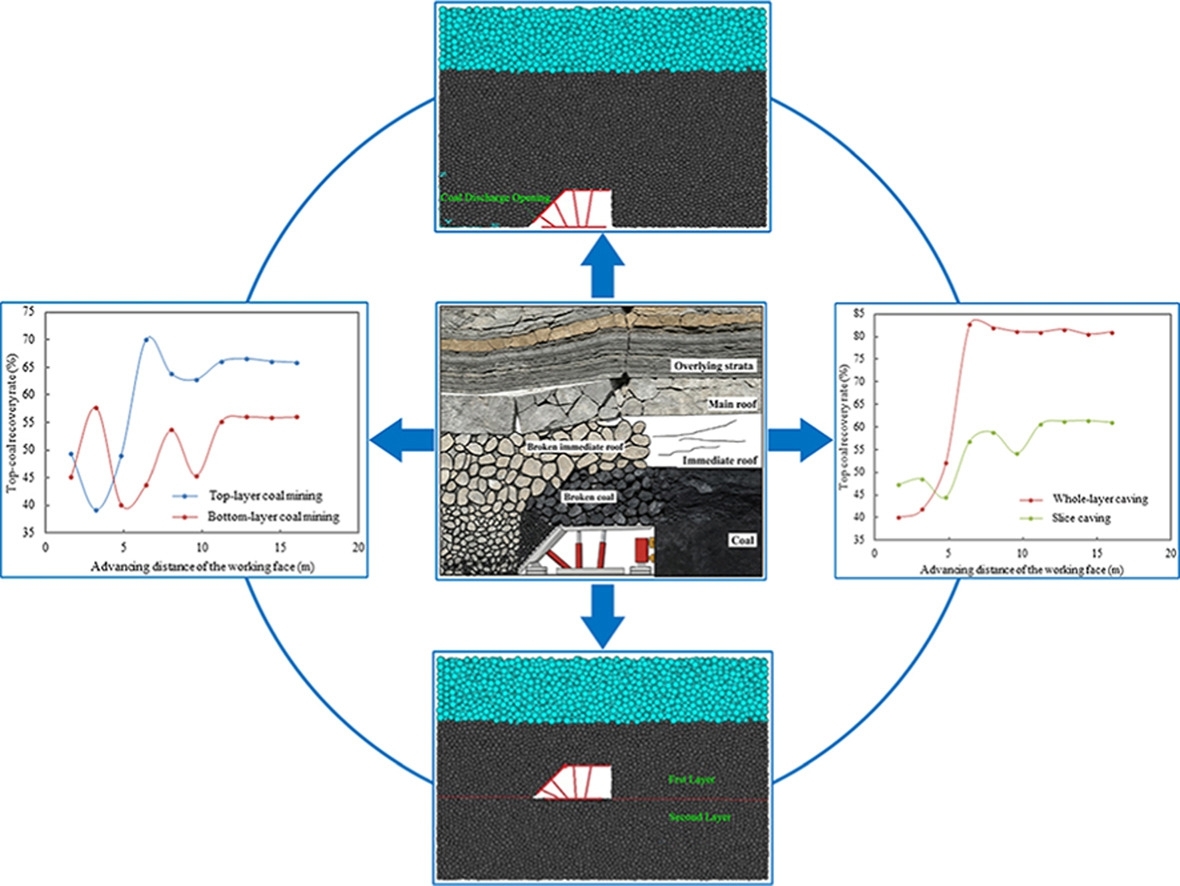
To investigate top-coal flow behavior and optimize caving parameters in extra-thick coal seam longwall top coal caving (LTCC), this study establishes a three-dimensional discrete element model (PFC3D) based on the Yima Coal Mine conditions and validates it against field data. The flow behaviors under slice caving and whole-layer caving are compared, and the effects of caving step distance and drawing sequence on the recovery ratio are analyzed. Results show that the pressure arch within the coal mass undergoes a cyclic “formation–failure–upward migration” evolution during top-coal drawing, and the pressure arch height exhibits a logarithmic growth with the cumulative drawing volume. The flow velocity field of coal-gangue particles presents an ellipsoidal distribution with an exponential decay along the vertical direction. Interval drawing increases the total drawn volume by 11.0% compared with sequential drawing. The recovery ratio decreases with increasing step distance, stabilizing at approximately 75% for one-cut-one-draw, 65% for two-cuts-one-draw, and below 60% for three-cuts-one-draw. Whole-layer caving achieves a stable recovery ratio of 80%, significantly higher than the 60% from slice caving. Considering both top-coal recovery efficiency and mining productivity, the whole-layer caving with one-cut-one-draw and interval drawing is recommended for similar geological conditions. The findings provide theoretical guidance for improving extraction efficiency and reducing residual coal in LTCC operations.
Graphical abstract
Keywords
Extra-thick coal seam; Longwall top coal caving; 3D discrete element method; Top-coal flow behavior; Caving process optimization
文章导读