
期刊文章
过刊浏览
- Volumes 108-119 (2025)
-
Volumes 96-107 (2025)
-
Volume 107
Pages 1-376 (December 2025)
-
Volume 106
Pages 1-336 (November 2025)
-
Volume 105
Pages 1-356 (October 2025)
-
Volume 104
Pages 1-332 (September 2025)
-
Volume 103
Pages 1-314 (August 2025)
-
Volume 102
Pages 1-276 (July 2025)
-
Volume 101
Pages 1-166 (June 2025)
-
Volume 100
Pages 1-256 (May 2025)
-
Volume 99
Pages 1-242 (April 2025)
-
Volume 98
Pages 1-288 (March 2025)
-
Volume 97
Pages 1-256 (February 2025)
-
Volume 96
Pages 1-340 (January 2025)
-
Volume 107
-
Volumes 84-95 (2024)
-
Volume 95
Pages 1-392 (December 2024)
-
Volume 94
Pages 1-400 (November 2024)
-
Volume 93
Pages 1-376 (October 2024)
-
Volume 92
Pages 1-316 (September 2024)
-
Volume 91
Pages 1-378 (August 2024)
-
Volume 90
Pages 1-580 (July 2024)
-
Volume 89
Pages 1-278 (June 2024)
-
Volume 88
Pages 1-350 (May 2024)
-
Volume 87
Pages 1-338 (April 2024)
-
Volume 86
Pages 1-312 (March 2024)
-
Volume 85
Pages 1-334 (February 2024)
-
Volume 84
Pages 1-308 (January 2024)
-
Volume 95
-
Volumes 72-83 (2023)
-
Volume 83
Pages 1-258 (December 2023)
-
Volume 82
Pages 1-204 (November 2023)
-
Volume 81
Pages 1-188 (October 2023)
-
Volume 80
Pages 1-202 (September 2023)
-
Volume 79
Pages 1-172 (August 2023)
-
Volume 78
Pages 1-146 (July 2023)
-
Volume 77
Pages 1-152 (June 2023)
-
Volume 76
Pages 1-176 (May 2023)
-
Volume 75
Pages 1-228 (April 2023)
-
Volume 74
Pages 1-200 (March 2023)
-
Volume 73
Pages 1-138 (February 2023)
-
Volume 72
Pages 1-144 (January 2023)
-
Volume 83
-
Volumes 60-71 (2022)
-
Volume 71
Pages 1-108 (December 2022)
-
Volume 70
Pages 1-106 (November 2022)
-
Volume 69
Pages 1-122 (October 2022)
-
Volume 68
Pages 1-124 (September 2022)
-
Volume 67
Pages 1-102 (August 2022)
-
Volume 66
Pages 1-112 (July 2022)
-
Volume 65
Pages 1-138 (June 2022)
-
Volume 64
Pages 1-186 (May 2022)
-
Volume 63
Pages 1-124 (April 2022)
-
Volume 62
Pages 1-104 (March 2022)
-
Volume 61
Pages 1-120 (February 2022)
-
Volume 60
Pages 1-124 (January 2022)
-
Volume 71
- Volumes 54-59 (2021)
- Volumes 48-53 (2020)
- Volumes 42-47 (2019)
- Volumes 36-41 (2018)
- Volumes 30-35 (2017)
- Volumes 24-29 (2016)
- Volumes 18-23 (2015)
- Volumes 12-17 (2014)
- Volume 11 (2013)
- Volume 10 (2012)
- Volume 9 (2011)
- Volume 8 (2010)
- Volume 7 (2009)
- Volume 6 (2008)
- Volume 5 (2007)
- Volume 4 (2006)
- Volume 3 (2005)
- Volume 2 (2004)
- Volume 1 (2003)
Volume 118
Data-driven prediction and quantification of flow asymmetry and solid concentration redistribution in rectangular-duct slurry transport (Open Access)
Hossein Fatahian *, Nyararai Mukandiwa, Rakesh Mishra, Naeem S. Mian, Esmaeel Fatahian
School of Computing and Engineering, University of Huddersfield, Huddersfield, HD1 3DH, UK
10.1016/j.partic.2026.08.034
Volume 118,
November 2026,
Pages 260-288
Received 13 June 2026, Revised 24 August 2026, Accepted 31 August 2026, Available online 3 September 2026, Version of Record 17 September 2026.
E-mail:
h.fatahian3@hud.ac.uk
Highlights
• New flux-based indices quantify velocity-transport asymmetry in rectangular slurry ducts.
• The upper duct half consistently transports more streamwise velocity than the lower half.
• Coarse iron ore produces the strongest asymmetry, with AIflux = 7.31% and ARflux = 1.088.
• The CFD–ANN framework accurately predicts velocity and concentration profiles.
Abstract
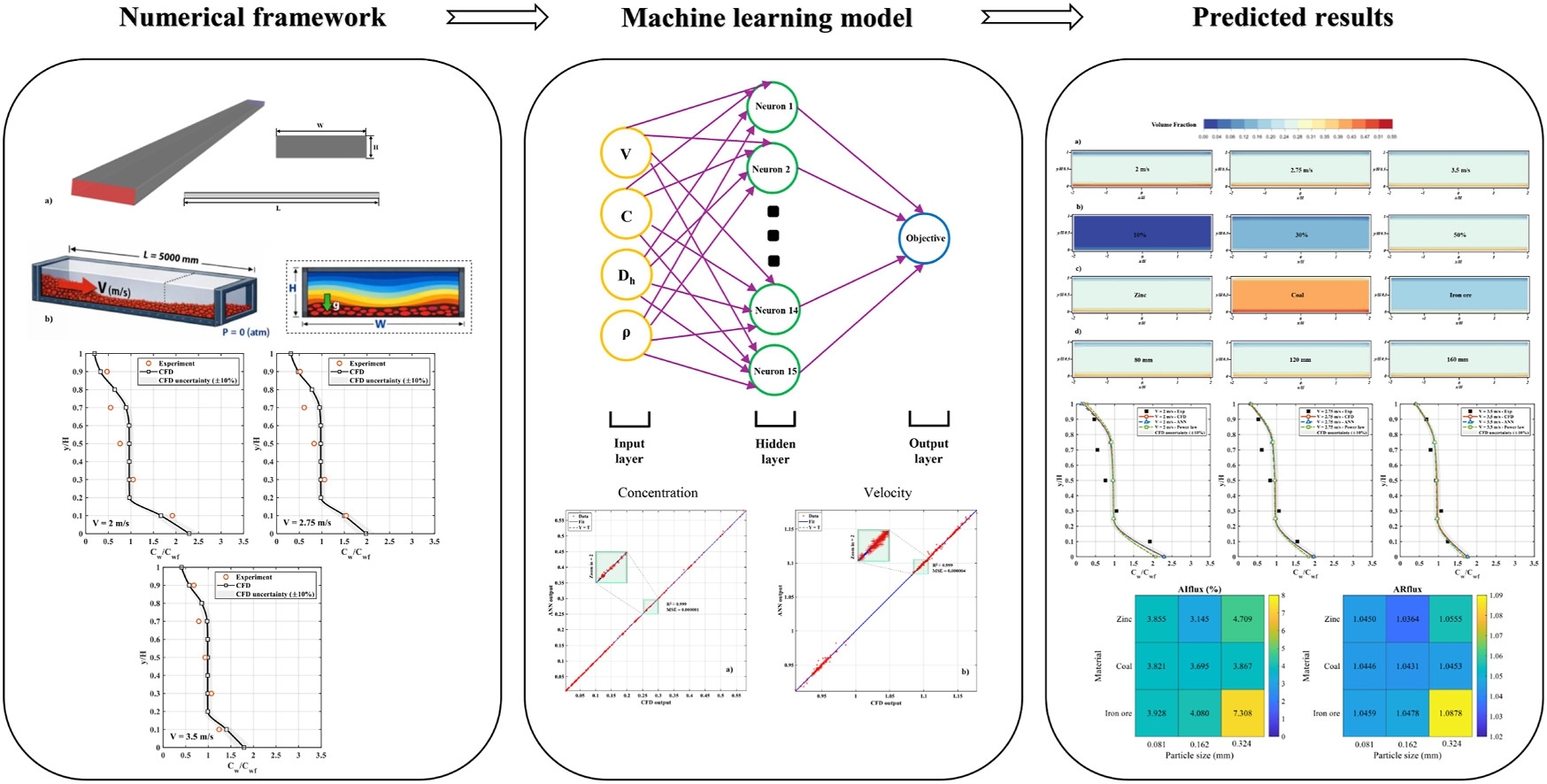
Rectangular-duct slurry transport exhibits coupled particle stratification and velocity-profile asymmetry that cannot be represented adequately by circular-pipe correlations. This study develops a validated CFD–machine-learning framework to quantify these effects and predict concentration and velocity profiles. A three-dimensional mixture model coupled with kinetic-theory and turbulence closures examined the influences of velocity, solids concentration, hydraulic diameter, particle density, and particle size. The resulting 81-case full-factorial CFD database trained separate shallow artificial neural networks, with predictive assessment extended to Support Vector Regression, Random Forest, and power-law regression. Increasing velocity from 2.0 to 3.5 m/s reduced the dimensionless bottom-to-top concentration ratio from approximately 3.5 to nearly 1.0, whereas higher concentration, density, and particle size intensified settling and lower-region accumulation. The proposed flux indices showed that the upper duct half consistently transported more streamwise velocity than the lower half. Coarse iron ore produced the strongest asymmetry, with AIflux = 7.31% and ARflux = 1.088. Pressure loss increased with velocity, concentration, and density, while larger ducts reduced it by more than 50%. For three independent intermediate cases, the velocity ANN achieved mean R2 = 0.99937 and RMSE = 0.00203. The framework enables rapid, CFD-grounded assessment of non-circular slurry systems within the investigated domain and supports design optimisation without repeated full-scale CFD simulations.
Graphical abstract
Keywords
Rectangular-duct slurry transport; Velocity-flux asymmetry; Solid concentration redistribution; CFD-Machine learning; Multiphase flow
文章导读