
期刊文章
过刊浏览
- Volumes 108-119 (2025)
-
Volumes 96-107 (2025)
-
Volume 107
Pages 1-376 (December 2025)
-
Volume 106
Pages 1-336 (November 2025)
-
Volume 105
Pages 1-356 (October 2025)
-
Volume 104
Pages 1-332 (September 2025)
-
Volume 103
Pages 1-314 (August 2025)
-
Volume 102
Pages 1-276 (July 2025)
-
Volume 101
Pages 1-166 (June 2025)
-
Volume 100
Pages 1-256 (May 2025)
-
Volume 99
Pages 1-242 (April 2025)
-
Volume 98
Pages 1-288 (March 2025)
-
Volume 97
Pages 1-256 (February 2025)
-
Volume 96
Pages 1-340 (January 2025)
-
Volume 107
-
Volumes 84-95 (2024)
-
Volume 95
Pages 1-392 (December 2024)
-
Volume 94
Pages 1-400 (November 2024)
-
Volume 93
Pages 1-376 (October 2024)
-
Volume 92
Pages 1-316 (September 2024)
-
Volume 91
Pages 1-378 (August 2024)
-
Volume 90
Pages 1-580 (July 2024)
-
Volume 89
Pages 1-278 (June 2024)
-
Volume 88
Pages 1-350 (May 2024)
-
Volume 87
Pages 1-338 (April 2024)
-
Volume 86
Pages 1-312 (March 2024)
-
Volume 85
Pages 1-334 (February 2024)
-
Volume 84
Pages 1-308 (January 2024)
-
Volume 95
-
Volumes 72-83 (2023)
-
Volume 83
Pages 1-258 (December 2023)
-
Volume 82
Pages 1-204 (November 2023)
-
Volume 81
Pages 1-188 (October 2023)
-
Volume 80
Pages 1-202 (September 2023)
-
Volume 79
Pages 1-172 (August 2023)
-
Volume 78
Pages 1-146 (July 2023)
-
Volume 77
Pages 1-152 (June 2023)
-
Volume 76
Pages 1-176 (May 2023)
-
Volume 75
Pages 1-228 (April 2023)
-
Volume 74
Pages 1-200 (March 2023)
-
Volume 73
Pages 1-138 (February 2023)
-
Volume 72
Pages 1-144 (January 2023)
-
Volume 83
-
Volumes 60-71 (2022)
-
Volume 71
Pages 1-108 (December 2022)
-
Volume 70
Pages 1-106 (November 2022)
-
Volume 69
Pages 1-122 (October 2022)
-
Volume 68
Pages 1-124 (September 2022)
-
Volume 67
Pages 1-102 (August 2022)
-
Volume 66
Pages 1-112 (July 2022)
-
Volume 65
Pages 1-138 (June 2022)
-
Volume 64
Pages 1-186 (May 2022)
-
Volume 63
Pages 1-124 (April 2022)
-
Volume 62
Pages 1-104 (March 2022)
-
Volume 61
Pages 1-120 (February 2022)
-
Volume 60
Pages 1-124 (January 2022)
-
Volume 71
- Volumes 54-59 (2021)
- Volumes 48-53 (2020)
- Volumes 42-47 (2019)
- Volumes 36-41 (2018)
- Volumes 30-35 (2017)
- Volumes 24-29 (2016)
- Volumes 18-23 (2015)
- Volumes 12-17 (2014)
- Volume 11 (2013)
- Volume 10 (2012)
- Volume 9 (2011)
- Volume 8 (2010)
- Volume 7 (2009)
- Volume 6 (2008)
- Volume 5 (2007)
- Volume 4 (2006)
- Volume 3 (2005)
- Volume 2 (2004)
- Volume 1 (2003)
Volume 118
Two-dimensional PR-DNS of cellulose pyrolysis: Parametric and two-particle interaction studies (Open Access)
Riem Al-Hamadi a *, Abouelmagd Abdelsamie a b, Cheng Chi a, Gábor Janiga a, Dominique Thévenin a
a Otto von Guericke University Magdeburg, Universitätsplatz 2, Magdeburg, Saxony-Anhalt, 39106, Germany
b Capital University, Cairo, 11311, Egypt
10.1016/j.partic.2026.08.036
Volume 118,
November 2026,
Pages 289-304
Received 31 May 2026, Revised 22 July 2026, Accepted 24 August 2026, Available online 11 September 2026, Version of Record 18 September 2026.
E-mail:
riem.al-hamadi@ovgu.de
Highlights
• PR-DNS captures flow–heat–reaction coupling in cellulose pyrolysis.
• Higher temperature enhances heat transfer and formation of light products.
• Inflow velocity shows minor impact on product distributions.
• Side-by-side particles exhibit nearly symmetric behavior.
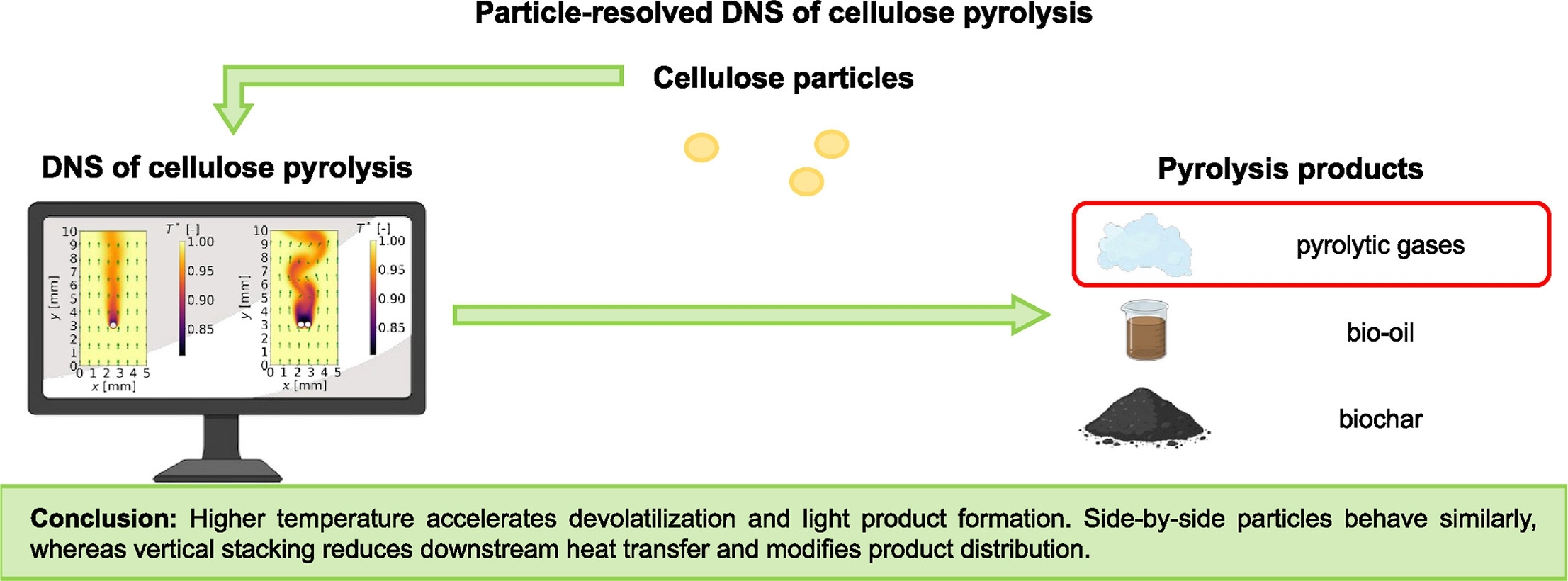
• Vertical stacking reduces downstream heating and alters product formation.
Abstract
Biomass pyrolysis is a key thermochemical pathway for sustainable energy production, converting organic matter into biochar, bio-oil, and pyrolytic gases. Its multiscale and multiphysics nature complicates experiments and motivates high-fidelity numerical modeling. This work extends our particle-resolved Direct Numerical Simulation (PR-DNS) framework by incorporating a semi-detailed cellulose pyrolysis mechanism derived from chemical reaction neural networks (CRNN), enabling fully resolved simulations of coupled flow, heat transfer, mass transfer, and cellulose conversion. The resulting framework, implemented in our in-house code DINO, is employed to investigate early-stage cellulose pyrolysis (up to 10 ms) through systematic parametric and two-particle interaction studies in two dimensions. Elevated fluid temperatures intensify convective heat transfer and promote the formation of lighter products. Increasing inflow velocity enhances convective transport but reduces residence time, resulting in only weak variations in surface-averaged product mass fractions within the investigated range. Two-particle simulations reveal pronounced interaction effects: Side-by-side configurations show nearly symmetric behavior, whereas vertically stacked particles exhibit wake shielding effects in the two-dimensional flow field, reducing heat transfer to the downstream particle and modifying local species distributions. These findings provide mechanistic insight into particle-scale flow–heat–chemistry coupling during cellulose pyrolysis and demonstrate the importance of explicitly resolving interparticle interactions.
Graphical abstract
Keywords
Biomass pyrolysis; PR-DNS; Renewable energy; Surface reactions; Pyrolytic gas production
文章导读