
期刊文章
过刊浏览
- Volumes 108-119 (2025)
-
Volumes 96-107 (2025)
-
Volume 107
Pages 1-376 (December 2025)
-
Volume 106
Pages 1-336 (November 2025)
-
Volume 105
Pages 1-356 (October 2025)
-
Volume 104
Pages 1-332 (September 2025)
-
Volume 103
Pages 1-314 (August 2025)
-
Volume 102
Pages 1-276 (July 2025)
-
Volume 101
Pages 1-166 (June 2025)
-
Volume 100
Pages 1-256 (May 2025)
-
Volume 99
Pages 1-242 (April 2025)
-
Volume 98
Pages 1-288 (March 2025)
-
Volume 97
Pages 1-256 (February 2025)
-
Volume 96
Pages 1-340 (January 2025)
-
Volume 107
-
Volumes 84-95 (2024)
-
Volume 95
Pages 1-392 (December 2024)
-
Volume 94
Pages 1-400 (November 2024)
-
Volume 93
Pages 1-376 (October 2024)
-
Volume 92
Pages 1-316 (September 2024)
-
Volume 91
Pages 1-378 (August 2024)
-
Volume 90
Pages 1-580 (July 2024)
-
Volume 89
Pages 1-278 (June 2024)
-
Volume 88
Pages 1-350 (May 2024)
-
Volume 87
Pages 1-338 (April 2024)
-
Volume 86
Pages 1-312 (March 2024)
-
Volume 85
Pages 1-334 (February 2024)
-
Volume 84
Pages 1-308 (January 2024)
-
Volume 95
-
Volumes 72-83 (2023)
-
Volume 83
Pages 1-258 (December 2023)
-
Volume 82
Pages 1-204 (November 2023)
-
Volume 81
Pages 1-188 (October 2023)
-
Volume 80
Pages 1-202 (September 2023)
-
Volume 79
Pages 1-172 (August 2023)
-
Volume 78
Pages 1-146 (July 2023)
-
Volume 77
Pages 1-152 (June 2023)
-
Volume 76
Pages 1-176 (May 2023)
-
Volume 75
Pages 1-228 (April 2023)
-
Volume 74
Pages 1-200 (March 2023)
-
Volume 73
Pages 1-138 (February 2023)
-
Volume 72
Pages 1-144 (January 2023)
-
Volume 83
-
Volumes 60-71 (2022)
-
Volume 71
Pages 1-108 (December 2022)
-
Volume 70
Pages 1-106 (November 2022)
-
Volume 69
Pages 1-122 (October 2022)
-
Volume 68
Pages 1-124 (September 2022)
-
Volume 67
Pages 1-102 (August 2022)
-
Volume 66
Pages 1-112 (July 2022)
-
Volume 65
Pages 1-138 (June 2022)
-
Volume 64
Pages 1-186 (May 2022)
-
Volume 63
Pages 1-124 (April 2022)
-
Volume 62
Pages 1-104 (March 2022)
-
Volume 61
Pages 1-120 (February 2022)
-
Volume 60
Pages 1-124 (January 2022)
-
Volume 71
- Volumes 54-59 (2021)
- Volumes 48-53 (2020)
- Volumes 42-47 (2019)
- Volumes 36-41 (2018)
- Volumes 30-35 (2017)
- Volumes 24-29 (2016)
- Volumes 18-23 (2015)
- Volumes 12-17 (2014)
- Volume 11 (2013)
- Volume 10 (2012)
- Volume 9 (2011)
- Volume 8 (2010)
- Volume 7 (2009)
- Volume 6 (2008)
- Volume 5 (2007)
- Volume 4 (2006)
- Volume 3 (2005)
- Volume 2 (2004)
- Volume 1 (2003)
Volume 118
Functionally modified PVA microspheres empowering emerging interventional combination therapies: Design, adaptation, and advances in clinical research
Tong Zhang a, Hongyu Wang a, Fei Wang a, Luying Wang a b, Jing Liu a b, Jiandu Lei a b *
a Beijing Key Laboratory of Lignocellulosic Chemistry, College of Material Science and Technology, Beijing Forestry University, Beijing, 100083, China
b MOE Engineering Research Center of Forestry Biomass Materials and Bioenergy, Beijing Forestry University, Beijing, 100083, China
10.1016/j.partic.2026.08.035
Volume 118,
Received 3 April 2026, Revised 26 June 2026, Accepted 27 August 2026, Available online 31 August 2026, Version of Record 21 September 2026.,
Pages 325-349
November 2026
E-mail:
ljd2012@bjfu.edu.cn
Highlights
• Reviews three key modification strategies for PVA microspheres.
• Transforms passive embolic fillers into active therapeutic platforms.
• Elaborates synergy with four emerging interventional therapies.
• Establishes a framework for multimodal precise intervention.
• Categorizes clinical applications and forecasts intelligent trends.
Abstract
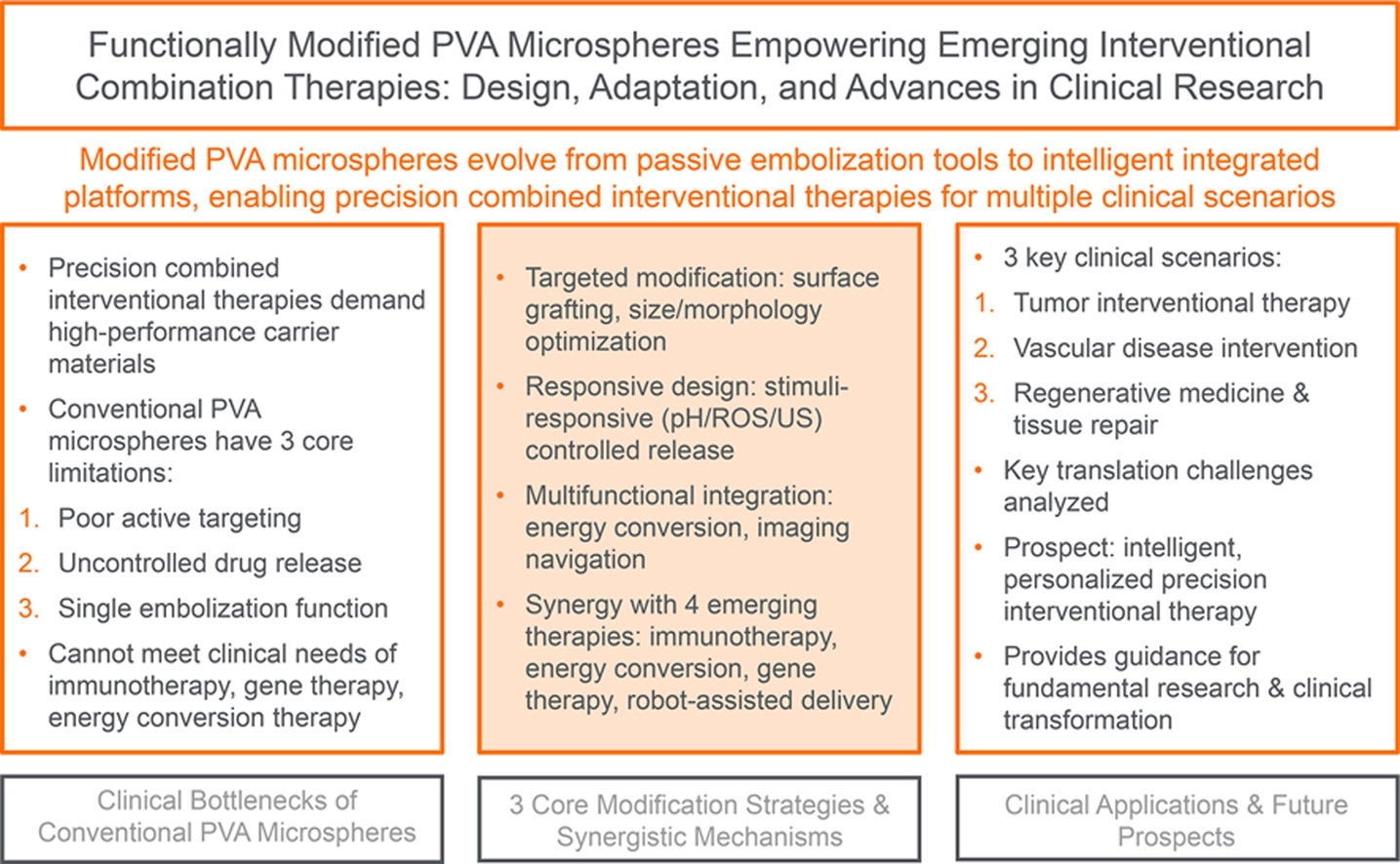
The rapid advancement of precision combined interventional therapies raises higher requirements for the functional integration and clinical adaptability of medical carrier materials. With excellent biocompatibility, mechanical stability, and structural modifiability, polyvinyl alcohol (PVA) microspheres are core carriers for tumor interventional embolization. Their prominent strengths cover excellent biocompatibility, stable mechanical performance, and flexible structural modifiability. Conventional unmodified PVA microspheres have obvious inherent limitations. They lack specific tumor-targeting capacity, cannot realize precise on-demand drug release, and only retain a single embolization function. These drawbacks prevent them from adapting to multi-modal combined clinical schemes, including immunotherapy, gene therapy, and energy conversion synergistic treatment. Focusing on the functional modification of PVA microspheres, this review summarizes three major strategies, illustrates their synergistic mechanisms with emerging therapies, and presents applications in tumor treatment, vascular intervention, and regenerative repair. This work identifies three specific bottlenecks hindering the clinical translation of functionalized PVA microspheres: insufficient long-term biocompatibility validation data from standardized large-animal models, poor batch consistency, and high manufacturing costs under Good Manufacturing Practice (GMP)-compliant scale-up production, and protracted, complex regulatory approval workflows for multifunctional drug-device combination medical devices. This review provides novel research perspectives and operable design guidance for basic material exploration and subsequent clinical transformation, and facilitates the upgrade of interventional medicine into an integrated system that realizes synchronous embolization, local tumor therapy, and real-time lesion monitoring.
Graphical abstract
Keywords
Polyvinyl alcohol microspheres; Functional modification; Precision interventional therapy; Combination therapy
文章导读