
期刊文章
过刊浏览
- Volumes 108-119 (2025)
-
Volumes 96-107 (2025)
-
Volume 107
Pages 1-376 (December 2025)
-
Volume 106
Pages 1-336 (November 2025)
-
Volume 105
Pages 1-356 (October 2025)
-
Volume 104
Pages 1-332 (September 2025)
-
Volume 103
Pages 1-314 (August 2025)
-
Volume 102
Pages 1-276 (July 2025)
-
Volume 101
Pages 1-166 (June 2025)
-
Volume 100
Pages 1-256 (May 2025)
-
Volume 99
Pages 1-242 (April 2025)
-
Volume 98
Pages 1-288 (March 2025)
-
Volume 97
Pages 1-256 (February 2025)
-
Volume 96
Pages 1-340 (January 2025)
-
Volume 107
-
Volumes 84-95 (2024)
-
Volume 95
Pages 1-392 (December 2024)
-
Volume 94
Pages 1-400 (November 2024)
-
Volume 93
Pages 1-376 (October 2024)
-
Volume 92
Pages 1-316 (September 2024)
-
Volume 91
Pages 1-378 (August 2024)
-
Volume 90
Pages 1-580 (July 2024)
-
Volume 89
Pages 1-278 (June 2024)
-
Volume 88
Pages 1-350 (May 2024)
-
Volume 87
Pages 1-338 (April 2024)
-
Volume 86
Pages 1-312 (March 2024)
-
Volume 85
Pages 1-334 (February 2024)
-
Volume 84
Pages 1-308 (January 2024)
-
Volume 95
-
Volumes 72-83 (2023)
-
Volume 83
Pages 1-258 (December 2023)
-
Volume 82
Pages 1-204 (November 2023)
-
Volume 81
Pages 1-188 (October 2023)
-
Volume 80
Pages 1-202 (September 2023)
-
Volume 79
Pages 1-172 (August 2023)
-
Volume 78
Pages 1-146 (July 2023)
-
Volume 77
Pages 1-152 (June 2023)
-
Volume 76
Pages 1-176 (May 2023)
-
Volume 75
Pages 1-228 (April 2023)
-
Volume 74
Pages 1-200 (March 2023)
-
Volume 73
Pages 1-138 (February 2023)
-
Volume 72
Pages 1-144 (January 2023)
-
Volume 83
-
Volumes 60-71 (2022)
-
Volume 71
Pages 1-108 (December 2022)
-
Volume 70
Pages 1-106 (November 2022)
-
Volume 69
Pages 1-122 (October 2022)
-
Volume 68
Pages 1-124 (September 2022)
-
Volume 67
Pages 1-102 (August 2022)
-
Volume 66
Pages 1-112 (July 2022)
-
Volume 65
Pages 1-138 (June 2022)
-
Volume 64
Pages 1-186 (May 2022)
-
Volume 63
Pages 1-124 (April 2022)
-
Volume 62
Pages 1-104 (March 2022)
-
Volume 61
Pages 1-120 (February 2022)
-
Volume 60
Pages 1-124 (January 2022)
-
Volume 71
- Volumes 54-59 (2021)
- Volumes 48-53 (2020)
- Volumes 42-47 (2019)
- Volumes 36-41 (2018)
- Volumes 30-35 (2017)
- Volumes 24-29 (2016)
- Volumes 18-23 (2015)
- Volumes 12-17 (2014)
- Volume 11 (2013)
- Volume 10 (2012)
- Volume 9 (2011)
- Volume 8 (2010)
- Volume 7 (2009)
- Volume 6 (2008)
- Volume 5 (2007)
- Volume 4 (2006)
- Volume 3 (2005)
- Volume 2 (2004)
- Volume 1 (2003)
Volume 118
A constructive sphere packing method for DEM using centroidal Voronoi tessellation and maximum inscribed spheres
Hui Yuan, Yongzhi Zhao *
Institute of Process Equipment, College of Energy Engineering, Zhejiang University, Hangzhou, 310027, China
10.1016/j.partic.2026.09.007
Volume 118,
November 2026,
Pages 364-376
Institute of Process Equipment, College of Energy Engineering, Zhejiang University, Hangzhou, 310027, China
E-mail:
yzzhao@zju.edu.cn
Highlights
• A constructive sphere packing method combines CVT and maximum inscribed spheres.
• Nonoverlapping packings are generated in complex and concave 3D domains.
• CVT iterations govern particle size distribution and packing fraction.
• Computational time increases approximately linearly with particle number.
Abstract
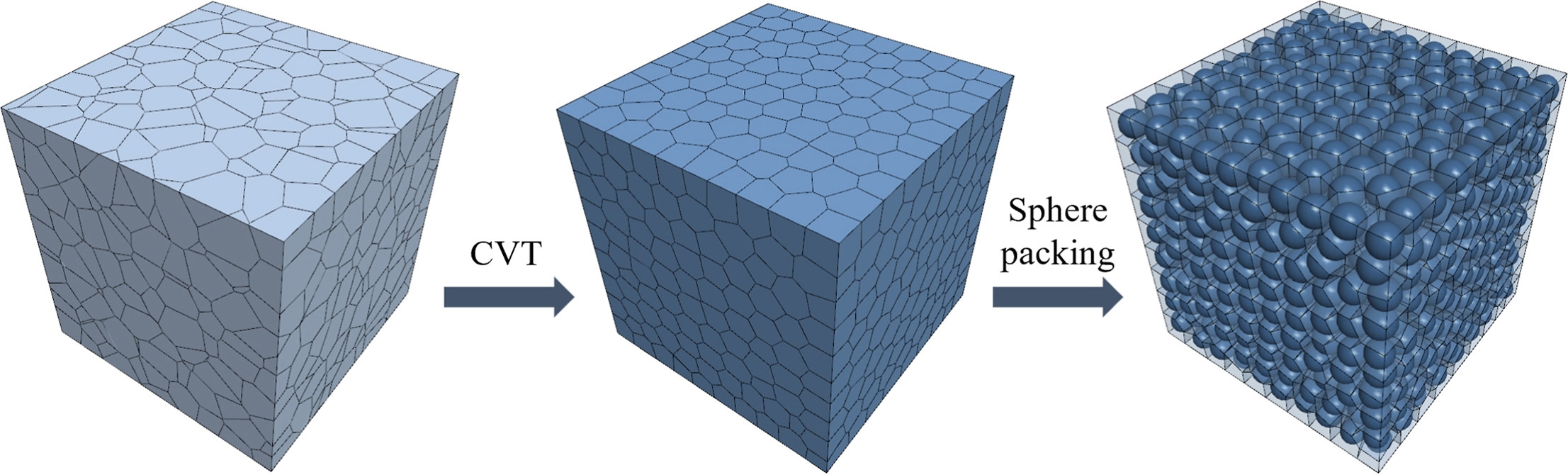
Discrete element method (DEM) simulations generally require an initial particle packing before calculation. This preprocessing step can be time-consuming, particularly for large particle systems and domains with complex geometries. In this study, a constructive method for sphere packing generation is presented based on centroidal Voronoi tessellation (CVT) and maximum inscribed spheres. Initial seeds are distributed in the target domain using a regular background grid, and the corresponding Voronoi cells are then constructed. Lloyd iterations are subsequently performed to regularize the spatial partition, after which the maximum inscribed sphere is generated within each final cell. The method is applicable to complex and concave 3D domains and produces sphere packings without initial particle overlap. The normalized particle radius distributions are approximately normal, with limited sensitivity to the domain geometry and particle number. Their statistical characteristics are governed mainly by the number of CVT iterations. As the iteration number increases, the mean normalized particle radius and packing fraction increase, whereas the particle size dispersion decreases. Both computational time and memory consumption increase approximately linearly with particle number over the investigated range. These results show that the proposed method provides a practical geometric approach for generating large-scale sphere packings for DEM simulations.
Graphical abstract
Keywords
Discrete element method; Particle packing; Centroidal Voronoi tessellation; Maximum inscribed sphere
文章导读