
期刊文章
过刊浏览
- Volumes 108-119 (2025)
-
Volumes 96-107 (2025)
-
Volume 107
Pages 1-376 (December 2025)
-
Volume 106
Pages 1-336 (November 2025)
-
Volume 105
Pages 1-356 (October 2025)
-
Volume 104
Pages 1-332 (September 2025)
-
Volume 103
Pages 1-314 (August 2025)
-
Volume 102
Pages 1-276 (July 2025)
-
Volume 101
Pages 1-166 (June 2025)
-
Volume 100
Pages 1-256 (May 2025)
-
Volume 99
Pages 1-242 (April 2025)
-
Volume 98
Pages 1-288 (March 2025)
-
Volume 97
Pages 1-256 (February 2025)
-
Volume 96
Pages 1-340 (January 2025)
-
Volume 107
-
Volumes 84-95 (2024)
-
Volume 95
Pages 1-392 (December 2024)
-
Volume 94
Pages 1-400 (November 2024)
-
Volume 93
Pages 1-376 (October 2024)
-
Volume 92
Pages 1-316 (September 2024)
-
Volume 91
Pages 1-378 (August 2024)
-
Volume 90
Pages 1-580 (July 2024)
-
Volume 89
Pages 1-278 (June 2024)
-
Volume 88
Pages 1-350 (May 2024)
-
Volume 87
Pages 1-338 (April 2024)
-
Volume 86
Pages 1-312 (March 2024)
-
Volume 85
Pages 1-334 (February 2024)
-
Volume 84
Pages 1-308 (January 2024)
-
Volume 95
-
Volumes 72-83 (2023)
-
Volume 83
Pages 1-258 (December 2023)
-
Volume 82
Pages 1-204 (November 2023)
-
Volume 81
Pages 1-188 (October 2023)
-
Volume 80
Pages 1-202 (September 2023)
-
Volume 79
Pages 1-172 (August 2023)
-
Volume 78
Pages 1-146 (July 2023)
-
Volume 77
Pages 1-152 (June 2023)
-
Volume 76
Pages 1-176 (May 2023)
-
Volume 75
Pages 1-228 (April 2023)
-
Volume 74
Pages 1-200 (March 2023)
-
Volume 73
Pages 1-138 (February 2023)
-
Volume 72
Pages 1-144 (January 2023)
-
Volume 83
-
Volumes 60-71 (2022)
-
Volume 71
Pages 1-108 (December 2022)
-
Volume 70
Pages 1-106 (November 2022)
-
Volume 69
Pages 1-122 (October 2022)
-
Volume 68
Pages 1-124 (September 2022)
-
Volume 67
Pages 1-102 (August 2022)
-
Volume 66
Pages 1-112 (July 2022)
-
Volume 65
Pages 1-138 (June 2022)
-
Volume 64
Pages 1-186 (May 2022)
-
Volume 63
Pages 1-124 (April 2022)
-
Volume 62
Pages 1-104 (March 2022)
-
Volume 61
Pages 1-120 (February 2022)
-
Volume 60
Pages 1-124 (January 2022)
-
Volume 71
- Volumes 54-59 (2021)
- Volumes 48-53 (2020)
- Volumes 42-47 (2019)
- Volumes 36-41 (2018)
- Volumes 30-35 (2017)
- Volumes 24-29 (2016)
- Volumes 18-23 (2015)
- Volumes 12-17 (2014)
- Volume 11 (2013)
- Volume 10 (2012)
- Volume 9 (2011)
- Volume 8 (2010)
- Volume 7 (2009)
- Volume 6 (2008)
- Volume 5 (2007)
- Volume 4 (2006)
- Volume 3 (2005)
- Volume 2 (2004)
- Volume 1 (2003)
Volume 118
Electric-field and flow-induced particle collection enhancement in a two-stage electrostatic precipitator with wavy collecting plates
Young Min Seo a b, Ho Yeon Choi c, Yong Gap Park d *
a Hydrogen Electric Research Team, Korea Electrotechnology Research Institute, Changwon, 51543, South Korea
b Electric Energy & Materials Engineering, University of Science and Technology (UST), Daejeon, 34129, South Korea
c LG Electronics H&A Air Solution R&D Center, Changwon, 51140, South Korea
d School of Mechanical Engineering, Changwon National University, Changwon, 51140, South Korea
10.1016/j.partic.2026.09.011
Volume 118,
November 2026,
Pages 416-431
Received 16 June 2026, Revised 11 September 2026, Accepted 16 September 2026, Available online 17 September 2026, Version of Record 25 September 2026.
E-mail:
pyg777@changwon.ac.kr
Highlights
• Wavy collecting plates alter electric field and flow in a two-stage ESP.
• Larger wave amplitude enhances particle migration and collection efficiency.
• Plate wavelength affects local fields with limited impact on efficiency.
• An ANN model accurately predicts collection efficiency.
• The combined numerical–ANN approach supports ESP performance optimization.
Abstract
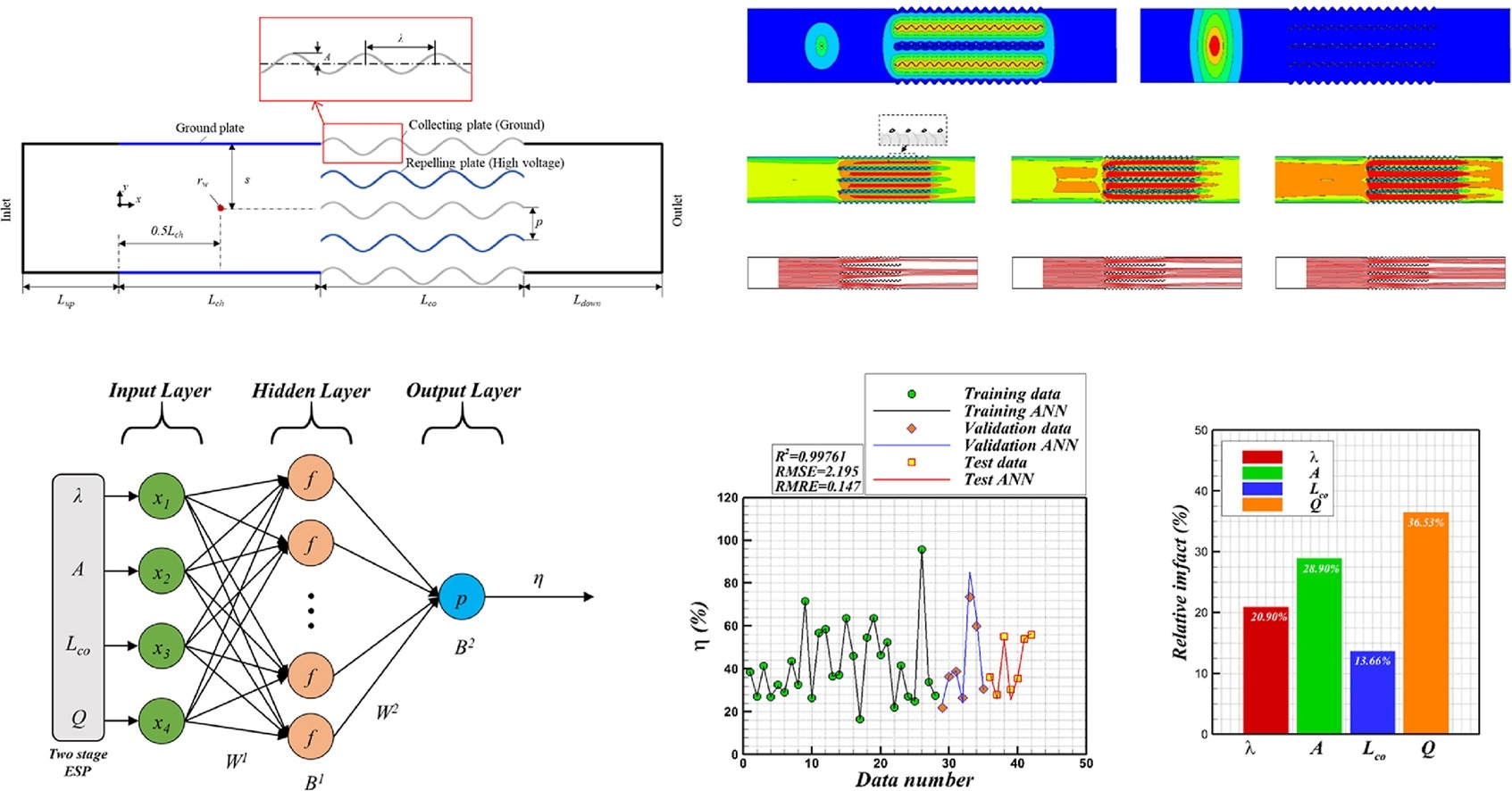
In this study, the effects of wavy collecting plate geometry on the performance of a two-stage electrostatic precipitator were numerically investigated. The results showed that variations in plate wavelength primarily affected the local electric field and flow structures, whereas increasing the wave amplitude significantly enhanced particle collection by strengthening the electric field and promoting transverse particle migration. The volumetric flow rate was also identified as a dominant parameter because lower flow rates increased particle residence time and charging, thereby enhancing collection efficiency. Among the representative configurations analyzed, the highest collection efficiency of 73.5% was obtained for TS-Wavy-E at a volumetric flow rate of 0.05 m3/s. An artificial neural network model was further developed to predict collection efficiency based on the geometric and operating parameters. The ANN showed good agreement with the numerical results and outperformed the conventional regression model within the investigated parameter range. These results demonstrate that appropriate modification of the collecting plate geometry can effectively improve particle collection performance and that the ANN provides a useful data-driven representation of the numerical results for two-stage ESP design.
Graphical abstract
Keywords
Two-stage; Electrostatic precipitator; Collecting plate shapes; Artificial neural networks; Collection efficiency
文章导读