
期刊文章
过刊浏览
- Volumes 108-119 (2025)
-
Volumes 96-107 (2025)
-
Volume 107
Pages 1-376 (December 2025)
-
Volume 106
Pages 1-336 (November 2025)
-
Volume 105
Pages 1-356 (October 2025)
-
Volume 104
Pages 1-332 (September 2025)
-
Volume 103
Pages 1-314 (August 2025)
-
Volume 102
Pages 1-276 (July 2025)
-
Volume 101
Pages 1-166 (June 2025)
-
Volume 100
Pages 1-256 (May 2025)
-
Volume 99
Pages 1-242 (April 2025)
-
Volume 98
Pages 1-288 (March 2025)
-
Volume 97
Pages 1-256 (February 2025)
-
Volume 96
Pages 1-340 (January 2025)
-
Volume 107
-
Volumes 84-95 (2024)
-
Volume 95
Pages 1-392 (December 2024)
-
Volume 94
Pages 1-400 (November 2024)
-
Volume 93
Pages 1-376 (October 2024)
-
Volume 92
Pages 1-316 (September 2024)
-
Volume 91
Pages 1-378 (August 2024)
-
Volume 90
Pages 1-580 (July 2024)
-
Volume 89
Pages 1-278 (June 2024)
-
Volume 88
Pages 1-350 (May 2024)
-
Volume 87
Pages 1-338 (April 2024)
-
Volume 86
Pages 1-312 (March 2024)
-
Volume 85
Pages 1-334 (February 2024)
-
Volume 84
Pages 1-308 (January 2024)
-
Volume 95
-
Volumes 72-83 (2023)
-
Volume 83
Pages 1-258 (December 2023)
-
Volume 82
Pages 1-204 (November 2023)
-
Volume 81
Pages 1-188 (October 2023)
-
Volume 80
Pages 1-202 (September 2023)
-
Volume 79
Pages 1-172 (August 2023)
-
Volume 78
Pages 1-146 (July 2023)
-
Volume 77
Pages 1-152 (June 2023)
-
Volume 76
Pages 1-176 (May 2023)
-
Volume 75
Pages 1-228 (April 2023)
-
Volume 74
Pages 1-200 (March 2023)
-
Volume 73
Pages 1-138 (February 2023)
-
Volume 72
Pages 1-144 (January 2023)
-
Volume 83
-
Volumes 60-71 (2022)
-
Volume 71
Pages 1-108 (December 2022)
-
Volume 70
Pages 1-106 (November 2022)
-
Volume 69
Pages 1-122 (October 2022)
-
Volume 68
Pages 1-124 (September 2022)
-
Volume 67
Pages 1-102 (August 2022)
-
Volume 66
Pages 1-112 (July 2022)
-
Volume 65
Pages 1-138 (June 2022)
-
Volume 64
Pages 1-186 (May 2022)
-
Volume 63
Pages 1-124 (April 2022)
-
Volume 62
Pages 1-104 (March 2022)
-
Volume 61
Pages 1-120 (February 2022)
-
Volume 60
Pages 1-124 (January 2022)
-
Volume 71
- Volumes 54-59 (2021)
- Volumes 48-53 (2020)
- Volumes 42-47 (2019)
- Volumes 36-41 (2018)
- Volumes 30-35 (2017)
- Volumes 24-29 (2016)
- Volumes 18-23 (2015)
- Volumes 12-17 (2014)
- Volume 11 (2013)
- Volume 10 (2012)
- Volume 9 (2011)
- Volume 8 (2010)
- Volume 7 (2009)
- Volume 6 (2008)
- Volume 5 (2007)
- Volume 4 (2006)
- Volume 3 (2005)
- Volume 2 (2004)
- Volume 1 (2003)
Volume 118
Deformation and fragmentation of wet agglomerates in head-on collisions: A DEM study
Jiliang Ma *, Jialiang Cai, Xiaoping Chen, Daoyin Liu, Cai Liang
Key Laboratory of Energy Thermal Conversion and Control of Ministry of Education, School of Energy and Environment, Southeast University, Nanjing, 210096, China
10.1016/j.partic.2026.09.013
Volume 118,
November 2026,
Pages 432-441
Received 14 June 2026, Revised 1 September 2026, Accepted 20 September 2026, Available online 22 September 2026, Version of Record 25 September 2026.
E-mail:
jlma@seu.edu.cn
Highlights
• Head-on fragmentation of two wet agglomerates was studied.
• Liquid bridge evolution controls collision-induced structural failure.
• Impact velocity dominates fragment generation and contact network decay.
• Liquid bridges enhance cohesion and increase resistance to agglomerate breakup.
• High-impact collisions produce smaller, less compact fragments.
Abstract
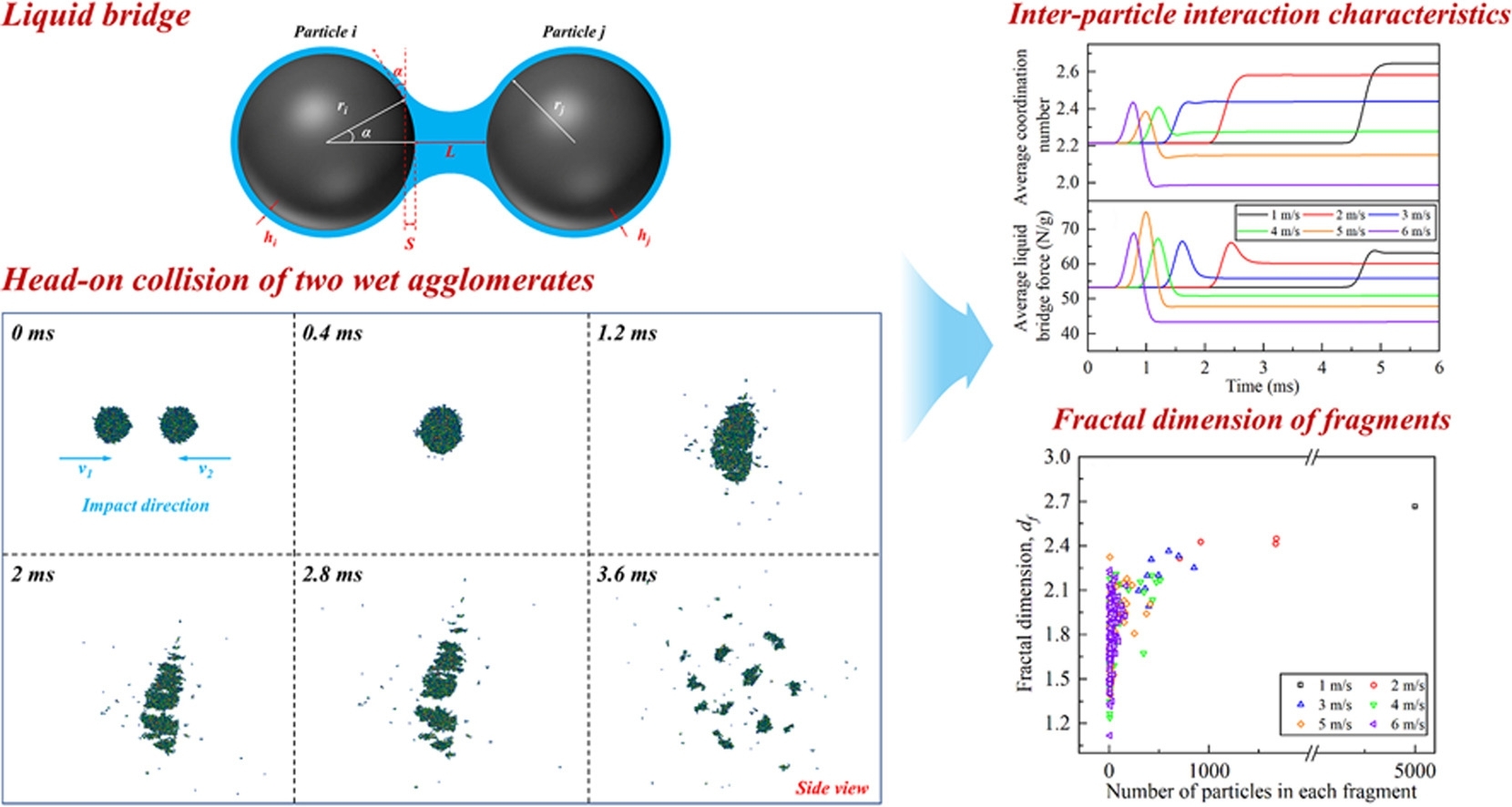
Impact-induced fragmentation of wet agglomerates plays a critical role in wet gas-solid flows, yet the collision-induced fragmentation behavior of wet agglomerates remains insufficiently understood. In this study, the head-on collisional breakage behavior of wet agglomerates was systematically investigated using DEM simulation under varying impact velocities and liquid contents. The results reveal a distinctive breakage pathway accompanied by the coupled evolution of liquid bridges and particle contact networks, involving transient merging, deformation, crack propagation, and fragment dispersion. Increasing liquid content strengthens inter-particle cohesion through liquid bridge interactions, reduces structural damage, and enhances the resistance of wet agglomerates to fragmentation. Impact velocity is identified as the dominant factor controlling liquid bridge rupture, contact network degradation, and fragment generation, whereas higher liquid contents significantly improve resistance to breakage. Furthermore, a relationship between collision intensity and post-breakage fragment structure is established, showing that both the radius of gyration and fractal dimension decrease with increasing impact velocity. These findings provide new insights into the mechanisms of wet agglomerate fragmentation and offer theoretical guidance for controlling particle agglomeration in wet gas-solid systems.
Graphical abstract
Keywords
Wet agglomerates; Head-on collision; Fragmentation; DEM; Fractal dimension
文章导读