
期刊文章
过刊浏览
- Volumes 108-119 (2025)
-
Volumes 96-107 (2025)
-
Volume 107
Pages 1-376 (December 2025)
-
Volume 106
Pages 1-336 (November 2025)
-
Volume 105
Pages 1-356 (October 2025)
-
Volume 104
Pages 1-332 (September 2025)
-
Volume 103
Pages 1-314 (August 2025)
-
Volume 102
Pages 1-276 (July 2025)
-
Volume 101
Pages 1-166 (June 2025)
-
Volume 100
Pages 1-256 (May 2025)
-
Volume 99
Pages 1-242 (April 2025)
-
Volume 98
Pages 1-288 (March 2025)
-
Volume 97
Pages 1-256 (February 2025)
-
Volume 96
Pages 1-340 (January 2025)
-
Volume 107
-
Volumes 84-95 (2024)
-
Volume 95
Pages 1-392 (December 2024)
-
Volume 94
Pages 1-400 (November 2024)
-
Volume 93
Pages 1-376 (October 2024)
-
Volume 92
Pages 1-316 (September 2024)
-
Volume 91
Pages 1-378 (August 2024)
-
Volume 90
Pages 1-580 (July 2024)
-
Volume 89
Pages 1-278 (June 2024)
-
Volume 88
Pages 1-350 (May 2024)
-
Volume 87
Pages 1-338 (April 2024)
-
Volume 86
Pages 1-312 (March 2024)
-
Volume 85
Pages 1-334 (February 2024)
-
Volume 84
Pages 1-308 (January 2024)
-
Volume 95
-
Volumes 72-83 (2023)
-
Volume 83
Pages 1-258 (December 2023)
-
Volume 82
Pages 1-204 (November 2023)
-
Volume 81
Pages 1-188 (October 2023)
-
Volume 80
Pages 1-202 (September 2023)
-
Volume 79
Pages 1-172 (August 2023)
-
Volume 78
Pages 1-146 (July 2023)
-
Volume 77
Pages 1-152 (June 2023)
-
Volume 76
Pages 1-176 (May 2023)
-
Volume 75
Pages 1-228 (April 2023)
-
Volume 74
Pages 1-200 (March 2023)
-
Volume 73
Pages 1-138 (February 2023)
-
Volume 72
Pages 1-144 (January 2023)
-
Volume 83
-
Volumes 60-71 (2022)
-
Volume 71
Pages 1-108 (December 2022)
-
Volume 70
Pages 1-106 (November 2022)
-
Volume 69
Pages 1-122 (October 2022)
-
Volume 68
Pages 1-124 (September 2022)
-
Volume 67
Pages 1-102 (August 2022)
-
Volume 66
Pages 1-112 (July 2022)
-
Volume 65
Pages 1-138 (June 2022)
-
Volume 64
Pages 1-186 (May 2022)
-
Volume 63
Pages 1-124 (April 2022)
-
Volume 62
Pages 1-104 (March 2022)
-
Volume 61
Pages 1-120 (February 2022)
-
Volume 60
Pages 1-124 (January 2022)
-
Volume 71
- Volumes 54-59 (2021)
- Volumes 48-53 (2020)
- Volumes 42-47 (2019)
- Volumes 36-41 (2018)
- Volumes 30-35 (2017)
- Volumes 24-29 (2016)
- Volumes 18-23 (2015)
- Volumes 12-17 (2014)
- Volume 11 (2013)
- Volume 10 (2012)
- Volume 9 (2011)
- Volume 8 (2010)
- Volume 7 (2009)
- Volume 6 (2008)
- Volume 5 (2007)
- Volume 4 (2006)
- Volume 3 (2005)
- Volume 2 (2004)
- Volume 1 (2003)
Volume 118
Application of a microstructure-based particle-gas force model for the simulation of a fluidized bed (Open Access)
Maximilian Brömmer a *, Enric Illana Mahiques a, Viktor Scherer a, Berend van Wachem b
a Department of Energy Plant Technology, Ruhr-Universität Bochum, Universitätsstraße 150, Bochum, 44780, Germany
b Chair of Mechanical Process Engineering, Otto-von-Guericke-Universität Magdeburg, Universitätsplatz 2, Magdeburg, 39106, Germany
10.1016/j.partic.2026.08.038
Volume 118,
November 2026,
Pages 442-458
Received 28 April 2026, Revised 4 August 2026, Accepted 24 August 2026, Available online 19 September 2026, Version of Record 25 September 2026.
E-mail:
broemmer@leat.rub.de
Highlights
• Microstructure-based force modelling in CFD-DEM simulation of a fluidized bed.
• Comparison of different simulation approaches and experimental data for particle velocity and pressure drop.
• Improved prediction of particle fluctuation and dominant frequencies in pressure-drop spectrum with microstructure-based force model.
Abstract
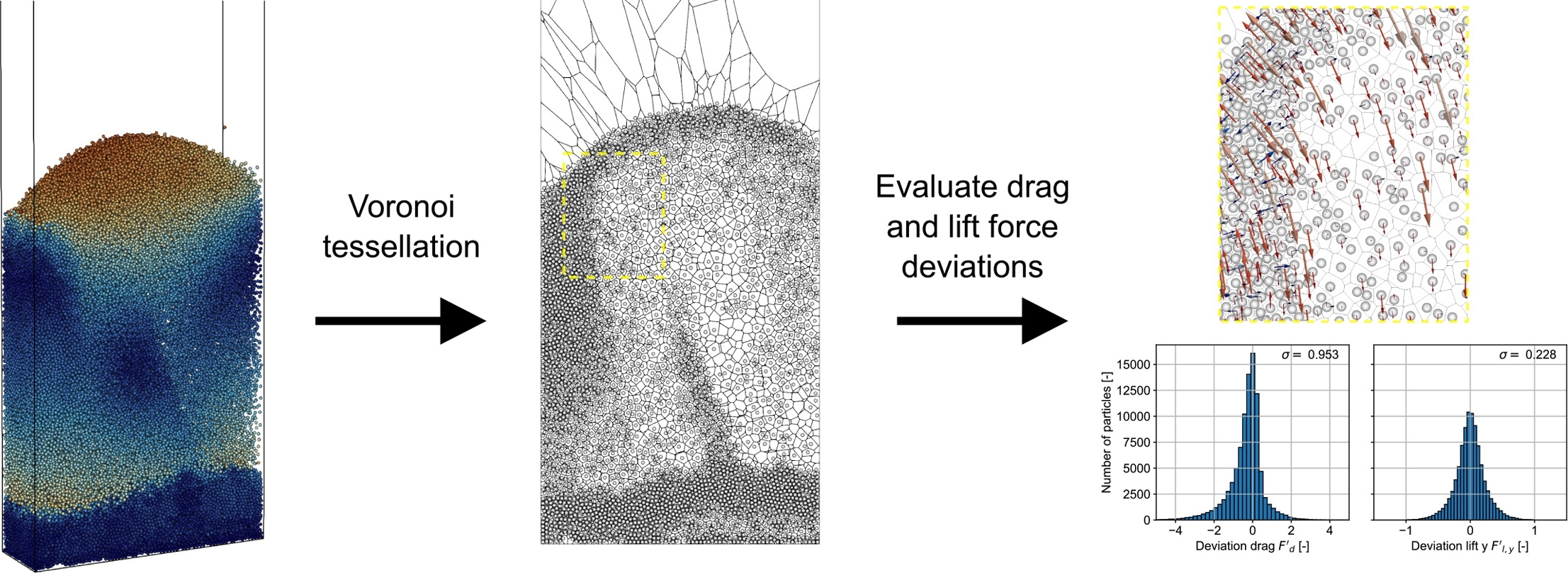
CFD-DEM simulations of the Small-Scale Challenge Problem 1 (SSCP-I) fluidized bed are performed to assess the effect of a microstructure-based particle-gas force model on bed dynamics and particle velocity statistics. Three force-modelling approaches are compared: the conventional Di Felice drag model, the microstructure model with van Wachem mean drag, and the microstructure model with Di Felice mean drag, in which the Di Felice model provides the mean drag while the microstructure-based model accounts for drag deviations and lateral forces. The simulations are evaluated against experimental measurements of the pressure-drop spectrum and Eulerian particle velocity statistics, and bubble statistics are additionally compared with literature correlations.
The results show that the combined microstructure with the Di Felice approach improves the prediction of the dominant pressure-drop frequencies, indicating a better representation of the characteristic slugging dynamics. Mean particle velocities are captured with comparable accuracy by the different approaches, while simulations, including microstructure-dependent force contributions, show improved agreement for particle velocity fluctuations. In particular, the granular temperature is substantially better predicted than with the conventional Di Felice model. Bubble diameters and bubble rise velocities are only weakly affected by the choice of force model. Overall, the results demonstrate that including local microstructure information in particle-gas force modelling can improve fluctuation-dominated quantities in unresolved CFD-DEM simulations of fluidized beds.
Graphical abstract
Keywords
Microstructure-based force modelling; Fluidized bed; Voronoi tessellation; CFD-DEM
文章导读