
期刊文章
过刊浏览
- Volumes 108-119 (2025)
-
Volumes 96-107 (2025)
-
Volume 107
Pages 1-376 (December 2025)
-
Volume 106
Pages 1-336 (November 2025)
-
Volume 105
Pages 1-356 (October 2025)
-
Volume 104
Pages 1-332 (September 2025)
-
Volume 103
Pages 1-314 (August 2025)
-
Volume 102
Pages 1-276 (July 2025)
-
Volume 101
Pages 1-166 (June 2025)
-
Volume 100
Pages 1-256 (May 2025)
-
Volume 99
Pages 1-242 (April 2025)
-
Volume 98
Pages 1-288 (March 2025)
-
Volume 97
Pages 1-256 (February 2025)
-
Volume 96
Pages 1-340 (January 2025)
-
Volume 107
-
Volumes 84-95 (2024)
-
Volume 95
Pages 1-392 (December 2024)
-
Volume 94
Pages 1-400 (November 2024)
-
Volume 93
Pages 1-376 (October 2024)
-
Volume 92
Pages 1-316 (September 2024)
-
Volume 91
Pages 1-378 (August 2024)
-
Volume 90
Pages 1-580 (July 2024)
-
Volume 89
Pages 1-278 (June 2024)
-
Volume 88
Pages 1-350 (May 2024)
-
Volume 87
Pages 1-338 (April 2024)
-
Volume 86
Pages 1-312 (March 2024)
-
Volume 85
Pages 1-334 (February 2024)
-
Volume 84
Pages 1-308 (January 2024)
-
Volume 95
-
Volumes 72-83 (2023)
-
Volume 83
Pages 1-258 (December 2023)
-
Volume 82
Pages 1-204 (November 2023)
-
Volume 81
Pages 1-188 (October 2023)
-
Volume 80
Pages 1-202 (September 2023)
-
Volume 79
Pages 1-172 (August 2023)
-
Volume 78
Pages 1-146 (July 2023)
-
Volume 77
Pages 1-152 (June 2023)
-
Volume 76
Pages 1-176 (May 2023)
-
Volume 75
Pages 1-228 (April 2023)
-
Volume 74
Pages 1-200 (March 2023)
-
Volume 73
Pages 1-138 (February 2023)
-
Volume 72
Pages 1-144 (January 2023)
-
Volume 83
-
Volumes 60-71 (2022)
-
Volume 71
Pages 1-108 (December 2022)
-
Volume 70
Pages 1-106 (November 2022)
-
Volume 69
Pages 1-122 (October 2022)
-
Volume 68
Pages 1-124 (September 2022)
-
Volume 67
Pages 1-102 (August 2022)
-
Volume 66
Pages 1-112 (July 2022)
-
Volume 65
Pages 1-138 (June 2022)
-
Volume 64
Pages 1-186 (May 2022)
-
Volume 63
Pages 1-124 (April 2022)
-
Volume 62
Pages 1-104 (March 2022)
-
Volume 61
Pages 1-120 (February 2022)
-
Volume 60
Pages 1-124 (January 2022)
-
Volume 71
- Volumes 54-59 (2021)
- Volumes 48-53 (2020)
- Volumes 42-47 (2019)
- Volumes 36-41 (2018)
- Volumes 30-35 (2017)
- Volumes 24-29 (2016)
- Volumes 18-23 (2015)
- Volumes 12-17 (2014)
- Volume 11 (2013)
- Volume 10 (2012)
- Volume 9 (2011)
- Volume 8 (2010)
- Volume 7 (2009)
- Volume 6 (2008)
- Volume 5 (2007)
- Volume 4 (2006)
- Volume 3 (2005)
- Volume 2 (2004)
- Volume 1 (2003)
Volume 110
Bellosta von Colbe, J. M., Benz, H. U., Zoz, H., Jepsen, J., Taube, K., Dornheim, M., & Klassen, T. (2026). Transient bimodal effects in the in-line particle size measurement during milling of solid state materials. Particuology, 110, 280-285. https://doi.org/10.1016/j.partic.2025.12.026
Transient bimodal effects in the in-line particle size measurement during milling of solid state materials (Open Access)
José M. Bellosta von Colbe a *, Hans Ulrich Benz b, Henning Zoz b, Julian Jepsen a c, Klaus Taube a, Martin Dornheim a 1, Thomas Klassen a c
a Helmholtz Zentrum hereon GmbH, Max-Planck Str. 1, Geesthacht, 21502, Germany
b Zoz GmbH, Maltoz-Straße, Wenden, 57482, Germany
c Helmut Schmidt University, Holstenhofweg 85, Hamburg, 22043, Germany
10.1016/j.partic.2025.12.026
Volume 110,
March 2026,
Pages 280-285
Received 10 June 2025, Revised 10 December 2025, Accepted 19 December 2025, Available online 20 January 2026, Version of Record 5 February 2026.
E-mail:
jose.bellostavoncolbe@hereon.de
Highlights
• A setup to measure the particle size of solid powder materials during milling was designed, built and successfully tested.
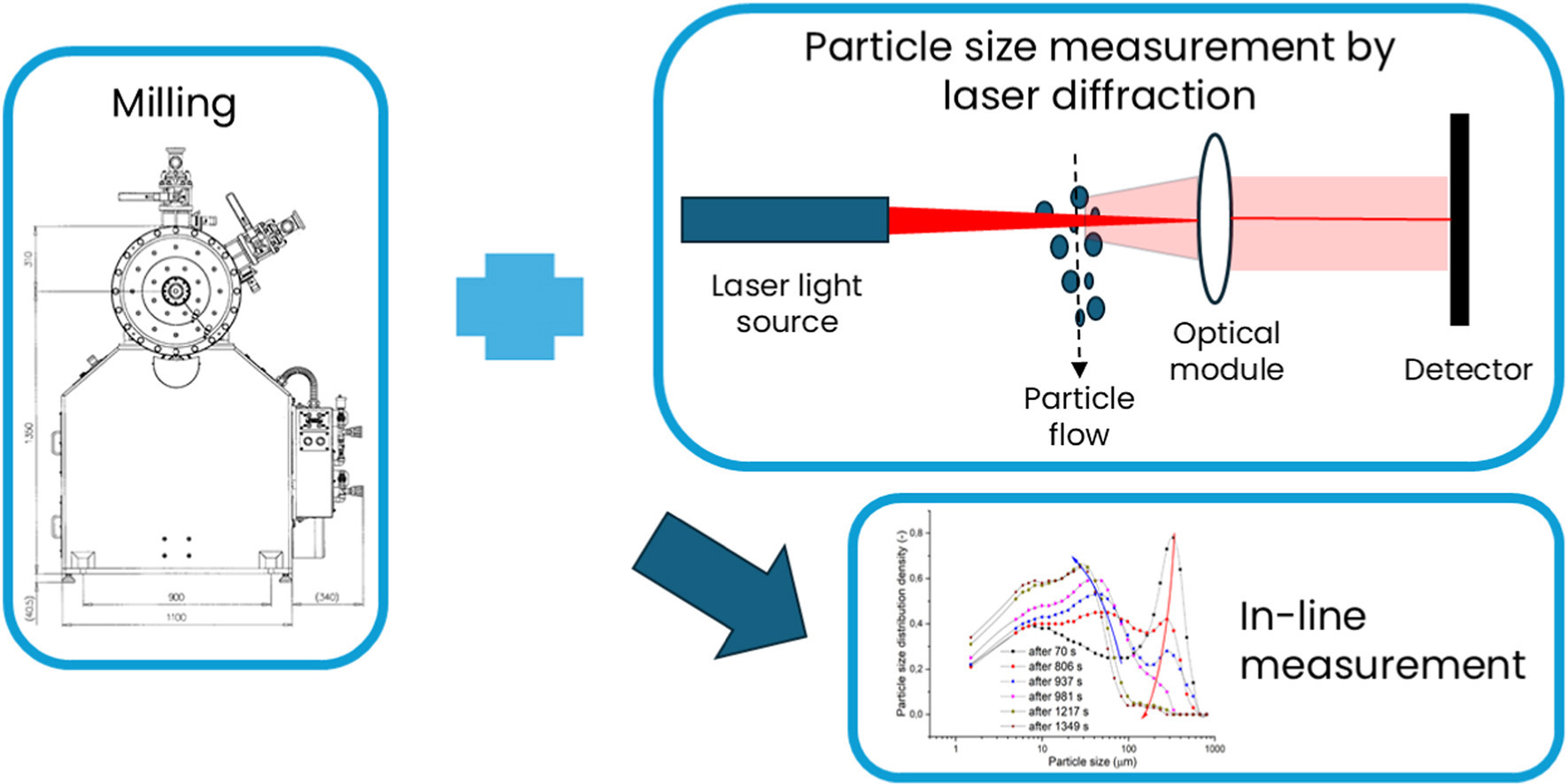
• The particle size during milling showed an unexpected evolution from a monomodal to a transient bi-modal distribution density.
• A solution for the return of analyzed powder to the mill was explored.
Abstract
For the processing or synthesis of solid state materials, ball milling has proven to be an effective method. However, due to the continuous agitation, the process is not suited for in-situ measurement techniques. In this work, a system for the in-line particle size measurement during milling has been developed and tested. The results show that milling of a sample with a certain mean particle size results in the production of a bimodal size distribution before a final product with the smaller particle size is produced. Moreover, a much faster than expected reduction in size was achieved, whose time evolution could otherwise only be followed by wasteful and time-consuming specimen analysis in intervals. In conclusion, in-line particle size measurement during milling is a promising technique to optimize the processing time or obtain a product powder in a certain condition.
Graphical abstract
Keywords
Particle size measurement; Laser scattering; MillingIn-line measurement; Scale up; Hydride
文章导读