
期刊文章
过刊浏览
- Volumes 108-119 (2025)
-
Volumes 96-107 (2025)
-
Volume 107
Pages 1-376 (December 2025)
-
Volume 106
Pages 1-336 (November 2025)
-
Volume 105
Pages 1-356 (October 2025)
-
Volume 104
Pages 1-332 (September 2025)
-
Volume 103
Pages 1-314 (August 2025)
-
Volume 102
Pages 1-276 (July 2025)
-
Volume 101
Pages 1-166 (June 2025)
-
Volume 100
Pages 1-256 (May 2025)
-
Volume 99
Pages 1-242 (April 2025)
-
Volume 98
Pages 1-288 (March 2025)
-
Volume 97
Pages 1-256 (February 2025)
-
Volume 96
Pages 1-340 (January 2025)
-
Volume 107
-
Volumes 84-95 (2024)
-
Volume 95
Pages 1-392 (December 2024)
-
Volume 94
Pages 1-400 (November 2024)
-
Volume 93
Pages 1-376 (October 2024)
-
Volume 92
Pages 1-316 (September 2024)
-
Volume 91
Pages 1-378 (August 2024)
-
Volume 90
Pages 1-580 (July 2024)
-
Volume 89
Pages 1-278 (June 2024)
-
Volume 88
Pages 1-350 (May 2024)
-
Volume 87
Pages 1-338 (April 2024)
-
Volume 86
Pages 1-312 (March 2024)
-
Volume 85
Pages 1-334 (February 2024)
-
Volume 84
Pages 1-308 (January 2024)
-
Volume 95
-
Volumes 72-83 (2023)
-
Volume 83
Pages 1-258 (December 2023)
-
Volume 82
Pages 1-204 (November 2023)
-
Volume 81
Pages 1-188 (October 2023)
-
Volume 80
Pages 1-202 (September 2023)
-
Volume 79
Pages 1-172 (August 2023)
-
Volume 78
Pages 1-146 (July 2023)
-
Volume 77
Pages 1-152 (June 2023)
-
Volume 76
Pages 1-176 (May 2023)
-
Volume 75
Pages 1-228 (April 2023)
-
Volume 74
Pages 1-200 (March 2023)
-
Volume 73
Pages 1-138 (February 2023)
-
Volume 72
Pages 1-144 (January 2023)
-
Volume 83
-
Volumes 60-71 (2022)
-
Volume 71
Pages 1-108 (December 2022)
-
Volume 70
Pages 1-106 (November 2022)
-
Volume 69
Pages 1-122 (October 2022)
-
Volume 68
Pages 1-124 (September 2022)
-
Volume 67
Pages 1-102 (August 2022)
-
Volume 66
Pages 1-112 (July 2022)
-
Volume 65
Pages 1-138 (June 2022)
-
Volume 64
Pages 1-186 (May 2022)
-
Volume 63
Pages 1-124 (April 2022)
-
Volume 62
Pages 1-104 (March 2022)
-
Volume 61
Pages 1-120 (February 2022)
-
Volume 60
Pages 1-124 (January 2022)
-
Volume 71
- Volumes 54-59 (2021)
- Volumes 48-53 (2020)
- Volumes 42-47 (2019)
- Volumes 36-41 (2018)
- Volumes 30-35 (2017)
- Volumes 24-29 (2016)
- Volumes 18-23 (2015)
- Volumes 12-17 (2014)
- Volume 11 (2013)
- Volume 10 (2012)
- Volume 9 (2011)
- Volume 8 (2010)
- Volume 7 (2009)
- Volume 6 (2008)
- Volume 5 (2007)
- Volume 4 (2006)
- Volume 3 (2005)
- Volume 2 (2004)
- Volume 1 (2003)
Volume 111
Tran, M. P., Le, N. Q.-K., Le, A. T., Bui, M. T., Vo, N. D. H., & Dang, T. M. D. (2026). Uniform superparamagnetic Fe3O4 nanoparticles synthesized via a hybrid coprecipitation–solvothermal method. Particuology, 111, 1-10. https://doi.org/10.1016/j.partic.2026.01.026
Uniform superparamagnetic Fe3O4 nanoparticles synthesized via a hybrid coprecipitation–solvothermal method
Minh Phuc Tran, Nhat Quang-Khoi Le, Anh Thi Le, Minh Thang Bui, Nguyen Da Huyen Vo, Thi My Dung Dang *
Advanced Materials Technology Institute, Vietnam National University Ho Chi Minh City, 700000, Viet Nam
10.1016/j.partic.2026.01.026
Volume 111,
April 2026,
Pages 1-10
Received 19 November 2025, Revised 19 January 2026, Accepted 22 January 2026, Available online 30 January 2026, Version of Record 5 February 2026.
E-mail:
dtmdung@vnuhcm.edu.vn
Highlights
• Hybrid synthesis yields uniform Fe3O4 NPs with a pure inverse spinel structure.
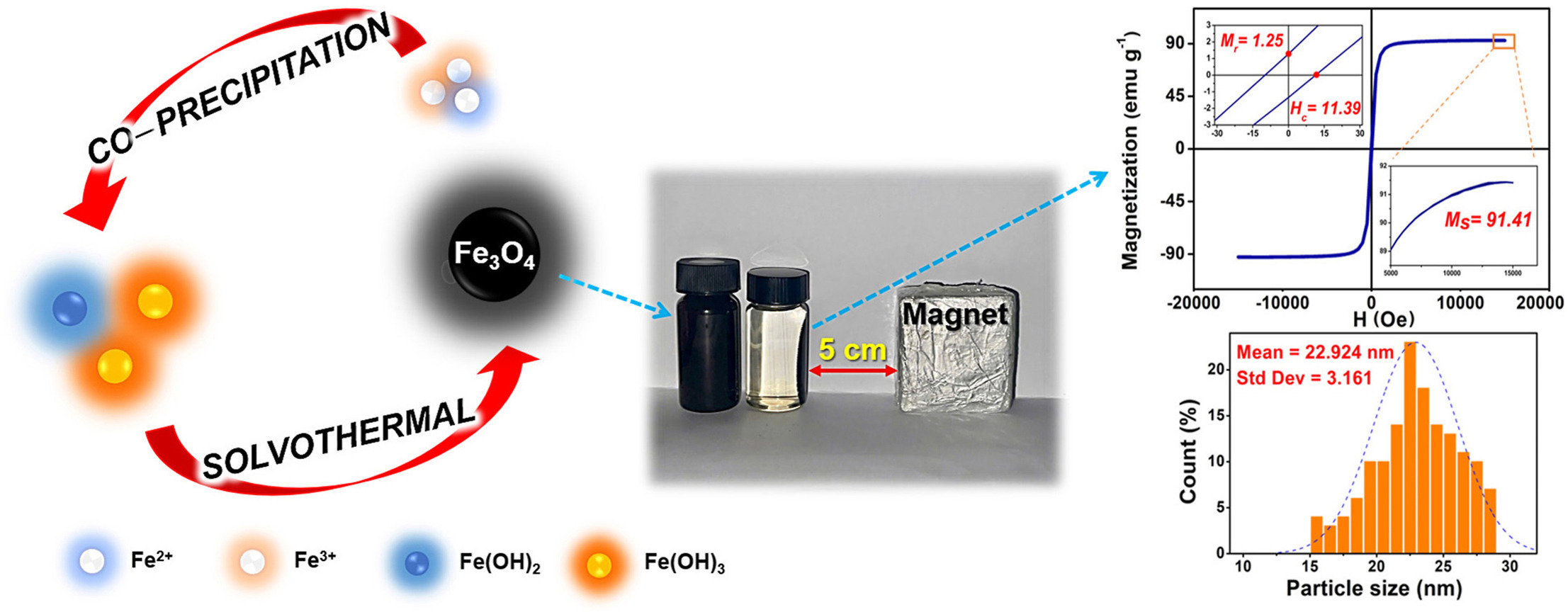
• Monodisperse spherical NPs achieved an average diameter of 22.92 ± 3.16 nm.
• High saturation magnetization of 91.41 emu g−1 with superparamagnetic behavior.
• Fe3O4 NPs show high structural and magnetic stability after organic dye exposure.
Abstract
Controlling the size while maintaining its superparamagnetic behavior has been one of the key challenges in synthesizing magnetite (Fe3O4) nanostructures. This study presents a facile hybrid coprecipitation–solvothermal route to synthesize uniform magnetite nanoparticles. X-ray diffraction and Raman spectroscopy confirmed the formation of phase-pure magnetite with an inverse spinel structure. Fourier-transform infrared spectroscopy and thermogravimetric analysis verified the presence of a stable polyvinylpyrrolidone coating on the particle surface. Field-emission scanning electron microscopy revealed spherical, well-dispersed Fe3O4 NPs with a narrow size distribution centered at 22.92 ± 3.16 nm. The NPs exhibited superior superparamagnetism at room temperature, characterized by a high saturation magnetization of 91.41 emu g−1, alongside negligible coercivity and remanence. Furthermore, stability experiments involving exposure to Rhodamine B under both dark and UV-light conditions revealed that the nanoparticles fully retained their structural integrity, original morphology, and magnetic sensitivity. Based on these results, our hybrid approach is believed to be a promising methodology for developing stable, high-performance magnetic systems for targeted drug delivery and wastewater remediation.
Graphical abstract
Keywords
Fe3O4 NPs; Superparamagnetic; Saturation magnetization; Coprecipitation-solvothermal
文章导读