
期刊文章
过刊浏览
- Volumes 108-119 (2025)
-
Volumes 96-107 (2025)
-
Volume 107
Pages 1-376 (December 2025)
-
Volume 106
Pages 1-336 (November 2025)
-
Volume 105
Pages 1-356 (October 2025)
-
Volume 104
Pages 1-332 (September 2025)
-
Volume 103
Pages 1-314 (August 2025)
-
Volume 102
Pages 1-276 (July 2025)
-
Volume 101
Pages 1-166 (June 2025)
-
Volume 100
Pages 1-256 (May 2025)
-
Volume 99
Pages 1-242 (April 2025)
-
Volume 98
Pages 1-288 (March 2025)
-
Volume 97
Pages 1-256 (February 2025)
-
Volume 96
Pages 1-340 (January 2025)
-
Volume 107
-
Volumes 84-95 (2024)
-
Volume 95
Pages 1-392 (December 2024)
-
Volume 94
Pages 1-400 (November 2024)
-
Volume 93
Pages 1-376 (October 2024)
-
Volume 92
Pages 1-316 (September 2024)
-
Volume 91
Pages 1-378 (August 2024)
-
Volume 90
Pages 1-580 (July 2024)
-
Volume 89
Pages 1-278 (June 2024)
-
Volume 88
Pages 1-350 (May 2024)
-
Volume 87
Pages 1-338 (April 2024)
-
Volume 86
Pages 1-312 (March 2024)
-
Volume 85
Pages 1-334 (February 2024)
-
Volume 84
Pages 1-308 (January 2024)
-
Volume 95
-
Volumes 72-83 (2023)
-
Volume 83
Pages 1-258 (December 2023)
-
Volume 82
Pages 1-204 (November 2023)
-
Volume 81
Pages 1-188 (October 2023)
-
Volume 80
Pages 1-202 (September 2023)
-
Volume 79
Pages 1-172 (August 2023)
-
Volume 78
Pages 1-146 (July 2023)
-
Volume 77
Pages 1-152 (June 2023)
-
Volume 76
Pages 1-176 (May 2023)
-
Volume 75
Pages 1-228 (April 2023)
-
Volume 74
Pages 1-200 (March 2023)
-
Volume 73
Pages 1-138 (February 2023)
-
Volume 72
Pages 1-144 (January 2023)
-
Volume 83
-
Volumes 60-71 (2022)
-
Volume 71
Pages 1-108 (December 2022)
-
Volume 70
Pages 1-106 (November 2022)
-
Volume 69
Pages 1-122 (October 2022)
-
Volume 68
Pages 1-124 (September 2022)
-
Volume 67
Pages 1-102 (August 2022)
-
Volume 66
Pages 1-112 (July 2022)
-
Volume 65
Pages 1-138 (June 2022)
-
Volume 64
Pages 1-186 (May 2022)
-
Volume 63
Pages 1-124 (April 2022)
-
Volume 62
Pages 1-104 (March 2022)
-
Volume 61
Pages 1-120 (February 2022)
-
Volume 60
Pages 1-124 (January 2022)
-
Volume 71
- Volumes 54-59 (2021)
- Volumes 48-53 (2020)
- Volumes 42-47 (2019)
- Volumes 36-41 (2018)
- Volumes 30-35 (2017)
- Volumes 24-29 (2016)
- Volumes 18-23 (2015)
- Volumes 12-17 (2014)
- Volume 11 (2013)
- Volume 10 (2012)
- Volume 9 (2011)
- Volume 8 (2010)
- Volume 7 (2009)
- Volume 6 (2008)
- Volume 5 (2007)
- Volume 4 (2006)
- Volume 3 (2005)
- Volume 2 (2004)
- Volume 1 (2003)
Volume 111
Abd Khalil, A. T., Mohamad Yusop, M. F., & Ahmad, M. A. (2026). Remediation of oxytetracycline-contaminated aqueous solution utilizing functionalized coffee ground waste-derived activated carbon. Particuology, 111, 11-26. https://doi.org/10.1016/j.partic.2026.01.027
Remediation of oxytetracycline-contaminated aqueous solution utilizing functionalized coffee ground waste-derived activated carbon
Afiqah Tasneem Abd Khalil, Mohamad Firdaus Mohamad Yusop *, Mohd Azmier Ahmad *
School of Chemical Engineering, Engineering Campus, Universiti Sains Malaysia, Nibong Tebal, 14300, Penang, Malaysia
10.1016/j.partic.2026.01.027
Volume 111,
April 2026,
Pages 11-26
Received 11 September 2025, Revised 14 January 2026, Accepted 21 January 2026, Available online 3 February 2026, Version of Record 9 February 2026.
E-mail:
mfirdausyusop@yahoo.com; chazmier@usm.my
Highlights
• Copper-modified activated carbon was synthesized from coffee ground waste using microwave-assisted CO2 activation.
• Optimized parameters (616W, 4 min and 1 g/g IR) achieved 25.32 mg/g oxytetracycline uptake and 80.68% yield.
• Adsorption kinetics followed a pseudo-second order model, indicating dominance of chemisorption.
• Langmuir isotherm best described the monolayer adsorption with enhanced uptake at higher temperatures.
• Thermodynamic results confirmed the process was spontaneous and endothermic, favoring higher solution temperatures.
Abstract
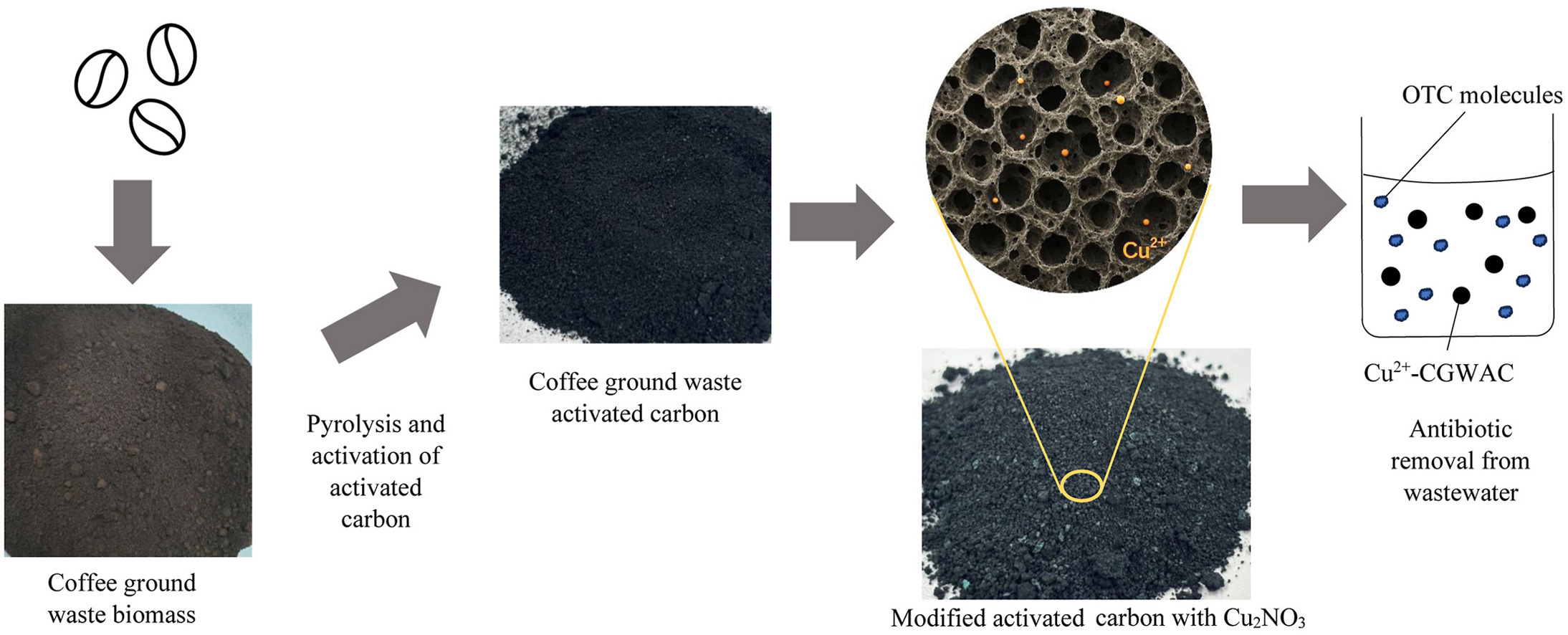
The removal of trace concentrations of oxytetracycline (OTC), a stable antibiotic prevalent in aquatic environments represents a significant environmental challenge. This study effectively removed it by utilizing a cost-effective copper-modified coffee ground waste activated carbon (Cu2+-CGWAC), designed specifically for an enhanced adsorption of dilute pharmaceutical pollutants. The modified adsorbent was synthesized via a simplified method involving microwave-assisted activation with CO2 gasification. Optimization via response surface methodology (RSM) has identified 616 W radiation power, 4 min radiation time and 1.00 g/g modification impregnation ratio (IR) as optimal conditions. The resulting adsorbent yielded 23.04 mg/g OTC uptake (actual: 24.88 mg/g; error: 7.40 %) and 75.86 % yield (actual: 80.52 %; error: 5.79 %). Cu2+-CGWAC adsorbent exhibited a high surface area (904.56 m2/g by BET analysis) and pore volume (0.3711 cm3/g), with carboxyl group functionalization. Subsequently, batch adsorption analysis was conducted to study the effect of adsorbent dosage, contact time, OTC initial concentration, OTC solution temperature and pH on the OTC removal, achieving a complete removal (100%) with maximum adsorption uptake of 30 mg/g for low concentration OTC solutions. Adsorption followed pseudo-second order (PSO) kinetics model and Freundlich isotherm, indicating heterogeneous multilayer adsorption behaviour with RMSE of 0.80 and minimal error of 7.51 %. Thermodynamic analysis suggested a spontaneous and endothermic process, with positive values of entropy change (0.37 kJ/mol K), enthalpy change (81.17 kJ/mol) and Arrhenius activation energy value (8.76 kJ/mol). The tailored Cu2+-CGWAC demonstrates advancement in a simplified adsorbent design, outlining a cost-effective, robust and high-performance potential for dilute pharmaceutical wastewater treatment.
Graphical abstract
Keywords
Activated carbon; Oxytetracycline; Coffee ground waste; Optimization; Microwave activation; Metal-functionalized carbon
文章导读