
期刊文章
过刊浏览
- Volumes 108-119 (2025)
-
Volumes 96-107 (2025)
-
Volume 107
Pages 1-376 (December 2025)
-
Volume 106
Pages 1-336 (November 2025)
-
Volume 105
Pages 1-356 (October 2025)
-
Volume 104
Pages 1-332 (September 2025)
-
Volume 103
Pages 1-314 (August 2025)
-
Volume 102
Pages 1-276 (July 2025)
-
Volume 101
Pages 1-166 (June 2025)
-
Volume 100
Pages 1-256 (May 2025)
-
Volume 99
Pages 1-242 (April 2025)
-
Volume 98
Pages 1-288 (March 2025)
-
Volume 97
Pages 1-256 (February 2025)
-
Volume 96
Pages 1-340 (January 2025)
-
Volume 107
-
Volumes 84-95 (2024)
-
Volume 95
Pages 1-392 (December 2024)
-
Volume 94
Pages 1-400 (November 2024)
-
Volume 93
Pages 1-376 (October 2024)
-
Volume 92
Pages 1-316 (September 2024)
-
Volume 91
Pages 1-378 (August 2024)
-
Volume 90
Pages 1-580 (July 2024)
-
Volume 89
Pages 1-278 (June 2024)
-
Volume 88
Pages 1-350 (May 2024)
-
Volume 87
Pages 1-338 (April 2024)
-
Volume 86
Pages 1-312 (March 2024)
-
Volume 85
Pages 1-334 (February 2024)
-
Volume 84
Pages 1-308 (January 2024)
-
Volume 95
-
Volumes 72-83 (2023)
-
Volume 83
Pages 1-258 (December 2023)
-
Volume 82
Pages 1-204 (November 2023)
-
Volume 81
Pages 1-188 (October 2023)
-
Volume 80
Pages 1-202 (September 2023)
-
Volume 79
Pages 1-172 (August 2023)
-
Volume 78
Pages 1-146 (July 2023)
-
Volume 77
Pages 1-152 (June 2023)
-
Volume 76
Pages 1-176 (May 2023)
-
Volume 75
Pages 1-228 (April 2023)
-
Volume 74
Pages 1-200 (March 2023)
-
Volume 73
Pages 1-138 (February 2023)
-
Volume 72
Pages 1-144 (January 2023)
-
Volume 83
-
Volumes 60-71 (2022)
-
Volume 71
Pages 1-108 (December 2022)
-
Volume 70
Pages 1-106 (November 2022)
-
Volume 69
Pages 1-122 (October 2022)
-
Volume 68
Pages 1-124 (September 2022)
-
Volume 67
Pages 1-102 (August 2022)
-
Volume 66
Pages 1-112 (July 2022)
-
Volume 65
Pages 1-138 (June 2022)
-
Volume 64
Pages 1-186 (May 2022)
-
Volume 63
Pages 1-124 (April 2022)
-
Volume 62
Pages 1-104 (March 2022)
-
Volume 61
Pages 1-120 (February 2022)
-
Volume 60
Pages 1-124 (January 2022)
-
Volume 71
- Volumes 54-59 (2021)
- Volumes 48-53 (2020)
- Volumes 42-47 (2019)
- Volumes 36-41 (2018)
- Volumes 30-35 (2017)
- Volumes 24-29 (2016)
- Volumes 18-23 (2015)
- Volumes 12-17 (2014)
- Volume 11 (2013)
- Volume 10 (2012)
- Volume 9 (2011)
- Volume 8 (2010)
- Volume 7 (2009)
- Volume 6 (2008)
- Volume 5 (2007)
- Volume 4 (2006)
- Volume 3 (2005)
- Volume 2 (2004)
- Volume 1 (2003)
Volume 111
Li, Y., Liao, N., Wu, C., Liu, R., Wu, J., Lin, Z., & Wu, H. (2026). Effects of different grinding media on the interfacial properties and flotation mechanism of lepidolite grinding products. Particuology, 111, 27-37. https://doi.org/10.1016/j.partic.2026.01.029
Effects of different grinding media on the interfacial properties and flotation mechanism of lepidolite grinding products
Yuqing Li a, Ningning Liao a b c *, Caibin Wu a b c *, Riqian Liu a, Ji Wu a, Zepeng Lin a, Haowen Wu a
a School of Mining and Environmental Engineering, Jiangxi University of Science and Technology, Ganzhou, 341000, China
b Jiangxi Provincial Key Laboratory of Low-Carbon Processing and Utilization of Strategic Metal Mineral Resources, Ganzhou, 341000, China
c Yichun Lithium New Energy Industry Research Institute, Jiangxi University of Science and Technology, Yichun, 336023, China
10.1016/j.partic.2026.01.029
Volume 111,
April 2026,
Pages 27-37
Received 2 December 2025, Revised 11 January 2026, Accepted 27 January 2026, Available online 4 February 2026, Version of Record 9 February 2026.
E-mail:
liaoningning@jxust.edu.cn; caibin.wu@jxust.edu.cn
Highlights
• Demonstration that ceramic grinding minimizes surface iron contamination.
• Elucidation of how grinding media modify surface chemistry and particle morphology.
• Steel grinding boosts surface hydrophilicity, reducing collector adsorption.
• Three grinding methods guide lepidolite flotation theory.
Abstract
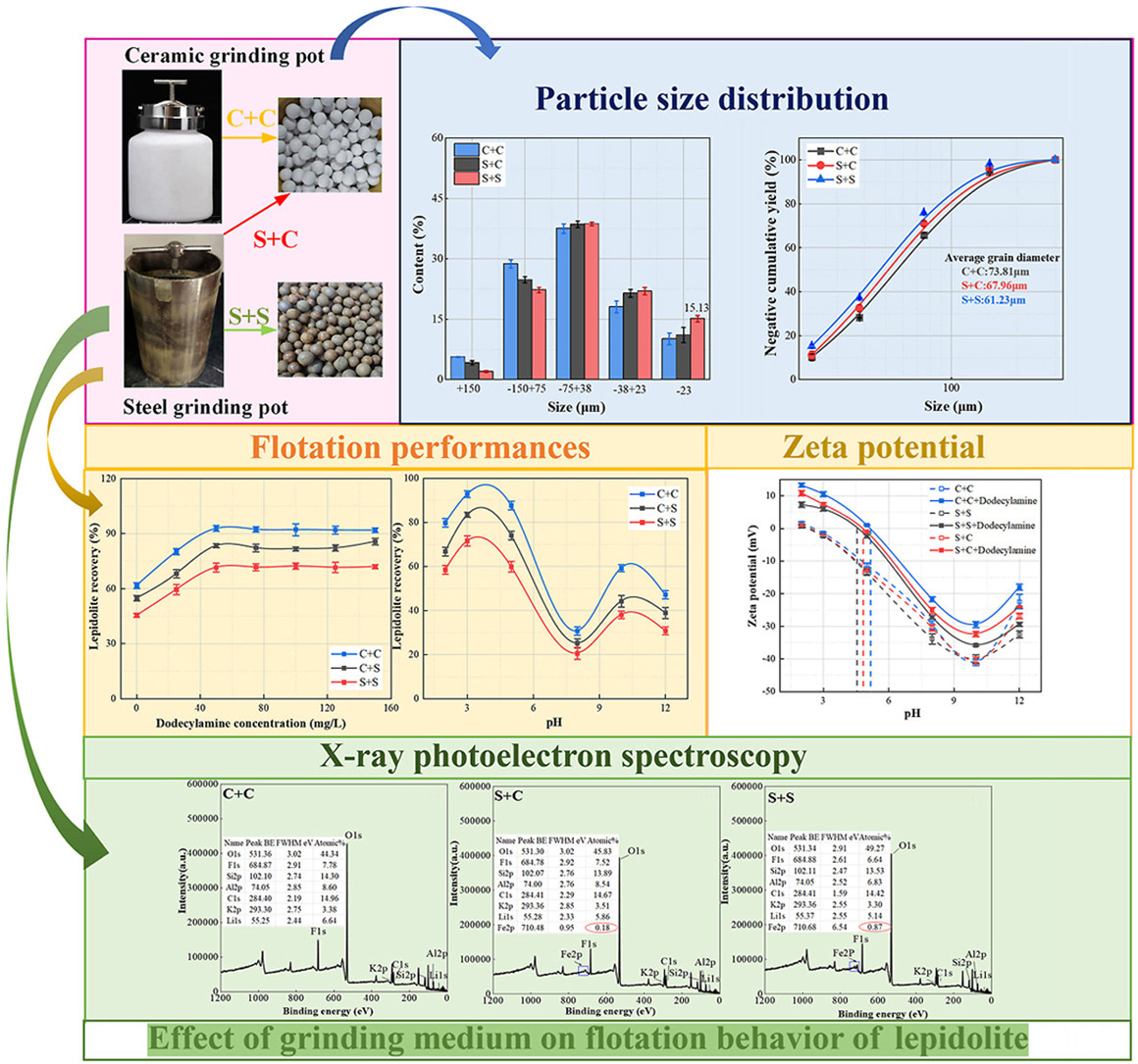
Grinding plays a fundamental role in determining flotation efficiency, as the morphology of grinding media directly influences mineral particle morphology and surface properties. This research systematically examines the impact of mill barrel materials and grinding media types on the flotation performance of lepidolite through comprehensive multi-scale characterization. Analytical results demonstrate that compared to conventional steel ball milling, ceramic ball milling generates products with coarser particle size distribution and substantially reduces the content of fine particles below 23 μm. Particularly noteworthy is the configuration combining ceramic mill barrel with ceramic balls (C + C), which effectively promotes the exposure of {001} cleavage planes, thereby significantly enhancing collector adsorption on mineral surfaces. SEM-EDS characterization identified substantial iron-rich flocculent coatings on particle surfaces processed in steel mill environments, whether using ceramic balls (S + C) or steel balls (S + S), which considerably hindered effective reagent adsorption. The C + C ground products exhibited the most pronounced positive potential shift upon collector addition, coupled with the lowest surface oxidation degree and minimal FeOOH formation. Comparative flotation tests ultimately verified that the C + C grinding approach enhanced lepidolite recovery by 10-20 % points. This work elucidates the interfacial mechanism through which media materials regulate cleavage plane exposure and iron contamination, providing a novel theoretical framework for media selection in silicate mineral processing. The findings offer crucial theoretical and practical guidance for optimizing grinding operations to improve lithium resource efficiency.
Graphical abstract
Keywords
Lepidolite; Grinding medium; Ground products; Flotation; Surface properties
文章导读