
期刊文章
过刊浏览
- Volumes 108-119 (2025)
-
Volumes 96-107 (2025)
-
Volume 107
Pages 1-376 (December 2025)
-
Volume 106
Pages 1-336 (November 2025)
-
Volume 105
Pages 1-356 (October 2025)
-
Volume 104
Pages 1-332 (September 2025)
-
Volume 103
Pages 1-314 (August 2025)
-
Volume 102
Pages 1-276 (July 2025)
-
Volume 101
Pages 1-166 (June 2025)
-
Volume 100
Pages 1-256 (May 2025)
-
Volume 99
Pages 1-242 (April 2025)
-
Volume 98
Pages 1-288 (March 2025)
-
Volume 97
Pages 1-256 (February 2025)
-
Volume 96
Pages 1-340 (January 2025)
-
Volume 107
-
Volumes 84-95 (2024)
-
Volume 95
Pages 1-392 (December 2024)
-
Volume 94
Pages 1-400 (November 2024)
-
Volume 93
Pages 1-376 (October 2024)
-
Volume 92
Pages 1-316 (September 2024)
-
Volume 91
Pages 1-378 (August 2024)
-
Volume 90
Pages 1-580 (July 2024)
-
Volume 89
Pages 1-278 (June 2024)
-
Volume 88
Pages 1-350 (May 2024)
-
Volume 87
Pages 1-338 (April 2024)
-
Volume 86
Pages 1-312 (March 2024)
-
Volume 85
Pages 1-334 (February 2024)
-
Volume 84
Pages 1-308 (January 2024)
-
Volume 95
-
Volumes 72-83 (2023)
-
Volume 83
Pages 1-258 (December 2023)
-
Volume 82
Pages 1-204 (November 2023)
-
Volume 81
Pages 1-188 (October 2023)
-
Volume 80
Pages 1-202 (September 2023)
-
Volume 79
Pages 1-172 (August 2023)
-
Volume 78
Pages 1-146 (July 2023)
-
Volume 77
Pages 1-152 (June 2023)
-
Volume 76
Pages 1-176 (May 2023)
-
Volume 75
Pages 1-228 (April 2023)
-
Volume 74
Pages 1-200 (March 2023)
-
Volume 73
Pages 1-138 (February 2023)
-
Volume 72
Pages 1-144 (January 2023)
-
Volume 83
-
Volumes 60-71 (2022)
-
Volume 71
Pages 1-108 (December 2022)
-
Volume 70
Pages 1-106 (November 2022)
-
Volume 69
Pages 1-122 (October 2022)
-
Volume 68
Pages 1-124 (September 2022)
-
Volume 67
Pages 1-102 (August 2022)
-
Volume 66
Pages 1-112 (July 2022)
-
Volume 65
Pages 1-138 (June 2022)
-
Volume 64
Pages 1-186 (May 2022)
-
Volume 63
Pages 1-124 (April 2022)
-
Volume 62
Pages 1-104 (March 2022)
-
Volume 61
Pages 1-120 (February 2022)
-
Volume 60
Pages 1-124 (January 2022)
-
Volume 71
- Volumes 54-59 (2021)
- Volumes 48-53 (2020)
- Volumes 42-47 (2019)
- Volumes 36-41 (2018)
- Volumes 30-35 (2017)
- Volumes 24-29 (2016)
- Volumes 18-23 (2015)
- Volumes 12-17 (2014)
- Volume 11 (2013)
- Volume 10 (2012)
- Volume 9 (2011)
- Volume 8 (2010)
- Volume 7 (2009)
- Volume 6 (2008)
- Volume 5 (2007)
- Volume 4 (2006)
- Volume 3 (2005)
- Volume 2 (2004)
- Volume 1 (2003)
Volume 111
Jiang, F., Hu, B., Zhang, X., Zhang, Y., Hu, S., Li, J., . . . Liu, K. (2026). Preparation of micron-nano coal particles by wet grinding in methanol. Particuology, 111, 38-49. https://doi.org/10.1016/j.partic.2026.01.028
Preparation of micron-nano coal particles by wet grinding in methanol
Fenghao Jiang a, Biao Hu a, Xusheng Zhang a, Yifan Zhang a, Shunxuan Hu b, Junguo Li b, Changning Wu b c *, Ke Liu a b *
a Department of Chemistry, Southern University of Science and Technology, Shenzhen, 518055, China
b School of Innovation and Entrepreneurship, Southern University of Science and Technology, Shenzhen, 518055, China
c Beijing Petrochemical Engineering Co., Ltd., Beijing, 100107, China
10.1016/j.partic.2026.01.028
Volume 111,
April 2026,
Pages 38-49
Received 16 December 2025, Revised 24 January 2026, Accepted 28 January 2026, Available online 3 February 2026, Version of Record 11 February 2026.
E-mail:
wucn@sustech.edu.cn; liuk@sustech.edu.cn
Highlights
• Wet grinding in methanol produced micro-to nanoscale coal particles.
• Comminution limit was not reached, despite submicron products.
• Stress-induced amorphization progressively damaged the crystalline structure.
• Aromatics rings were cleavaged and rearranged under continuous high-energy stress.
• Methanol-derived surface solvation shells suppressed particle agglomeration.
Abstract
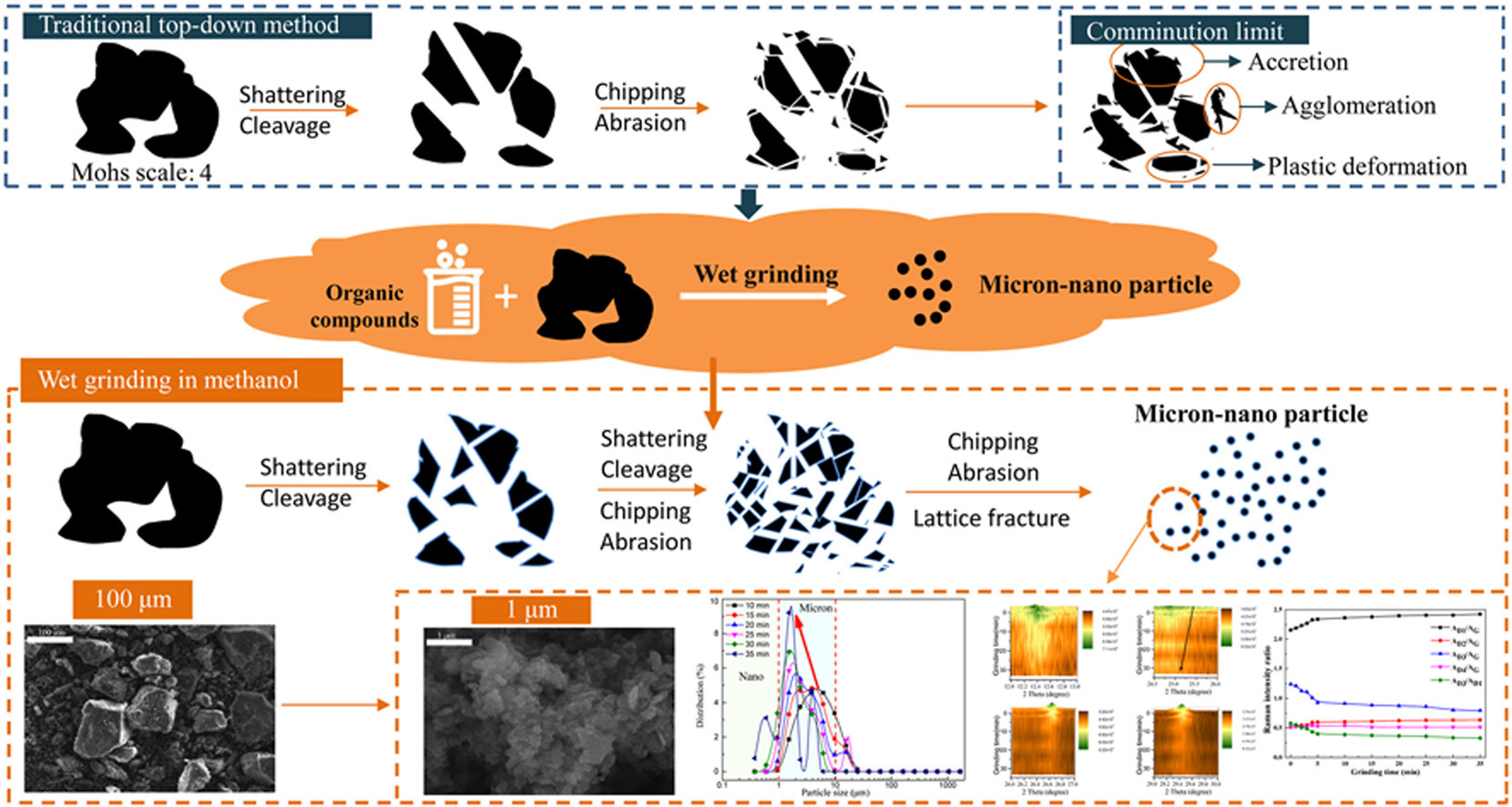
Limited by comminution limit, the top-down method is a time-consuming and high energy demands process to produce ultrafine and submicron coal. The feasibility of the wet grinding in methanol was probed, and the breakage mechanism was investigated from the macroscopic, microstructure, crystal, and molecular perspectives in this study. The results show that at 35 min grinding time, the coal’s d50 size decreased from 23.20 to 1.60 μm. Therefore, wet grinding in methanol is an efficient method to produce ultrafine coal. Moreover, with the increase of grinding time, the BET specific surface area of the sample increase, indicating that the comminution limit is not reached. Moreover, the characteristic diffraction peak intensity of kaolinite, amorphous carbon, quartz, and calcite of the sample decrease until they completely disappear due to destroy the crystal structure by the unstable energy on the lattice surface. The aromatics rings are cleaved and rearranged to form aromatic rings with radicals in continuous high-energy stress. The methanol was grafted onto the aromatic rings with radicals. The methanol shell may be easily built on the outside of coal particles due to increasing these side chains with compatibility with methanol. The agglomeration of particles is hindered, and thus the ultrafine grinding is promoted.
Graphical abstract
Keywords
Wet grinding; Methanol; Ultrafine coal particle; Breakage mechanism
文章导读