
期刊文章
过刊浏览
- Volumes 108-119 (2025)
-
Volumes 96-107 (2025)
-
Volume 107
Pages 1-376 (December 2025)
-
Volume 106
Pages 1-336 (November 2025)
-
Volume 105
Pages 1-356 (October 2025)
-
Volume 104
Pages 1-332 (September 2025)
-
Volume 103
Pages 1-314 (August 2025)
-
Volume 102
Pages 1-276 (July 2025)
-
Volume 101
Pages 1-166 (June 2025)
-
Volume 100
Pages 1-256 (May 2025)
-
Volume 99
Pages 1-242 (April 2025)
-
Volume 98
Pages 1-288 (March 2025)
-
Volume 97
Pages 1-256 (February 2025)
-
Volume 96
Pages 1-340 (January 2025)
-
Volume 107
-
Volumes 84-95 (2024)
-
Volume 95
Pages 1-392 (December 2024)
-
Volume 94
Pages 1-400 (November 2024)
-
Volume 93
Pages 1-376 (October 2024)
-
Volume 92
Pages 1-316 (September 2024)
-
Volume 91
Pages 1-378 (August 2024)
-
Volume 90
Pages 1-580 (July 2024)
-
Volume 89
Pages 1-278 (June 2024)
-
Volume 88
Pages 1-350 (May 2024)
-
Volume 87
Pages 1-338 (April 2024)
-
Volume 86
Pages 1-312 (March 2024)
-
Volume 85
Pages 1-334 (February 2024)
-
Volume 84
Pages 1-308 (January 2024)
-
Volume 95
-
Volumes 72-83 (2023)
-
Volume 83
Pages 1-258 (December 2023)
-
Volume 82
Pages 1-204 (November 2023)
-
Volume 81
Pages 1-188 (October 2023)
-
Volume 80
Pages 1-202 (September 2023)
-
Volume 79
Pages 1-172 (August 2023)
-
Volume 78
Pages 1-146 (July 2023)
-
Volume 77
Pages 1-152 (June 2023)
-
Volume 76
Pages 1-176 (May 2023)
-
Volume 75
Pages 1-228 (April 2023)
-
Volume 74
Pages 1-200 (March 2023)
-
Volume 73
Pages 1-138 (February 2023)
-
Volume 72
Pages 1-144 (January 2023)
-
Volume 83
-
Volumes 60-71 (2022)
-
Volume 71
Pages 1-108 (December 2022)
-
Volume 70
Pages 1-106 (November 2022)
-
Volume 69
Pages 1-122 (October 2022)
-
Volume 68
Pages 1-124 (September 2022)
-
Volume 67
Pages 1-102 (August 2022)
-
Volume 66
Pages 1-112 (July 2022)
-
Volume 65
Pages 1-138 (June 2022)
-
Volume 64
Pages 1-186 (May 2022)
-
Volume 63
Pages 1-124 (April 2022)
-
Volume 62
Pages 1-104 (March 2022)
-
Volume 61
Pages 1-120 (February 2022)
-
Volume 60
Pages 1-124 (January 2022)
-
Volume 71
- Volumes 54-59 (2021)
- Volumes 48-53 (2020)
- Volumes 42-47 (2019)
- Volumes 36-41 (2018)
- Volumes 30-35 (2017)
- Volumes 24-29 (2016)
- Volumes 18-23 (2015)
- Volumes 12-17 (2014)
- Volume 11 (2013)
- Volume 10 (2012)
- Volume 9 (2011)
- Volume 8 (2010)
- Volume 7 (2009)
- Volume 6 (2008)
- Volume 5 (2007)
- Volume 4 (2006)
- Volume 3 (2005)
- Volume 2 (2004)
- Volume 1 (2003)
Volume 111
Chen, H., Wu, T., Zhang, J., Fan, X., Ju, W., Chen, J., . . . Kong, L. (2026). Anion coordination strength mediated aluminum corrosion for high-voltage lithium-metal batteries. Particuology, 111, 50-57. https://doi.org/10.1016/j.partic.2026.01.019
Anion coordination strength mediated aluminum corrosion for high-voltage lithium-metal batteries
Han Chen a, Tong Wu a, Jinhao Zhang a, Xiaozhong Fan a, Wenping Ju a, Jinxiu Chen a, Lin Zhu b *, Haoxiong Nan c, Shujing Ni d, Peng Li e *, Long Kong a *
a Institute of Flexible Electronics, Northwestern Polytechnical University, Xi'an, 710129, China
b Air Defense and Antimissile School, Air Force Engineering University, Xi'an, 710100, China
c School of Chemistry and Chemical Engineering, Hainan University, Haikou, 570228, China
d Digital Energy Research Institute, LinchrNewEnergy Technology Co., Ltd., Xi'an, 710100, China
e CATARC New Energy Vehicle Research and Inspection Center (Tianjin) Co., Ltd., Tianjin, 300300, China
10.1016/j.partic.2026.01.019
Volume 111,
April 2026,
Pages 50-57
Received 30 December 2025, Revised 12 January 2026, Accepted 19 January 2026, Available online 27 January 2026, Version of Record 14 February 2026.
E-mail:
zhulin_chem@126.com; lipeng2024@catarc.ac.cn; iamlkong@nwpu.edu.cn
Highlights
• Inhibiting aluminum corrosion from the perspective of solvation structures.
• DFOB− anions can effectively reduce the concentration of free anions in the electrolyte.
• LiDFOB-based electrolyte solvation structure endures cell operating over 5.5 V.
• An approach of broadens the options of electrolyte is constructed.
Abstract
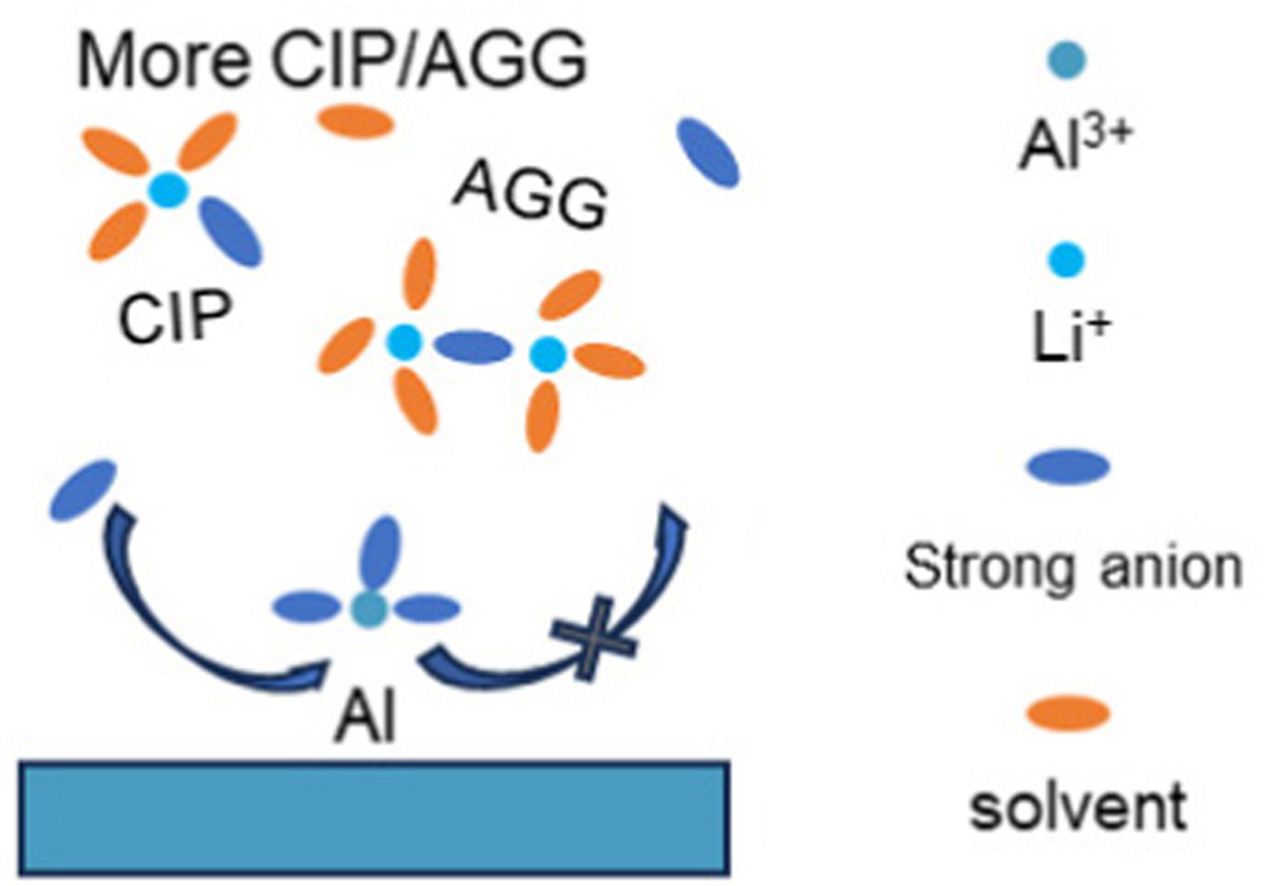
While high-voltage lithium-metal batteries are severely hindered limitations of active materials and electrolytes, the corrosion of aluminum (Al) current collector attract mild attention. In this work, the Al corrosion behavior mediated by anion is probed from the electrolyte solvation chemistry. The strong coordination strength of difluoro (oxalato)borate (DFOB−) anion effectively binds with Al3+, forming the contact ion pairs and aggregates structures. Compare with solvent-separated ion pairs, these structures with Al3+ complex deposit more readily on Al surface, exhibiting excellent capability to inhibit Al corrosion. The performance of Li||NCM622 cells employing lithium salts that inhibit Al corrosion is improved. This result confirms the detrimental impact of Al corrosion on battery performance under high-voltage cell operation, contributing to a deeper understanding of that the strong coordination strength anion inhibits Al corrosion and provides valuable insights for designing electrolytes for high-voltage batteries.
Graphical abstract
Keywords
High voltage; Anion coordination strength; Al corrosion; Solvation structure; Lithium metal battery
文章导读