
期刊文章
过刊浏览
- Volumes 108-119 (2025)
-
Volumes 96-107 (2025)
-
Volume 107
Pages 1-376 (December 2025)
-
Volume 106
Pages 1-336 (November 2025)
-
Volume 105
Pages 1-356 (October 2025)
-
Volume 104
Pages 1-332 (September 2025)
-
Volume 103
Pages 1-314 (August 2025)
-
Volume 102
Pages 1-276 (July 2025)
-
Volume 101
Pages 1-166 (June 2025)
-
Volume 100
Pages 1-256 (May 2025)
-
Volume 99
Pages 1-242 (April 2025)
-
Volume 98
Pages 1-288 (March 2025)
-
Volume 97
Pages 1-256 (February 2025)
-
Volume 96
Pages 1-340 (January 2025)
-
Volume 107
-
Volumes 84-95 (2024)
-
Volume 95
Pages 1-392 (December 2024)
-
Volume 94
Pages 1-400 (November 2024)
-
Volume 93
Pages 1-376 (October 2024)
-
Volume 92
Pages 1-316 (September 2024)
-
Volume 91
Pages 1-378 (August 2024)
-
Volume 90
Pages 1-580 (July 2024)
-
Volume 89
Pages 1-278 (June 2024)
-
Volume 88
Pages 1-350 (May 2024)
-
Volume 87
Pages 1-338 (April 2024)
-
Volume 86
Pages 1-312 (March 2024)
-
Volume 85
Pages 1-334 (February 2024)
-
Volume 84
Pages 1-308 (January 2024)
-
Volume 95
-
Volumes 72-83 (2023)
-
Volume 83
Pages 1-258 (December 2023)
-
Volume 82
Pages 1-204 (November 2023)
-
Volume 81
Pages 1-188 (October 2023)
-
Volume 80
Pages 1-202 (September 2023)
-
Volume 79
Pages 1-172 (August 2023)
-
Volume 78
Pages 1-146 (July 2023)
-
Volume 77
Pages 1-152 (June 2023)
-
Volume 76
Pages 1-176 (May 2023)
-
Volume 75
Pages 1-228 (April 2023)
-
Volume 74
Pages 1-200 (March 2023)
-
Volume 73
Pages 1-138 (February 2023)
-
Volume 72
Pages 1-144 (January 2023)
-
Volume 83
-
Volumes 60-71 (2022)
-
Volume 71
Pages 1-108 (December 2022)
-
Volume 70
Pages 1-106 (November 2022)
-
Volume 69
Pages 1-122 (October 2022)
-
Volume 68
Pages 1-124 (September 2022)
-
Volume 67
Pages 1-102 (August 2022)
-
Volume 66
Pages 1-112 (July 2022)
-
Volume 65
Pages 1-138 (June 2022)
-
Volume 64
Pages 1-186 (May 2022)
-
Volume 63
Pages 1-124 (April 2022)
-
Volume 62
Pages 1-104 (March 2022)
-
Volume 61
Pages 1-120 (February 2022)
-
Volume 60
Pages 1-124 (January 2022)
-
Volume 71
- Volumes 54-59 (2021)
- Volumes 48-53 (2020)
- Volumes 42-47 (2019)
- Volumes 36-41 (2018)
- Volumes 30-35 (2017)
- Volumes 24-29 (2016)
- Volumes 18-23 (2015)
- Volumes 12-17 (2014)
- Volume 11 (2013)
- Volume 10 (2012)
- Volume 9 (2011)
- Volume 8 (2010)
- Volume 7 (2009)
- Volume 6 (2008)
- Volume 5 (2007)
- Volume 4 (2006)
- Volume 3 (2005)
- Volume 2 (2004)
- Volume 1 (2003)
Volume 111
Liu, S., Zhang, Z., Wang, J., Tan, W., Wang, Y., & Hu, S. (2026). Tuning the multi-phase flow characteristics of underwater supersonic gas jet with inertial solid particles. Particuology, 111, 91-104. https://doi.org/10.1016/j.partic.2026.02.003
Tuning the multi-phase flow characteristics of underwater supersonic gas jet with inertial solid particles
Shuyuan Liu a *, Zhanzhi Zhang a, Jiannan Wang a, Wei Tan a, Yin Wang b *, Songqi Hu a
a National Key Laboratory Solid Rocket Propulsion, Northwestern Polytechnical University, Xi'an, 710072, China
b Xi'an Changfeng Electromechanical Institute, Xi'an, 710065, China
10.1016/j.partic.2026.02.003
Volume 111,
April 2026,
Pages 91-104
Received 1 December 2025, Revised 30 January 2026, Accepted 3 February 2026, Available online 12 February 2026, Version of Record 17 February 2026.
E-mail:
liushuyuan@nwpu.edu.cn; wongyin@mail.nwpu.edu.cn
Highlights
• Established multi-phase flow model for underwater supersonic gas jet.
• Obtained flow structure evolution behaviors of the underwater gas jet.
• Revealed the effect of underwater depth on multiphase flow properties.
• Identified the tuning effect of inertial solid particles on jet fluctuations.
Abstract
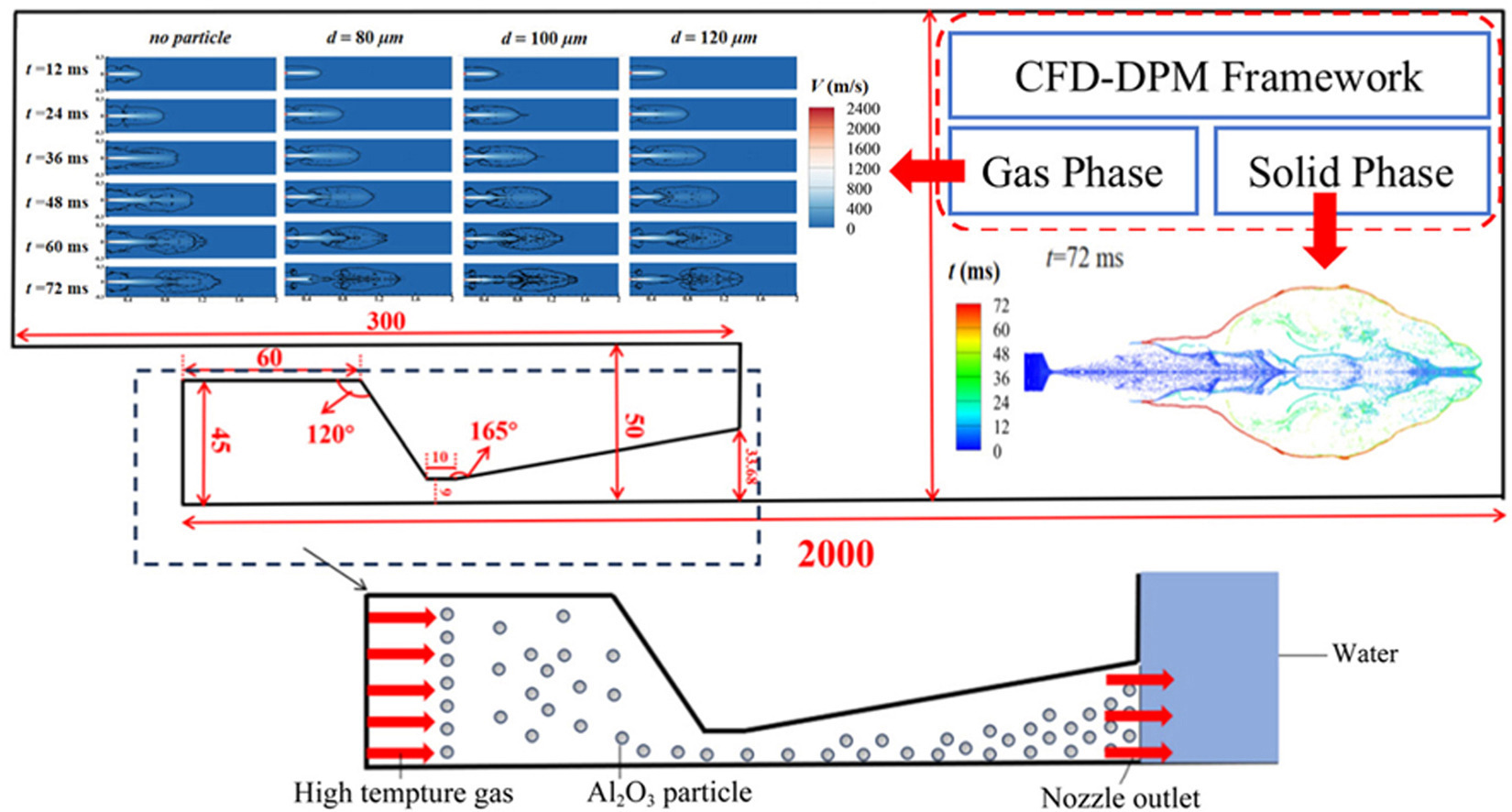
The multi-phase flow characteristics of underwater supersonic jet are significant to the overall performance of underwater solid rocket motor. In this study, a gas-solid-liquid multi-phase flow model considering the effect of solid particles is established accounting for the supersonic over-expanded gas jet underwater. Parametric analysis of the underwater depth and the diameter of the solid particles (Al2O3) are conducted to investigate the tuning effect of solid particles on the multi-phase flow characteristics of the underwater supersonic gas jet. The results show that the multi-phase flow structure is greatly affected by interaction between the supersonic gas jet and water. With the increase of underwater depth, the size of gas bubbles decreases due to deformation and breakup processes. Under the influence of shear force between the gas jet and water, the necking phenomenon downstream of the nozzle is enhanced, leading to the fluctuations of pressure and velocity of the jet. For the gas jet without solid particles, with increase of time, the structure of the gas jet is heavily deformed, which experiences high interface instability due to the shear effect between gas jet and water. The existence of solid particles significantly inhibits the fluctuations of the gas jet. However, the addition of either too large or too small particles leads to locally reversed pressure gradient. Compared with the gas jet with particles of 100 μm, significant discontinuity occurs in the gas jet with d = 80 and 120 μm particles. The addition of solid particles with medium size (d = 100 μm) leads to a decrease by 45% in the local pressure fluctuation magnitude. The tuning effects of the medium-size solid particles are related to the suppression of high-frequency Kelvin-Helmholtz instability in the near field and the suppression of low-frequency Rayleigh-Taylor instability in the far field.
Graphical abstract
Keywords
Shuyuan Liu a, Zhanzhi Zhang a, Jiannan Wang a, Wei Tan a, Yin Wang b, Songqi Hu a
文章导读