
期刊文章
过刊浏览
- Volumes 108-119 (2025)
-
Volumes 96-107 (2025)
-
Volume 107
Pages 1-376 (December 2025)
-
Volume 106
Pages 1-336 (November 2025)
-
Volume 105
Pages 1-356 (October 2025)
-
Volume 104
Pages 1-332 (September 2025)
-
Volume 103
Pages 1-314 (August 2025)
-
Volume 102
Pages 1-276 (July 2025)
-
Volume 101
Pages 1-166 (June 2025)
-
Volume 100
Pages 1-256 (May 2025)
-
Volume 99
Pages 1-242 (April 2025)
-
Volume 98
Pages 1-288 (March 2025)
-
Volume 97
Pages 1-256 (February 2025)
-
Volume 96
Pages 1-340 (January 2025)
-
Volume 107
-
Volumes 84-95 (2024)
-
Volume 95
Pages 1-392 (December 2024)
-
Volume 94
Pages 1-400 (November 2024)
-
Volume 93
Pages 1-376 (October 2024)
-
Volume 92
Pages 1-316 (September 2024)
-
Volume 91
Pages 1-378 (August 2024)
-
Volume 90
Pages 1-580 (July 2024)
-
Volume 89
Pages 1-278 (June 2024)
-
Volume 88
Pages 1-350 (May 2024)
-
Volume 87
Pages 1-338 (April 2024)
-
Volume 86
Pages 1-312 (March 2024)
-
Volume 85
Pages 1-334 (February 2024)
-
Volume 84
Pages 1-308 (January 2024)
-
Volume 95
-
Volumes 72-83 (2023)
-
Volume 83
Pages 1-258 (December 2023)
-
Volume 82
Pages 1-204 (November 2023)
-
Volume 81
Pages 1-188 (October 2023)
-
Volume 80
Pages 1-202 (September 2023)
-
Volume 79
Pages 1-172 (August 2023)
-
Volume 78
Pages 1-146 (July 2023)
-
Volume 77
Pages 1-152 (June 2023)
-
Volume 76
Pages 1-176 (May 2023)
-
Volume 75
Pages 1-228 (April 2023)
-
Volume 74
Pages 1-200 (March 2023)
-
Volume 73
Pages 1-138 (February 2023)
-
Volume 72
Pages 1-144 (January 2023)
-
Volume 83
-
Volumes 60-71 (2022)
-
Volume 71
Pages 1-108 (December 2022)
-
Volume 70
Pages 1-106 (November 2022)
-
Volume 69
Pages 1-122 (October 2022)
-
Volume 68
Pages 1-124 (September 2022)
-
Volume 67
Pages 1-102 (August 2022)
-
Volume 66
Pages 1-112 (July 2022)
-
Volume 65
Pages 1-138 (June 2022)
-
Volume 64
Pages 1-186 (May 2022)
-
Volume 63
Pages 1-124 (April 2022)
-
Volume 62
Pages 1-104 (March 2022)
-
Volume 61
Pages 1-120 (February 2022)
-
Volume 60
Pages 1-124 (January 2022)
-
Volume 71
- Volumes 54-59 (2021)
- Volumes 48-53 (2020)
- Volumes 42-47 (2019)
- Volumes 36-41 (2018)
- Volumes 30-35 (2017)
- Volumes 24-29 (2016)
- Volumes 18-23 (2015)
- Volumes 12-17 (2014)
- Volume 11 (2013)
- Volume 10 (2012)
- Volume 9 (2011)
- Volume 8 (2010)
- Volume 7 (2009)
- Volume 6 (2008)
- Volume 5 (2007)
- Volume 4 (2006)
- Volume 3 (2005)
- Volume 2 (2004)
- Volume 1 (2003)
Volume 111
hi, Y., Li, X., & Ge, C. (2026). Facile and cost-effective droplet cooling and solidification model for gas atomization: Influence of atomizing gas composition on droplet non-equilibrium solidification behavior. Particuology, 111, 120-135. https://doi.org/10.1016/j.partic.2026.02.010
Facile and cost-effective droplet cooling and solidification model for gas atomization: Influence of atomizing gas composition on droplet non-equilibrium solidification behavior
Yaxian Shi a, Xinggang Li b *, Changchun Ge a *
a Institute of Powder Metallurgy and Advanced Ceramics, University of Science and Technology Beijing, Beijing, 100083, China
b Institute for Advanced Materials, North China Electric Power University, Beijing, 102206, China
10.1016/j.partic.2026.02.010
Volume 111,
April 2026,
Pages 120-135
Received 30 October 2025, Revised 30 January 2026, Accepted 10 February 2026, Available online 12 February 2026, Version of Record 18 February 2026.
E-mail:
xing-gangli@163.com; ccge@mater.ustb.edu.cn
Highlights
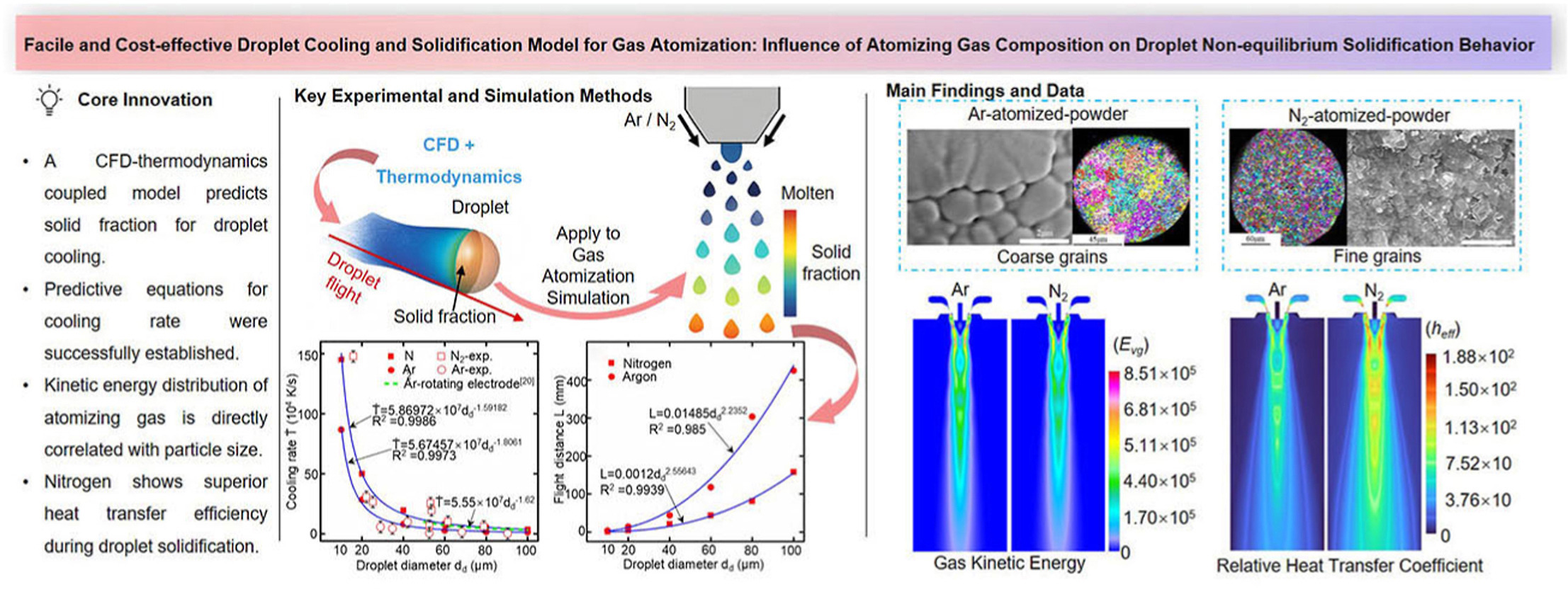
• A CFD-thermodynamics coupled model predicts solid fraction for droplet cooling.
• Predictive equations for cooling rate were successfully established.
• Kinetic energy distribution of atomizing is directly correlated with particle size.
• Nitrogen shows superior heat transfer efficiency during droplet solidification.
Abstract
A comprehensive droplet cooling and solidification model was developed to quantitatively predict the evolution of solid fraction in atomized droplets during gas atomization under rapid solidification conditions. The model integrates computational fluid dynamics with thermodynamic phase diagram calculations through modified Scheil-Gulliver-based solidification scheme, allowing for fully coupled tracking of droplet cooling and phase transformation dynamics during flight. The fitted equation relating droplet cooling rate to particle diameter obtained from the model exhibits both a functional form and cooling trend consistent with literature-reported, as well as with the cooling rates estimated from the experimentally measured secondary dendrite arm spacing of powder samples, thereby validating credibility and effectiveness of the proposed model. Key findings demonstrate that nitrogen atomization has significantly higher cooling rates compared to argon. While argon exhibits superior kinetic energy for droplet fragmentation, the enhanced thermal conductivity of nitrogen substantially improves heat transfer efficiency, leading to markedly reduced solidification distances. Experimental characterization confirms distinct microstructural differences of powders: argon-atomized powders display coarser grain structures with dendritic features, whereas nitrogen-atomized powders exhibit homogeneous fine crystalline structures and smoother surface morphology. The study establishes quantitative predictive models for cooling rates and solidification distances, providing a robust framework for optimizing gas atomization parameters.
Graphical abstract
Keywords
Gas atomization; Nonequilibrium solidification; Modified scheil-gulliver model; Computational fluid dynamics (CFD)
文章导读