
期刊文章
过刊浏览
- Volumes 108-119 (2025)
-
Volumes 96-107 (2025)
-
Volume 107
Pages 1-376 (December 2025)
-
Volume 106
Pages 1-336 (November 2025)
-
Volume 105
Pages 1-356 (October 2025)
-
Volume 104
Pages 1-332 (September 2025)
-
Volume 103
Pages 1-314 (August 2025)
-
Volume 102
Pages 1-276 (July 2025)
-
Volume 101
Pages 1-166 (June 2025)
-
Volume 100
Pages 1-256 (May 2025)
-
Volume 99
Pages 1-242 (April 2025)
-
Volume 98
Pages 1-288 (March 2025)
-
Volume 97
Pages 1-256 (February 2025)
-
Volume 96
Pages 1-340 (January 2025)
-
Volume 107
-
Volumes 84-95 (2024)
-
Volume 95
Pages 1-392 (December 2024)
-
Volume 94
Pages 1-400 (November 2024)
-
Volume 93
Pages 1-376 (October 2024)
-
Volume 92
Pages 1-316 (September 2024)
-
Volume 91
Pages 1-378 (August 2024)
-
Volume 90
Pages 1-580 (July 2024)
-
Volume 89
Pages 1-278 (June 2024)
-
Volume 88
Pages 1-350 (May 2024)
-
Volume 87
Pages 1-338 (April 2024)
-
Volume 86
Pages 1-312 (March 2024)
-
Volume 85
Pages 1-334 (February 2024)
-
Volume 84
Pages 1-308 (January 2024)
-
Volume 95
-
Volumes 72-83 (2023)
-
Volume 83
Pages 1-258 (December 2023)
-
Volume 82
Pages 1-204 (November 2023)
-
Volume 81
Pages 1-188 (October 2023)
-
Volume 80
Pages 1-202 (September 2023)
-
Volume 79
Pages 1-172 (August 2023)
-
Volume 78
Pages 1-146 (July 2023)
-
Volume 77
Pages 1-152 (June 2023)
-
Volume 76
Pages 1-176 (May 2023)
-
Volume 75
Pages 1-228 (April 2023)
-
Volume 74
Pages 1-200 (March 2023)
-
Volume 73
Pages 1-138 (February 2023)
-
Volume 72
Pages 1-144 (January 2023)
-
Volume 83
-
Volumes 60-71 (2022)
-
Volume 71
Pages 1-108 (December 2022)
-
Volume 70
Pages 1-106 (November 2022)
-
Volume 69
Pages 1-122 (October 2022)
-
Volume 68
Pages 1-124 (September 2022)
-
Volume 67
Pages 1-102 (August 2022)
-
Volume 66
Pages 1-112 (July 2022)
-
Volume 65
Pages 1-138 (June 2022)
-
Volume 64
Pages 1-186 (May 2022)
-
Volume 63
Pages 1-124 (April 2022)
-
Volume 62
Pages 1-104 (March 2022)
-
Volume 61
Pages 1-120 (February 2022)
-
Volume 60
Pages 1-124 (January 2022)
-
Volume 71
- Volumes 54-59 (2021)
- Volumes 48-53 (2020)
- Volumes 42-47 (2019)
- Volumes 36-41 (2018)
- Volumes 30-35 (2017)
- Volumes 24-29 (2016)
- Volumes 18-23 (2015)
- Volumes 12-17 (2014)
- Volume 11 (2013)
- Volume 10 (2012)
- Volume 9 (2011)
- Volume 8 (2010)
- Volume 7 (2009)
- Volume 6 (2008)
- Volume 5 (2007)
- Volume 4 (2006)
- Volume 3 (2005)
- Volume 2 (2004)
- Volume 1 (2003)
Volume 111
Li, X., & Bi, X. (2026). Quantifying streamers instabilities in 2D particle sedimentation using DNS. Particuology, 111, 136-149. https://doi.org/10.1016/j.partic.2026.01.030
Quantifying streamers instabilities in 2D particle sedimentation using DNS (Open Access)
Xiaoqi Li a b *, Xiaotao Bi a
a Department of Chemical and Biological Engineering, University of British Columbia, Vancouver, British Columbia, V6T 1Z4, Canada
b Petroleum Engineering Department, Colorado School of Mines, Golden, CO, 80401, USA
10.1016/j.partic.2026.01.030
Volume 111,
April 2026,
Pages 136-149
Received 30 October 2025, Revised 22 December 2025, Accepted 26 January 2026, Available online 6 February 2026, Version of Record 19 February 2026.
E-mail:
xiaoqi.li@ubc.ca; onlyviolet.lee@gmail.com
Highlights
• Streamer induced mesoscale instabilities in 2D sedimentation are quantified using DNS.
• A filtered framework links local solid fraction, slip velocity, and drag variations.
• A new DNS based H-index measures streamer orientation and intensity.
• Streamer anisotropy dominates local drag deviation from homogeneous conditions.
• The framework provides physical insights for closure models in multiphase simulations.
Abstract
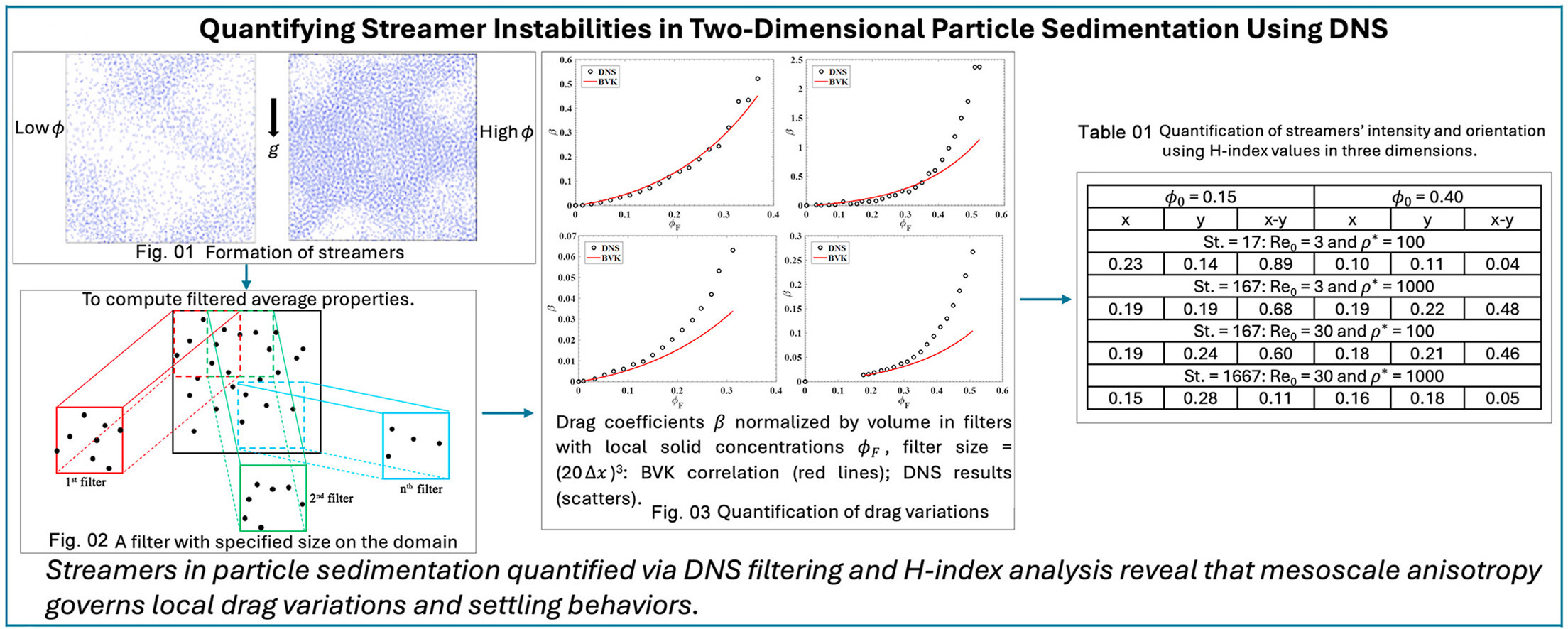
Particle streamers formed dynamically strongly influence hydrodynamics in gas–solid multiphase flows, yet their quantitative characterization in sedimentation remains incomplete. We performed a direct numerical simulation (DNS) of quasi-2D particle sedimentation process using the lattice Boltzmann method (LBM) coupled with hard-sphere collisions to resolve both gas–particle and particle–particle interactions. Simulations span solid volume fractions of 0.15 and 0.40, density ratios of 100 and 1000, and terminal Reynolds numbers Re0 = 3 and 30, corresponding to Stokes numbers St = 17–1667. Structure factor analysis identifies distinct instability modes: dilute systems develop bypassing and plug-funnel structures, whereas dense systems form void-like regions with retarded particle-gas coupling at high St. Domain averaged sedimentation velocities from DNS are compared with Richardson-Zaki and Yin correlations, showing enhanced settling at low St and hindered settling due to persistent plugs at high St. Filter based analysis of local drag demonstrates significant deviations from classical drag laws, with drag reduction in dense phases. Statistical analysis of velocity fluctuations reveals anisotropy, negative skewness linked to plug formation, and departure from Gaussian distributions. To quantify mesoscale heterogeneity, we introduced a heterogeneous index (H-index), which captures orientation dependent fluctuations in DNS fields. Results reveal that streamers are scale-dependent, which modify drag and sedimentation velocity through mesoscale heterogeneities in the flow field. These findings provide quantitative insights into the mechanisms governing gas-solid interactions and particle segregations in sedimentation systems.
Graphical abstract
Keywords
Gas-solid flow; Streamers; DNS; Sedimentation; Scale-dependent
文章导读