
期刊文章
过刊浏览
- Volumes 108-119 (2025)
-
Volumes 96-107 (2025)
-
Volume 107
Pages 1-376 (December 2025)
-
Volume 106
Pages 1-336 (November 2025)
-
Volume 105
Pages 1-356 (October 2025)
-
Volume 104
Pages 1-332 (September 2025)
-
Volume 103
Pages 1-314 (August 2025)
-
Volume 102
Pages 1-276 (July 2025)
-
Volume 101
Pages 1-166 (June 2025)
-
Volume 100
Pages 1-256 (May 2025)
-
Volume 99
Pages 1-242 (April 2025)
-
Volume 98
Pages 1-288 (March 2025)
-
Volume 97
Pages 1-256 (February 2025)
-
Volume 96
Pages 1-340 (January 2025)
-
Volume 107
-
Volumes 84-95 (2024)
-
Volume 95
Pages 1-392 (December 2024)
-
Volume 94
Pages 1-400 (November 2024)
-
Volume 93
Pages 1-376 (October 2024)
-
Volume 92
Pages 1-316 (September 2024)
-
Volume 91
Pages 1-378 (August 2024)
-
Volume 90
Pages 1-580 (July 2024)
-
Volume 89
Pages 1-278 (June 2024)
-
Volume 88
Pages 1-350 (May 2024)
-
Volume 87
Pages 1-338 (April 2024)
-
Volume 86
Pages 1-312 (March 2024)
-
Volume 85
Pages 1-334 (February 2024)
-
Volume 84
Pages 1-308 (January 2024)
-
Volume 95
-
Volumes 72-83 (2023)
-
Volume 83
Pages 1-258 (December 2023)
-
Volume 82
Pages 1-204 (November 2023)
-
Volume 81
Pages 1-188 (October 2023)
-
Volume 80
Pages 1-202 (September 2023)
-
Volume 79
Pages 1-172 (August 2023)
-
Volume 78
Pages 1-146 (July 2023)
-
Volume 77
Pages 1-152 (June 2023)
-
Volume 76
Pages 1-176 (May 2023)
-
Volume 75
Pages 1-228 (April 2023)
-
Volume 74
Pages 1-200 (March 2023)
-
Volume 73
Pages 1-138 (February 2023)
-
Volume 72
Pages 1-144 (January 2023)
-
Volume 83
-
Volumes 60-71 (2022)
-
Volume 71
Pages 1-108 (December 2022)
-
Volume 70
Pages 1-106 (November 2022)
-
Volume 69
Pages 1-122 (October 2022)
-
Volume 68
Pages 1-124 (September 2022)
-
Volume 67
Pages 1-102 (August 2022)
-
Volume 66
Pages 1-112 (July 2022)
-
Volume 65
Pages 1-138 (June 2022)
-
Volume 64
Pages 1-186 (May 2022)
-
Volume 63
Pages 1-124 (April 2022)
-
Volume 62
Pages 1-104 (March 2022)
-
Volume 61
Pages 1-120 (February 2022)
-
Volume 60
Pages 1-124 (January 2022)
-
Volume 71
- Volumes 54-59 (2021)
- Volumes 48-53 (2020)
- Volumes 42-47 (2019)
- Volumes 36-41 (2018)
- Volumes 30-35 (2017)
- Volumes 24-29 (2016)
- Volumes 18-23 (2015)
- Volumes 12-17 (2014)
- Volume 11 (2013)
- Volume 10 (2012)
- Volume 9 (2011)
- Volume 8 (2010)
- Volume 7 (2009)
- Volume 6 (2008)
- Volume 5 (2007)
- Volume 4 (2006)
- Volume 3 (2005)
- Volume 2 (2004)
- Volume 1 (2003)
Volume 111
Srevathsan, M. R., Selvam, C., & Senthil, R. (2026). Experimental study of a hybrid pin fin heat sink using phase change material and graphene nanofluid for electronic cooling. Particuology, 111, 150-163. https://doi.org/10.1016/j.partic.2026.02.006
Experimental study of a hybrid pin fin heat sink using phase change material and graphene nanofluid for electronic cooling
Mani Ravichander Srevathsan, Chandrasekaran Selvam *, Ramalingam Senthil *
Department of Mechanical Engineering, SRM Institute of Science and Technology, Kattankulathur, Chennai, 603203, Tamil Nadu, India
10.1016/j.partic.2026.02.006
Volume 111,
April 2026,
Pages 150-163
Received 10 October 2025, Revised 2 February 2026, Accepted 3 February 2026, Available online 12 February 2026, Version of Record 19 February 2026.
E-mail:
selvamc@srmist.edu.in; senthilr@srmist.edu.in
Highlights
• Hybrid heat sinks with fins, phase change material, and nanofluids are studied.
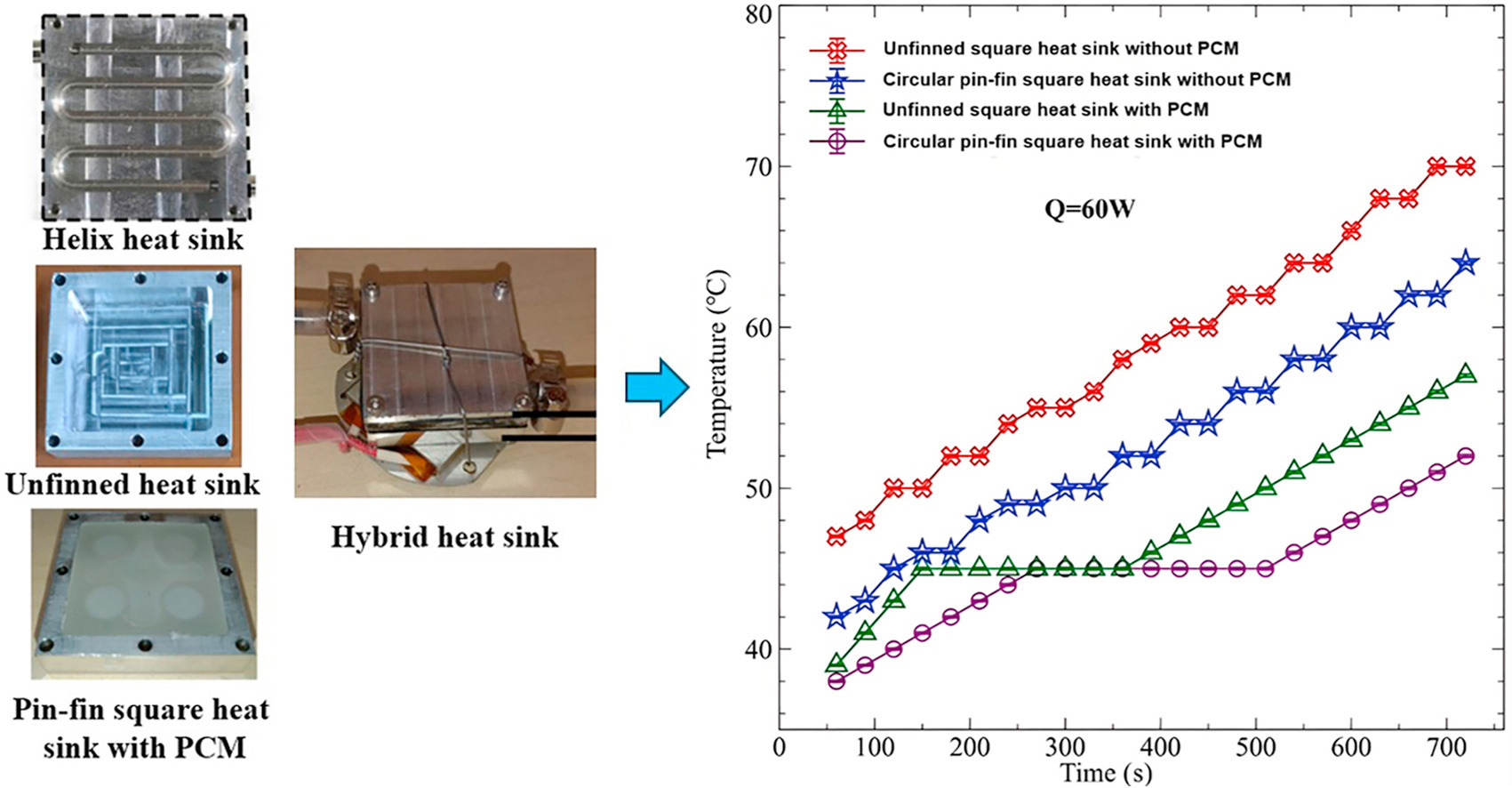
• Surface temperature of the hybrid heat sink reduced from 76 °C to 33 °C.
• Heat transfer coefficient of nanofluids enhanced by 35.5% with 0.1 vol% of GnP.
• The thermal resistance of the heat sink was reduced by 72.5% with 0.1 vol% of GnP.
• Hybrid heat sinks with heat storage and nanofluid boosts heat transfer performance.
Abstract
Efficient thermal management is essential for high-performance electronics, requiring reliable systems to improve heat dissipation and extend device lifespan. This study experimentally examines the cooling performance of a square-shaped hybrid heat sink combining helix and circular pin fin structures with a paraffin-based phase change material (PCM). A baseline test was conducted with a standalone helix heat sink using distilled water and graphene nanoplatelet (GnP)-based nanofluids (0.01–0.1 vol%) at power inputs of 60–100 W and flow rates of 0.6–2.2 mL/s. At 2.2 mL/s with 0.1% GnP, the lowest thermal resistance and the most significant temperature reduction were achieved, due to improved convective heat transfer. Then, a hybrid heat sink with PCM was tested under identical conditions, resulting in surface temperature reductions of up to 45 °C at 60 W and 76 °C at 100 W compared to the base case. The average surface-temperature increase per 100 s was lowest for the pin-fin heat sink with PCM (0–3 °C) and highest for configurations without PCM (up to 5 °C). A 35.5% increase in convective heat transfer coefficient (CHTC) was observed at 100 W, along with a 72.5% reduction in thermal resistance at 80 W, both at a flow rate of 2.2 mL/s with 0.1% GnP. At a Reynolds number of 1050, the hybrid heat sink achieved a maximum CHTC of 1142.86 W/(m2 K), about 12% higher than the helix-only design. Across all input power levels, the hybrid system consistently exhibited lower thermal resistance and higher CHTC, demonstrating a significant improvement in heat dissipation and providing a durable, efficient cooling solution for high-power electronic devices.
Graphical abstract
Keywords
Hybrid heat sink; Phase change material; Nanofluids; Heat transfer coefficient; Thermal resistance
文章导读