
期刊文章
过刊浏览
- Volumes 108-119 (2025)
-
Volumes 96-107 (2025)
-
Volume 107
Pages 1-376 (December 2025)
-
Volume 106
Pages 1-336 (November 2025)
-
Volume 105
Pages 1-356 (October 2025)
-
Volume 104
Pages 1-332 (September 2025)
-
Volume 103
Pages 1-314 (August 2025)
-
Volume 102
Pages 1-276 (July 2025)
-
Volume 101
Pages 1-166 (June 2025)
-
Volume 100
Pages 1-256 (May 2025)
-
Volume 99
Pages 1-242 (April 2025)
-
Volume 98
Pages 1-288 (March 2025)
-
Volume 97
Pages 1-256 (February 2025)
-
Volume 96
Pages 1-340 (January 2025)
-
Volume 107
-
Volumes 84-95 (2024)
-
Volume 95
Pages 1-392 (December 2024)
-
Volume 94
Pages 1-400 (November 2024)
-
Volume 93
Pages 1-376 (October 2024)
-
Volume 92
Pages 1-316 (September 2024)
-
Volume 91
Pages 1-378 (August 2024)
-
Volume 90
Pages 1-580 (July 2024)
-
Volume 89
Pages 1-278 (June 2024)
-
Volume 88
Pages 1-350 (May 2024)
-
Volume 87
Pages 1-338 (April 2024)
-
Volume 86
Pages 1-312 (March 2024)
-
Volume 85
Pages 1-334 (February 2024)
-
Volume 84
Pages 1-308 (January 2024)
-
Volume 95
-
Volumes 72-83 (2023)
-
Volume 83
Pages 1-258 (December 2023)
-
Volume 82
Pages 1-204 (November 2023)
-
Volume 81
Pages 1-188 (October 2023)
-
Volume 80
Pages 1-202 (September 2023)
-
Volume 79
Pages 1-172 (August 2023)
-
Volume 78
Pages 1-146 (July 2023)
-
Volume 77
Pages 1-152 (June 2023)
-
Volume 76
Pages 1-176 (May 2023)
-
Volume 75
Pages 1-228 (April 2023)
-
Volume 74
Pages 1-200 (March 2023)
-
Volume 73
Pages 1-138 (February 2023)
-
Volume 72
Pages 1-144 (January 2023)
-
Volume 83
-
Volumes 60-71 (2022)
-
Volume 71
Pages 1-108 (December 2022)
-
Volume 70
Pages 1-106 (November 2022)
-
Volume 69
Pages 1-122 (October 2022)
-
Volume 68
Pages 1-124 (September 2022)
-
Volume 67
Pages 1-102 (August 2022)
-
Volume 66
Pages 1-112 (July 2022)
-
Volume 65
Pages 1-138 (June 2022)
-
Volume 64
Pages 1-186 (May 2022)
-
Volume 63
Pages 1-124 (April 2022)
-
Volume 62
Pages 1-104 (March 2022)
-
Volume 61
Pages 1-120 (February 2022)
-
Volume 60
Pages 1-124 (January 2022)
-
Volume 71
- Volumes 54-59 (2021)
- Volumes 48-53 (2020)
- Volumes 42-47 (2019)
- Volumes 36-41 (2018)
- Volumes 30-35 (2017)
- Volumes 24-29 (2016)
- Volumes 18-23 (2015)
- Volumes 12-17 (2014)
- Volume 11 (2013)
- Volume 10 (2012)
- Volume 9 (2011)
- Volume 8 (2010)
- Volume 7 (2009)
- Volume 6 (2008)
- Volume 5 (2007)
- Volume 4 (2006)
- Volume 3 (2005)
- Volume 2 (2004)
- Volume 1 (2003)
Volume 111
Li, J., Xie, J., Wu, H., Ma, Y., Liu, X., Chai, H., . . . Li, J. (2026). Study on the atomization and fragmentation behavior and mechanism of droplets under non-contact ultrasonic conditions. Particuology, 111, 164-174. https://doi.org/10.1016/j.partic.2026.02.005
Study on the atomization and fragmentation behavior and mechanism of droplets under non-contact ultrasonic conditions
Junpeng Li a, Jun Xie b *, Hao Wu b, Yuejiao Ma b, Xinggang Liu a *, Hongyu Chai b, Junsong Gao b, Jingjing Liang b, Jinguo Li b *
a School of Materials Science and Engineering, Northeastern University, Shenyang, 110819, China
b Shi-changxu Innovation Center for Advanced Materials, Institute of Metal Research, Chinese Academy of Sciences, Shenyang, 110016, China
10.1016/j.partic.2026.02.005
Volume 111,
April 2026,
Pages 164-174
Received 19 October 2025, Revised 21 January 2026, Accepted 3 February 2026, Available online 11 February 2026, Version of Record 26 February 2026.
E-mail:
junxie@imr.ac.cn; liuxg@smm.neu.edu.cn; jgli@imr.ac.cn
Highlights
• The model provides a qualitative analysis of ultrasonic atomization and fragmentation behavior.
• The entire ultrasonic fragmentation process was simulated using 3D modeling.
• The simulated fragmentation process was validated through in situ observation.
Abstract
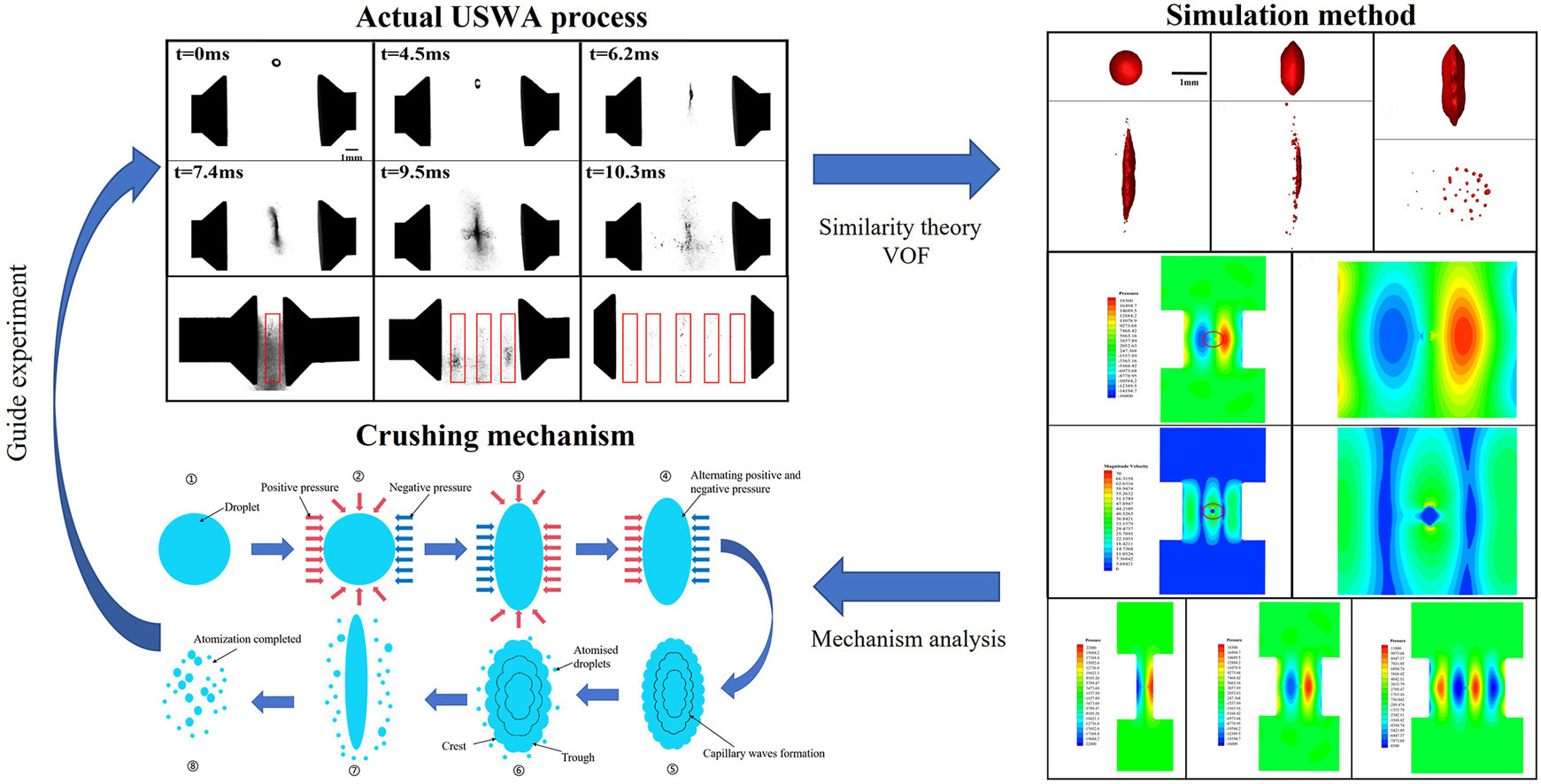
Metal powders produced by ultrasonic atomization exhibit excellent sphericity and narrow particle size distributions. However, most existing studies have focused on contact-mode ultrasonic atomization, whereas the multiscale breakup behavior of droplets and the underlying mechanisms under non-contact ultrasonic excitation remain poorly understood. In this work, water is employed as a model fluid to systematically investigate the atomization dynamics of droplets in a non-contact ultrasonic standing wave field by combining in situ high-speed visualization with three-dimensional multiphysics CFD simulations. A VOF-based model coupled with user-defined functions and adaptive mesh refinement is developed to capture the transient evolution of droplets under ultrasonic excitation. The results demonstrate that droplet breakup evolves from an initial bag breakup mode to a transitional mixed regime and finally to catastrophic fragmentation. Quantitative analyses based on the Weber number, interfacial shear stress, and acoustic radiation force reveal that the synergistic effects of non-uniform acoustic pressure gradients and acoustic streaming-induced shear govern the onset of the characteristic “pancake” deformation and the subsequent multistage breakup. The predicted breakup modes, time scales, and droplet size distributions show good agreement with high-speed imaging observations.
Graphical abstract
Keywords
Non-contact ultrasonic atomization; Multiphysics CFD simulation; In-situ observation; Capillary waves
文章导读