
期刊文章
过刊浏览
- Volumes 108-119 (2025)
-
Volumes 96-107 (2025)
-
Volume 107
Pages 1-376 (December 2025)
-
Volume 106
Pages 1-336 (November 2025)
-
Volume 105
Pages 1-356 (October 2025)
-
Volume 104
Pages 1-332 (September 2025)
-
Volume 103
Pages 1-314 (August 2025)
-
Volume 102
Pages 1-276 (July 2025)
-
Volume 101
Pages 1-166 (June 2025)
-
Volume 100
Pages 1-256 (May 2025)
-
Volume 99
Pages 1-242 (April 2025)
-
Volume 98
Pages 1-288 (March 2025)
-
Volume 97
Pages 1-256 (February 2025)
-
Volume 96
Pages 1-340 (January 2025)
-
Volume 107
-
Volumes 84-95 (2024)
-
Volume 95
Pages 1-392 (December 2024)
-
Volume 94
Pages 1-400 (November 2024)
-
Volume 93
Pages 1-376 (October 2024)
-
Volume 92
Pages 1-316 (September 2024)
-
Volume 91
Pages 1-378 (August 2024)
-
Volume 90
Pages 1-580 (July 2024)
-
Volume 89
Pages 1-278 (June 2024)
-
Volume 88
Pages 1-350 (May 2024)
-
Volume 87
Pages 1-338 (April 2024)
-
Volume 86
Pages 1-312 (March 2024)
-
Volume 85
Pages 1-334 (February 2024)
-
Volume 84
Pages 1-308 (January 2024)
-
Volume 95
-
Volumes 72-83 (2023)
-
Volume 83
Pages 1-258 (December 2023)
-
Volume 82
Pages 1-204 (November 2023)
-
Volume 81
Pages 1-188 (October 2023)
-
Volume 80
Pages 1-202 (September 2023)
-
Volume 79
Pages 1-172 (August 2023)
-
Volume 78
Pages 1-146 (July 2023)
-
Volume 77
Pages 1-152 (June 2023)
-
Volume 76
Pages 1-176 (May 2023)
-
Volume 75
Pages 1-228 (April 2023)
-
Volume 74
Pages 1-200 (March 2023)
-
Volume 73
Pages 1-138 (February 2023)
-
Volume 72
Pages 1-144 (January 2023)
-
Volume 83
-
Volumes 60-71 (2022)
-
Volume 71
Pages 1-108 (December 2022)
-
Volume 70
Pages 1-106 (November 2022)
-
Volume 69
Pages 1-122 (October 2022)
-
Volume 68
Pages 1-124 (September 2022)
-
Volume 67
Pages 1-102 (August 2022)
-
Volume 66
Pages 1-112 (July 2022)
-
Volume 65
Pages 1-138 (June 2022)
-
Volume 64
Pages 1-186 (May 2022)
-
Volume 63
Pages 1-124 (April 2022)
-
Volume 62
Pages 1-104 (March 2022)
-
Volume 61
Pages 1-120 (February 2022)
-
Volume 60
Pages 1-124 (January 2022)
-
Volume 71
- Volumes 54-59 (2021)
- Volumes 48-53 (2020)
- Volumes 42-47 (2019)
- Volumes 36-41 (2018)
- Volumes 30-35 (2017)
- Volumes 24-29 (2016)
- Volumes 18-23 (2015)
- Volumes 12-17 (2014)
- Volume 11 (2013)
- Volume 10 (2012)
- Volume 9 (2011)
- Volume 8 (2010)
- Volume 7 (2009)
- Volume 6 (2008)
- Volume 5 (2007)
- Volume 4 (2006)
- Volume 3 (2005)
- Volume 2 (2004)
- Volume 1 (2003)
Volume 111
Seidenbecher, J., Meitzner, C., & Herz, F. (2026). Transverse particle motion analysis as a basis for heat transfer investigations in rotary kilns with flights. Part I: Optical evaluation method. Particuology, 111, 186-196. https://doi.org/10.1016/j.partic.2026.02.012
Transverse particle motion analysis as a basis for heat transfer investigations in rotary kilns with flights. Part I: Optical evaluation method
Jakob Seidenbecher, Claudia Meitzner *, Fabian Herz
Anhalt University of Applied Sciences, 06366, Köthen, Germany
10.1016/j.partic.2026.02.012
Volume 111,
April 2026,
Pages 186-196
Received 17 December 2025, Revised 22 January 2026, Accepted 3 February 2026, Available online 24 February 2026, Version of Record 2 March 2026.
E-mail:
claudia.meitzner@hs-anhalt.de
Highlights
• Optical evaluation method for assessing heat transfer surfaces in rotary kilns is developed.
• Image-based technique is introduced to analyze transverse particle motion in kilns.
• Experimental foundation for heat transfer studies in rotary kilns with flights is provided.
• Method enhances the understanding of particle behavior and surface interactions in kilns.
• New approach to quantifying heat transfer-relevant surfaces in thermal processes.
Abstract
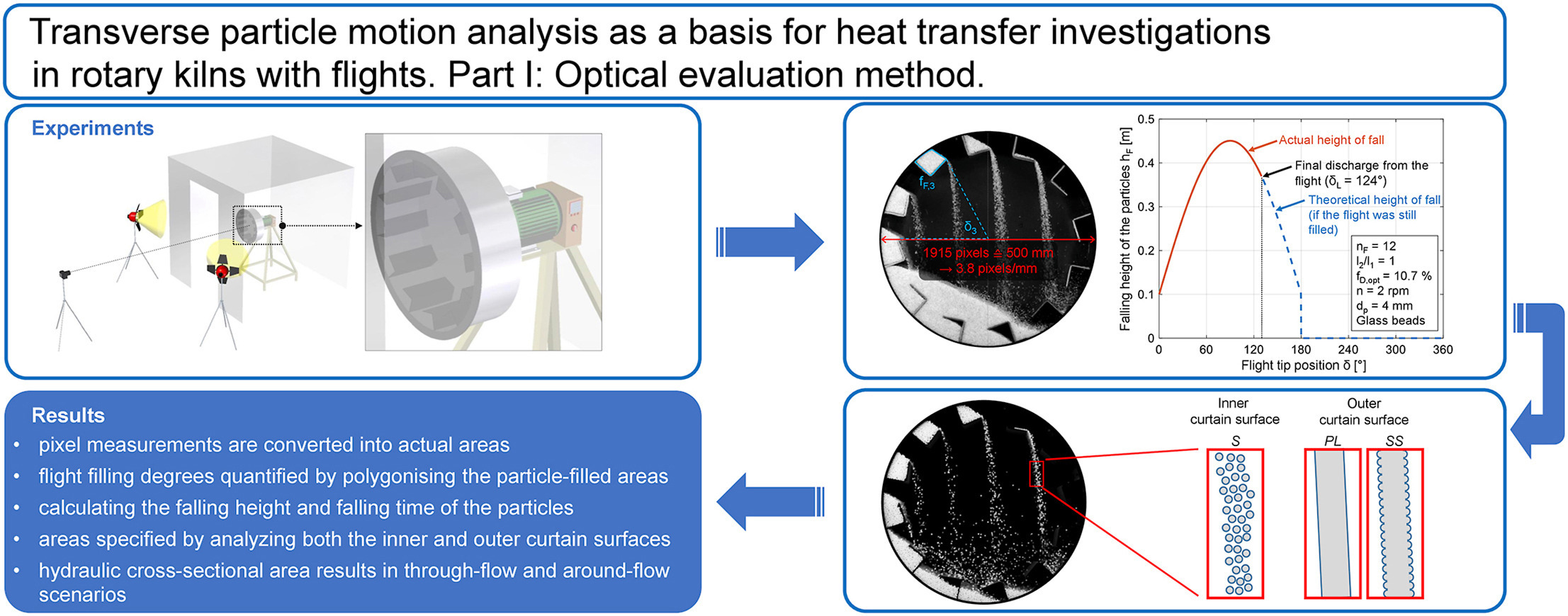
Heat transfer analysis in rotary kilns requires the determination of heat transfer surfaces and the hydraulic cross-sectional area. In flighted kilns, particle curtains introduce additional gas–solid contact, raising the question whether the inner or outer curtain surface is decisive for heat transfer.
To address this, two limiting flow scenarios are defined: gas flow through the particle curtain and gas flow around the curtain. Based on these assumptions, corresponding heat transfer surfaces and hydraulic cross-sectional areas for axial gas flow are derived.
An optical image-based methodology is used to quantify the relevant parameters. Representative results show that the number of particles in the airborne phase and the resulting inner curtain surface increase with rotational speed, while particle diameter affects the relative relevance of inner and outer curtain surfaces. Furthermore, the results indicate that flight length ratio and number of flights significantly influence curtain formation and heat transfer-relevant surfaces.
The presented approach provides a consistent and reproducible basis for heat transfer calculations and supports the analysis and design of flighted rotary kilns.
Graphical abstract
Keywords
Flighted rotary kiln; Transverse particle motion; Particle curtains; Heat transfer surfaces; Image-based analysis
文章导读