
期刊文章
过刊浏览
- Volumes 108-119 (2025)
-
Volumes 96-107 (2025)
-
Volume 107
Pages 1-376 (December 2025)
-
Volume 106
Pages 1-336 (November 2025)
-
Volume 105
Pages 1-356 (October 2025)
-
Volume 104
Pages 1-332 (September 2025)
-
Volume 103
Pages 1-314 (August 2025)
-
Volume 102
Pages 1-276 (July 2025)
-
Volume 101
Pages 1-166 (June 2025)
-
Volume 100
Pages 1-256 (May 2025)
-
Volume 99
Pages 1-242 (April 2025)
-
Volume 98
Pages 1-288 (March 2025)
-
Volume 97
Pages 1-256 (February 2025)
-
Volume 96
Pages 1-340 (January 2025)
-
Volume 107
-
Volumes 84-95 (2024)
-
Volume 95
Pages 1-392 (December 2024)
-
Volume 94
Pages 1-400 (November 2024)
-
Volume 93
Pages 1-376 (October 2024)
-
Volume 92
Pages 1-316 (September 2024)
-
Volume 91
Pages 1-378 (August 2024)
-
Volume 90
Pages 1-580 (July 2024)
-
Volume 89
Pages 1-278 (June 2024)
-
Volume 88
Pages 1-350 (May 2024)
-
Volume 87
Pages 1-338 (April 2024)
-
Volume 86
Pages 1-312 (March 2024)
-
Volume 85
Pages 1-334 (February 2024)
-
Volume 84
Pages 1-308 (January 2024)
-
Volume 95
-
Volumes 72-83 (2023)
-
Volume 83
Pages 1-258 (December 2023)
-
Volume 82
Pages 1-204 (November 2023)
-
Volume 81
Pages 1-188 (October 2023)
-
Volume 80
Pages 1-202 (September 2023)
-
Volume 79
Pages 1-172 (August 2023)
-
Volume 78
Pages 1-146 (July 2023)
-
Volume 77
Pages 1-152 (June 2023)
-
Volume 76
Pages 1-176 (May 2023)
-
Volume 75
Pages 1-228 (April 2023)
-
Volume 74
Pages 1-200 (March 2023)
-
Volume 73
Pages 1-138 (February 2023)
-
Volume 72
Pages 1-144 (January 2023)
-
Volume 83
-
Volumes 60-71 (2022)
-
Volume 71
Pages 1-108 (December 2022)
-
Volume 70
Pages 1-106 (November 2022)
-
Volume 69
Pages 1-122 (October 2022)
-
Volume 68
Pages 1-124 (September 2022)
-
Volume 67
Pages 1-102 (August 2022)
-
Volume 66
Pages 1-112 (July 2022)
-
Volume 65
Pages 1-138 (June 2022)
-
Volume 64
Pages 1-186 (May 2022)
-
Volume 63
Pages 1-124 (April 2022)
-
Volume 62
Pages 1-104 (March 2022)
-
Volume 61
Pages 1-120 (February 2022)
-
Volume 60
Pages 1-124 (January 2022)
-
Volume 71
- Volumes 54-59 (2021)
- Volumes 48-53 (2020)
- Volumes 42-47 (2019)
- Volumes 36-41 (2018)
- Volumes 30-35 (2017)
- Volumes 24-29 (2016)
- Volumes 18-23 (2015)
- Volumes 12-17 (2014)
- Volume 11 (2013)
- Volume 10 (2012)
- Volume 9 (2011)
- Volume 8 (2010)
- Volume 7 (2009)
- Volume 6 (2008)
- Volume 5 (2007)
- Volume 4 (2006)
- Volume 3 (2005)
- Volume 2 (2004)
- Volume 1 (2003)
Volume 111
Wang, Y., Xu, Y., Zhou, C., Fan, R., Bai, G., Zhang, Y., . . . Zhou, E. (2026). Research on particle motion behavior in gas-solid fluidized bed based on fluorescence tracing technology and machine learning. Particuology, 111, 197-213. https://doi.org/10.1016/j.partic.2026.01.031
Research on particle motion behavior in gas-solid fluidized bed based on fluorescence tracing technology and machine learning
Yifan Wang a b c, Yangfan Xu a b c, Chenyang Zhou a b c, Ruikang Fan a b c, Ge Bai c, Yadong Zhang a b c, Yu Wang a b c, Yuanyuan Li a b c, Enhui Zhou a b c *
a Key Laboratory of Coal Processing and Efficient Utilization of Ministry of Education, China University of Mining and Technology, Xuzhou, 221116, China
b Jiangsu Key Laboratory for Clean Utilization of Carbon Resources, China University of Mining & Technology, Xuzhou, 221116, China
c School of Chemical Engineering & Technology, China University of Mining & Technology, Xuzhou, 221116, China
10.1016/j.partic.2026.01.031
Volume 111,
April 2026,
Pages 197-213
Received 8 December 2025, Revised 16 January 2026, Accepted 27 January 2026, Available online 7 February 2026, Version of Record 3 March 2026.
E-mail:
zeh@cumt.edu.cn
Highlights
• A particle detection and tracking method based on machine learning.
• Fluorescent tracer particles were prepared to achieve clear imaging in fluidized beds.
• Movement behavior of tracer particles with different densities in fluidized beds.
• Influence of feeding heights on movement of tracer particles with different densities.
Abstract
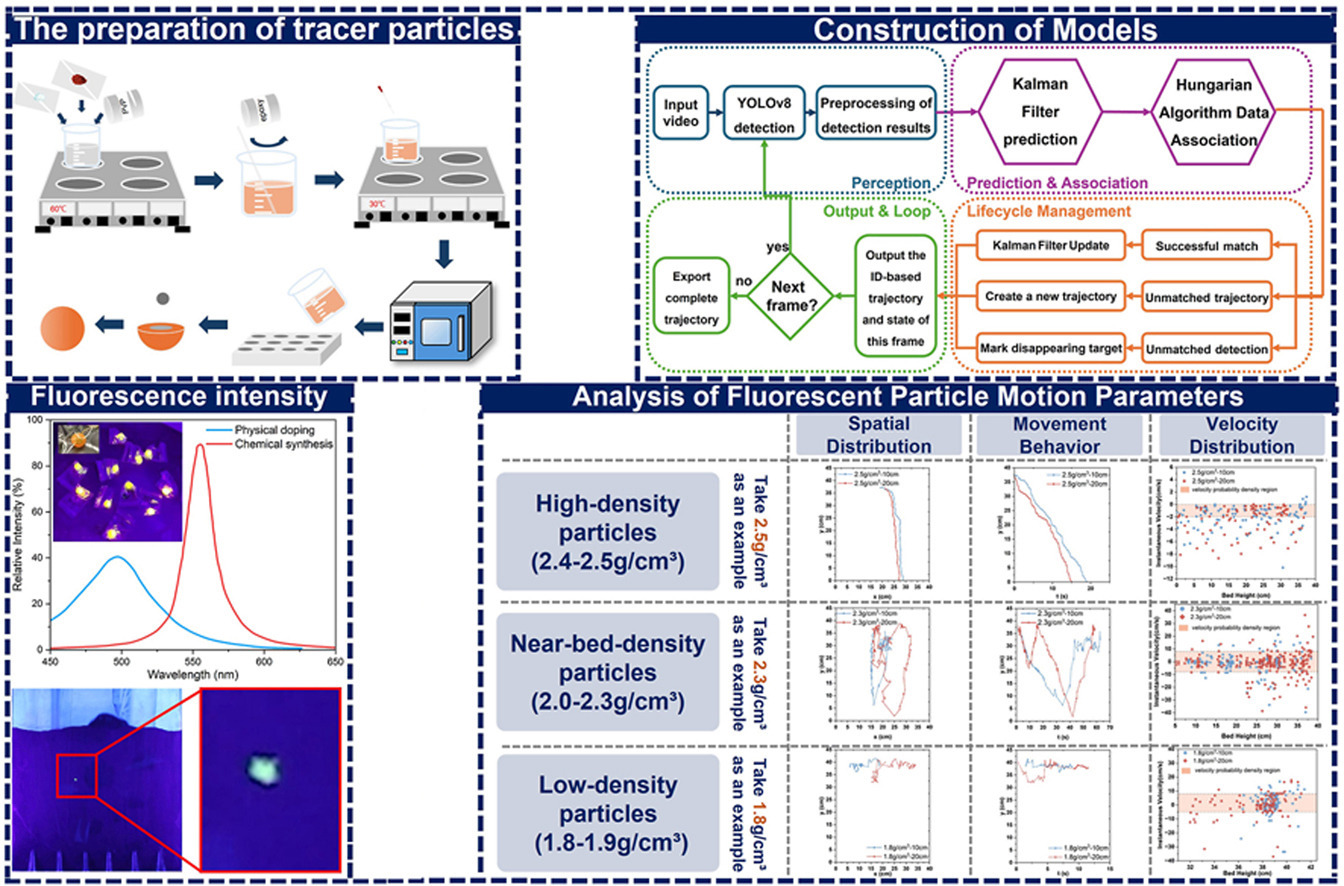
Accurate quantification of particle motion in gas-solid separation fluidized beds is essential for optimizing separation efficiency and elucidating flow mechanisms. This study proposed a non-invasive particle tracking method that combines fluorescence tracing with a deep learning-based detection framework. Chemically synthesized spherical tracers were validated for spectral stability and mechanical integrity. A vision system utilizing YOLOv8n for detection, coupled with Kalman filtering and the Hungarian algorithm for trajectory association was developed. The results demonstrated that this system achieves high detection performance (mAP50≈0.91; Precision/Recall≥0.85) and effectively bridges missed detections by occlusion or motion blur. Analysis of the extracted kinematic parameters reveals a continuous transition in particle motion behavior governed by the competition between gravity and bubble-induced drag. High-density particles exhibited gravity-dominated unidirectional settling, whereas low-density particles showed bubble-dominated surface floating. Particles with densities near the bed density displayed large-scale circulation characterized by asymmetric slow settle-steep ascent patterns. Feeding height significantly influenced the settling depth of near-bed-density particles by altering initial kinetic energy, while its effect on high- and low-density conditions was negligible. This study provides a new option for analyzing particle dynamics in complex multiphase flows.
Graphical abstract
Keywords
Gas-solid separation fluidized bed; Fluorescent tracer; Detection-tracking vision system; Particle settling behavior; Particle dynamics
文章导读