
期刊文章
过刊浏览
- Volumes 108-119 (2025)
-
Volumes 96-107 (2025)
-
Volume 107
Pages 1-376 (December 2025)
-
Volume 106
Pages 1-336 (November 2025)
-
Volume 105
Pages 1-356 (October 2025)
-
Volume 104
Pages 1-332 (September 2025)
-
Volume 103
Pages 1-314 (August 2025)
-
Volume 102
Pages 1-276 (July 2025)
-
Volume 101
Pages 1-166 (June 2025)
-
Volume 100
Pages 1-256 (May 2025)
-
Volume 99
Pages 1-242 (April 2025)
-
Volume 98
Pages 1-288 (March 2025)
-
Volume 97
Pages 1-256 (February 2025)
-
Volume 96
Pages 1-340 (January 2025)
-
Volume 107
-
Volumes 84-95 (2024)
-
Volume 95
Pages 1-392 (December 2024)
-
Volume 94
Pages 1-400 (November 2024)
-
Volume 93
Pages 1-376 (October 2024)
-
Volume 92
Pages 1-316 (September 2024)
-
Volume 91
Pages 1-378 (August 2024)
-
Volume 90
Pages 1-580 (July 2024)
-
Volume 89
Pages 1-278 (June 2024)
-
Volume 88
Pages 1-350 (May 2024)
-
Volume 87
Pages 1-338 (April 2024)
-
Volume 86
Pages 1-312 (March 2024)
-
Volume 85
Pages 1-334 (February 2024)
-
Volume 84
Pages 1-308 (January 2024)
-
Volume 95
-
Volumes 72-83 (2023)
-
Volume 83
Pages 1-258 (December 2023)
-
Volume 82
Pages 1-204 (November 2023)
-
Volume 81
Pages 1-188 (October 2023)
-
Volume 80
Pages 1-202 (September 2023)
-
Volume 79
Pages 1-172 (August 2023)
-
Volume 78
Pages 1-146 (July 2023)
-
Volume 77
Pages 1-152 (June 2023)
-
Volume 76
Pages 1-176 (May 2023)
-
Volume 75
Pages 1-228 (April 2023)
-
Volume 74
Pages 1-200 (March 2023)
-
Volume 73
Pages 1-138 (February 2023)
-
Volume 72
Pages 1-144 (January 2023)
-
Volume 83
-
Volumes 60-71 (2022)
-
Volume 71
Pages 1-108 (December 2022)
-
Volume 70
Pages 1-106 (November 2022)
-
Volume 69
Pages 1-122 (October 2022)
-
Volume 68
Pages 1-124 (September 2022)
-
Volume 67
Pages 1-102 (August 2022)
-
Volume 66
Pages 1-112 (July 2022)
-
Volume 65
Pages 1-138 (June 2022)
-
Volume 64
Pages 1-186 (May 2022)
-
Volume 63
Pages 1-124 (April 2022)
-
Volume 62
Pages 1-104 (March 2022)
-
Volume 61
Pages 1-120 (February 2022)
-
Volume 60
Pages 1-124 (January 2022)
-
Volume 71
- Volumes 54-59 (2021)
- Volumes 48-53 (2020)
- Volumes 42-47 (2019)
- Volumes 36-41 (2018)
- Volumes 30-35 (2017)
- Volumes 24-29 (2016)
- Volumes 18-23 (2015)
- Volumes 12-17 (2014)
- Volume 11 (2013)
- Volume 10 (2012)
- Volume 9 (2011)
- Volume 8 (2010)
- Volume 7 (2009)
- Volume 6 (2008)
- Volume 5 (2007)
- Volume 4 (2006)
- Volume 3 (2005)
- Volume 2 (2004)
- Volume 1 (2003)
Volume 111
Li, Y., Cai, J., Tong, L., Liu, Y., Jiao, G., Li, C., . . . Gong, J. (2026). Morphology and particle size control during the spherical agglomeration process of magnesium citrate nonahydrate. Particuology, 111, 231-240. https://doi.org/10.1016/j.partic.2026.01.022
Morphology and particle size control during the spherical agglomeration process of magnesium citrate nonahydrate
Yangguang Li a, Jingwei Cai a, Li Tong b, Yanbo Liu c, Guangming Jiao d, Chengwei Li d, Mingyang Chen a b *, Mingxuan Li a *, Junbo Gong a b
a State Key Laboratory of Chemical Engineering, School of Chemical Engineering and Technology, Tianjin University, Tianjin, 300072, China
b Zhejiang Institute of Tianjin University, Shaoxing, Shaoxing, 312300, China
c State Key Laboratory of Safety and Control for Chemicals, SINOPEC Research Institute of Safety Engineering Co., Ltd., Qingdao, 266071, China
d RZBC (JUXIAN) CO., LTD., Rizhao, 276800, China
10.1016/j.partic.2026.01.022
d RZBC (JUXIAN) CO., LTD., Rizhao, 276800, China
Volume 111,
April 2026,
Pages 231-240
Received 10 November 2025, Revised 9 January 2026, Accepted 10 January 2026, Available online 29 January 2026, Version of Record 7 March 2026.
E-mail:
chenmingyang@tju.edu.cn; lmx@tju.edu.cn
Highlights
• A negative adhesive free energy value proves tendency of MCN to agglomerate.
• Agglomeration mechanism of MCN spherical particles is investigated.
• Crystallization process of MCN is systematically studied.
• Optimized product presents good powder properties.
Abstract
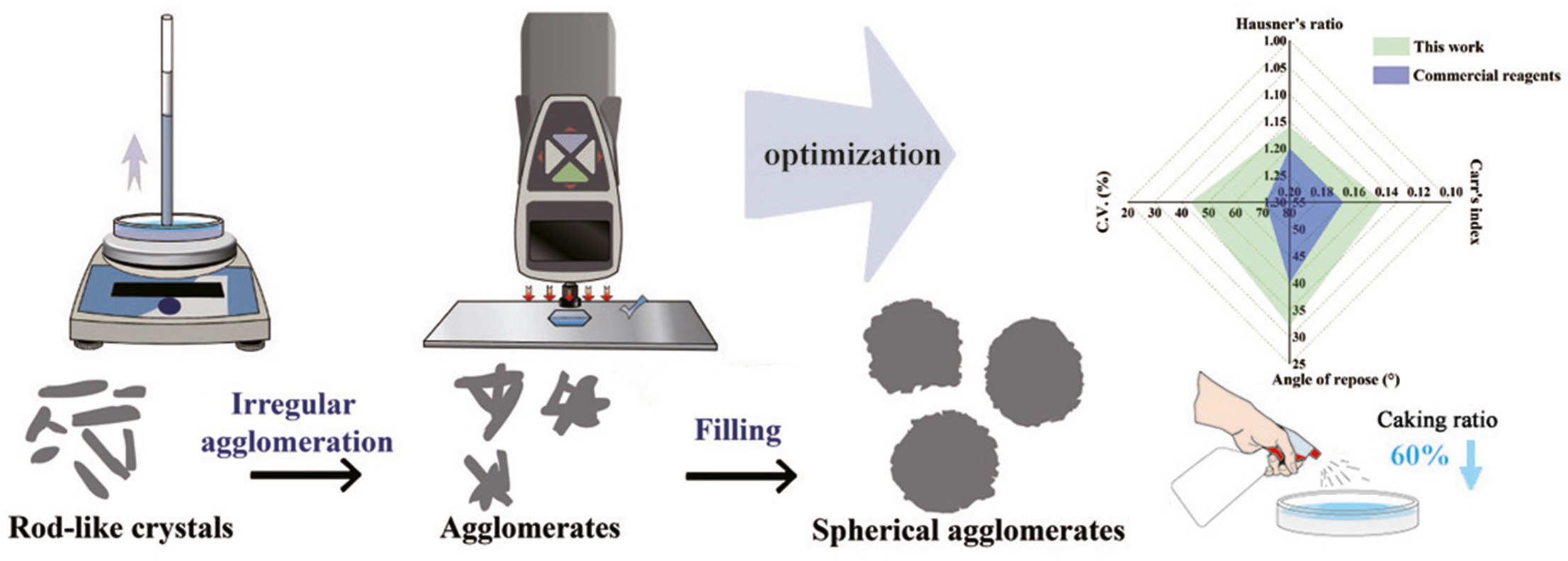
Magnesium citrate nonahydrate (MCN) is a highly effective magnesium supplement that has gained significant popularity in the food and pharmaceutical industries. This is highly attributable to its distinctive chemical structure and its high degree of biocompatibility. In contrast, the utilization of commercial MCN is constrained by its irregular morphology and particle size distribution. In this study, MCN particles were successfully produced. In accordance with the principles of Lifshitz-van der Waals acid-base theory, the adhesion free energy of MCN in water, ethanol, and formamide systems was calculated. Based on the result, water-based solvents were selected as the solvent system for spherical agglomeration. Subsequent analysis elucidated the agglomeration mechanism of MCN in aqueous systems. Furthermore, the crystallization process of MCN were systematically investigated. The optimal process parameters were determined, including seed loading, seed size, initial concentration, stirring rate and temperature. The MCN products exhibited a 20 % decrease in the angle of repose, a 39 % reduction in the coefficient of variation, and a 60 % decline in caking-ratio, thereby substantiating their enhanced quality. This study provides valuable data support and novel insights for the production of high-quality MCN crystals.
Graphical abstract
Keywords
Spherical agglomeration; Magnesium citrate nonahydrate; Particle size distribution; Spherical particles
文章导读