
期刊文章
过刊浏览
- Volumes 108-119 (2025)
-
Volumes 96-107 (2025)
-
Volume 107
Pages 1-376 (December 2025)
-
Volume 106
Pages 1-336 (November 2025)
-
Volume 105
Pages 1-356 (October 2025)
-
Volume 104
Pages 1-332 (September 2025)
-
Volume 103
Pages 1-314 (August 2025)
-
Volume 102
Pages 1-276 (July 2025)
-
Volume 101
Pages 1-166 (June 2025)
-
Volume 100
Pages 1-256 (May 2025)
-
Volume 99
Pages 1-242 (April 2025)
-
Volume 98
Pages 1-288 (March 2025)
-
Volume 97
Pages 1-256 (February 2025)
-
Volume 96
Pages 1-340 (January 2025)
-
Volume 107
-
Volumes 84-95 (2024)
-
Volume 95
Pages 1-392 (December 2024)
-
Volume 94
Pages 1-400 (November 2024)
-
Volume 93
Pages 1-376 (October 2024)
-
Volume 92
Pages 1-316 (September 2024)
-
Volume 91
Pages 1-378 (August 2024)
-
Volume 90
Pages 1-580 (July 2024)
-
Volume 89
Pages 1-278 (June 2024)
-
Volume 88
Pages 1-350 (May 2024)
-
Volume 87
Pages 1-338 (April 2024)
-
Volume 86
Pages 1-312 (March 2024)
-
Volume 85
Pages 1-334 (February 2024)
-
Volume 84
Pages 1-308 (January 2024)
-
Volume 95
-
Volumes 72-83 (2023)
-
Volume 83
Pages 1-258 (December 2023)
-
Volume 82
Pages 1-204 (November 2023)
-
Volume 81
Pages 1-188 (October 2023)
-
Volume 80
Pages 1-202 (September 2023)
-
Volume 79
Pages 1-172 (August 2023)
-
Volume 78
Pages 1-146 (July 2023)
-
Volume 77
Pages 1-152 (June 2023)
-
Volume 76
Pages 1-176 (May 2023)
-
Volume 75
Pages 1-228 (April 2023)
-
Volume 74
Pages 1-200 (March 2023)
-
Volume 73
Pages 1-138 (February 2023)
-
Volume 72
Pages 1-144 (January 2023)
-
Volume 83
-
Volumes 60-71 (2022)
-
Volume 71
Pages 1-108 (December 2022)
-
Volume 70
Pages 1-106 (November 2022)
-
Volume 69
Pages 1-122 (October 2022)
-
Volume 68
Pages 1-124 (September 2022)
-
Volume 67
Pages 1-102 (August 2022)
-
Volume 66
Pages 1-112 (July 2022)
-
Volume 65
Pages 1-138 (June 2022)
-
Volume 64
Pages 1-186 (May 2022)
-
Volume 63
Pages 1-124 (April 2022)
-
Volume 62
Pages 1-104 (March 2022)
-
Volume 61
Pages 1-120 (February 2022)
-
Volume 60
Pages 1-124 (January 2022)
-
Volume 71
- Volumes 54-59 (2021)
- Volumes 48-53 (2020)
- Volumes 42-47 (2019)
- Volumes 36-41 (2018)
- Volumes 30-35 (2017)
- Volumes 24-29 (2016)
- Volumes 18-23 (2015)
- Volumes 12-17 (2014)
- Volume 11 (2013)
- Volume 10 (2012)
- Volume 9 (2011)
- Volume 8 (2010)
- Volume 7 (2009)
- Volume 6 (2008)
- Volume 5 (2007)
- Volume 4 (2006)
- Volume 3 (2005)
- Volume 2 (2004)
- Volume 1 (2003)
Volume 112
Xu, Y., Xu, Y., Li, Z., Liu, X., Duan, C., & Zhou, C. (2026). Porous particles enhance particle-scale agitation for efficient fluidization and heat transfer. Particuology, 112, 123-136. https://doi.org/10.1016/j.partic.2026.02.032
Porous particles enhance particle-scale agitation for efficient fluidization and heat transfer
Yiming Xu a b c d, Yangfan Xu a b c d, Ziyuan Li a b c d, Xibo Liu a b c d, Chenlong Duan a b c d *, Chenyang Zhou a b c d *
a Key Laboratory of Coal Processing and Efficient Utilization of Ministry of Education, China University of Mining and Technology, Xuzhou, 221116, China
b International Joint Laboratory of Minerals Efficient Processing and Utilization, Ministry of Education, Xuzhou, 221116, China
c Jiangsu International University Cooperation Laboratory of Resource Low Carbon Processing & Utilization, Xuzhou, 221116, China
d School of Chemical Engineering & Technology, China University of Mining & Technology, Xuzhou, 221116, China
10.1016/j.partic.2026.02.032
Volume 112,
May 2026,
Pages 123-136
Received 11 December 2025, Revised 14 February 2026, Accepted 23 February 2026, Available online 13 March 2026, Version of Record 19 March 2026.
E-mail:
clduan@cumt.edu.cn; zhoucy@cumt.edu.cn
Highlights
• Pressure fluctuation characteristics of porous and solid particles were studied.
• Particle-scale agitation in fluidized bed was enhanced by porous structure.
• Porous particles brought more stable heat transfer compared with solid particles.
Abstract
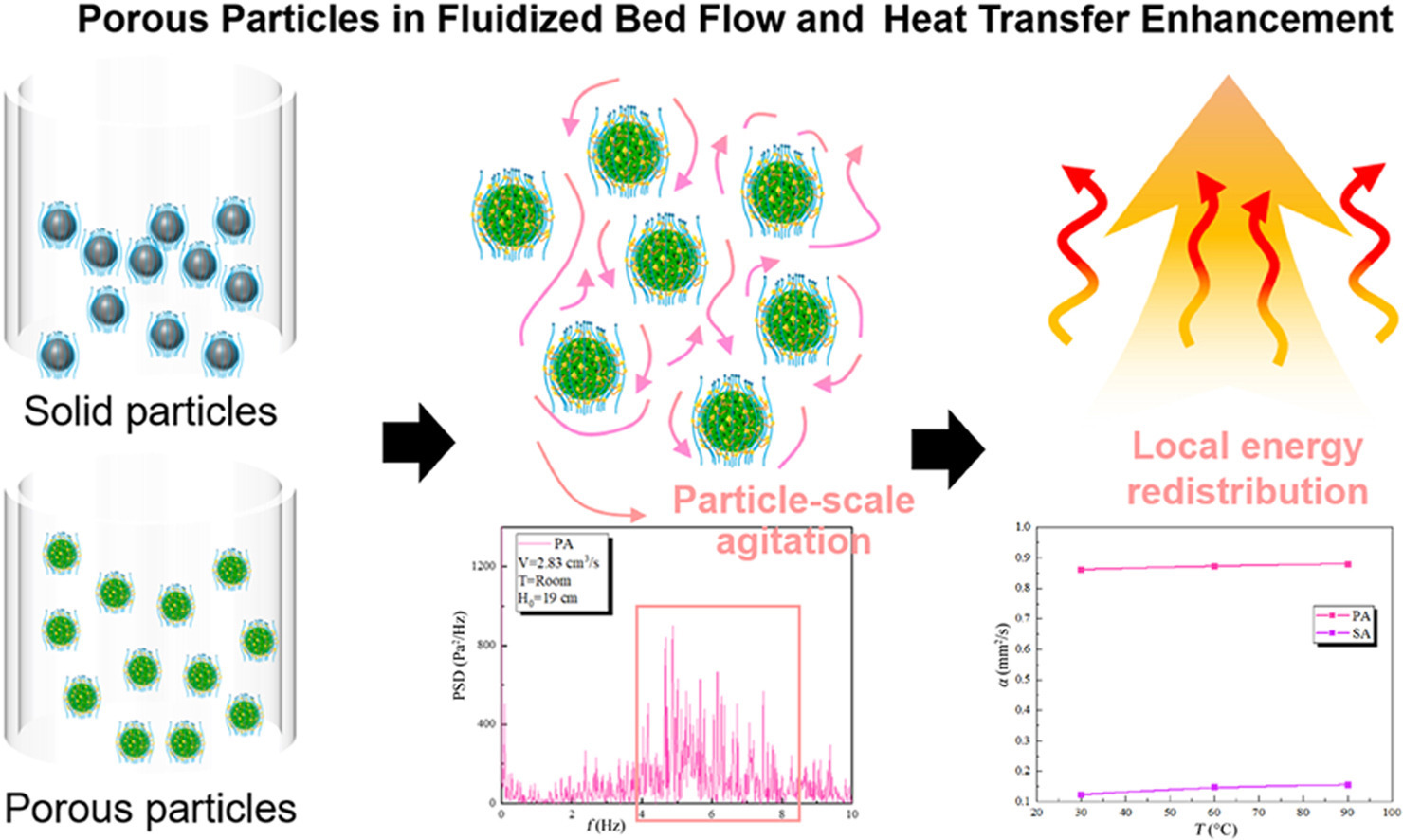
Because of the internal seepage channel, the energy cascade is altered within the fluidized beds of porous particles, yet their physical theory is often interpreted ambiguously. Here, dense particles (SA) and porous particles (PA) with comparable size and apparent density in a heated bubbling fluidized bed are compared, focusing on pressure-drop fluctuations and bed-scale thermal response. Under identical superficial gas velocities, PA shows a lower sensitivity of mean pressure drop to gas velocity. Power spectral density (PSD) analysis reveals a clear spectral energy redistribution. While a distinct low-frequency peak remains, the relative contribution of coherent bubbling components is weakened and mid-to-high-frequency incoherent components are enhanced, indicating intensified particle-scale agitation and localized unsteady interactions associated with permeation/discharge. A critical frequency fc is determined by segmented fitting in low- and high-frequency regions, providing a practical separation between coherent and incoherent contributions. To connect hydrodynamics with thermal performance, we further measure packed-bed thermal properties and fluidized-bed heating curves at 60 and 90 °C. Despite poorer intrinsic conductive/thermal-diffusive properties for PA in the packed state, PA exhibits a markedly faster heating response under fluidization, suggesting that structure–hydrodynamics coupling dominates the thermal enhancement rather than material conductivity alone.
Graphical abstract
Keywords
Porous particle fluidization; Pressure fluctuation characteristics; Particle-scale agitation; Heat transfer enhancement
文章导读