
期刊文章
过刊浏览
- Volumes 108-119 (2025)
-
Volumes 96-107 (2025)
-
Volume 107
Pages 1-376 (December 2025)
-
Volume 106
Pages 1-336 (November 2025)
-
Volume 105
Pages 1-356 (October 2025)
-
Volume 104
Pages 1-332 (September 2025)
-
Volume 103
Pages 1-314 (August 2025)
-
Volume 102
Pages 1-276 (July 2025)
-
Volume 101
Pages 1-166 (June 2025)
-
Volume 100
Pages 1-256 (May 2025)
-
Volume 99
Pages 1-242 (April 2025)
-
Volume 98
Pages 1-288 (March 2025)
-
Volume 97
Pages 1-256 (February 2025)
-
Volume 96
Pages 1-340 (January 2025)
-
Volume 107
-
Volumes 84-95 (2024)
-
Volume 95
Pages 1-392 (December 2024)
-
Volume 94
Pages 1-400 (November 2024)
-
Volume 93
Pages 1-376 (October 2024)
-
Volume 92
Pages 1-316 (September 2024)
-
Volume 91
Pages 1-378 (August 2024)
-
Volume 90
Pages 1-580 (July 2024)
-
Volume 89
Pages 1-278 (June 2024)
-
Volume 88
Pages 1-350 (May 2024)
-
Volume 87
Pages 1-338 (April 2024)
-
Volume 86
Pages 1-312 (March 2024)
-
Volume 85
Pages 1-334 (February 2024)
-
Volume 84
Pages 1-308 (January 2024)
-
Volume 95
-
Volumes 72-83 (2023)
-
Volume 83
Pages 1-258 (December 2023)
-
Volume 82
Pages 1-204 (November 2023)
-
Volume 81
Pages 1-188 (October 2023)
-
Volume 80
Pages 1-202 (September 2023)
-
Volume 79
Pages 1-172 (August 2023)
-
Volume 78
Pages 1-146 (July 2023)
-
Volume 77
Pages 1-152 (June 2023)
-
Volume 76
Pages 1-176 (May 2023)
-
Volume 75
Pages 1-228 (April 2023)
-
Volume 74
Pages 1-200 (March 2023)
-
Volume 73
Pages 1-138 (February 2023)
-
Volume 72
Pages 1-144 (January 2023)
-
Volume 83
-
Volumes 60-71 (2022)
-
Volume 71
Pages 1-108 (December 2022)
-
Volume 70
Pages 1-106 (November 2022)
-
Volume 69
Pages 1-122 (October 2022)
-
Volume 68
Pages 1-124 (September 2022)
-
Volume 67
Pages 1-102 (August 2022)
-
Volume 66
Pages 1-112 (July 2022)
-
Volume 65
Pages 1-138 (June 2022)
-
Volume 64
Pages 1-186 (May 2022)
-
Volume 63
Pages 1-124 (April 2022)
-
Volume 62
Pages 1-104 (March 2022)
-
Volume 61
Pages 1-120 (February 2022)
-
Volume 60
Pages 1-124 (January 2022)
-
Volume 71
- Volumes 54-59 (2021)
- Volumes 48-53 (2020)
- Volumes 42-47 (2019)
- Volumes 36-41 (2018)
- Volumes 30-35 (2017)
- Volumes 24-29 (2016)
- Volumes 18-23 (2015)
- Volumes 12-17 (2014)
- Volume 11 (2013)
- Volume 10 (2012)
- Volume 9 (2011)
- Volume 8 (2010)
- Volume 7 (2009)
- Volume 6 (2008)
- Volume 5 (2007)
- Volume 4 (2006)
- Volume 3 (2005)
- Volume 2 (2004)
- Volume 1 (2003)
Volume 112
Liu, Z., Lv, Z., Yang, F., & Xia, Y. (2026). In-situ adsorption of aluminum-adjuvanted hepatitis B vaccine for optimized antigen distribution and enhanced vaccination. Particuology, 112, 137-144. https://doi.org/10.1016/j.partic.2026.03.001
In-situ adsorption of aluminum-adjuvanted hepatitis B vaccine for optimized antigen distribution and enhanced vaccination
Zequn Liu a b c d, Zhe Lv c, Fan Yang c, Yufei Xia a b d *
a State Key Laboratory of Biopharmaceutical Preparation and Delivery, Institute of Process Engineering, Chinese Academy of Sciences, Beijing, 100190, China
b University of Chinese Academy of Sciences, Beijing, 100049, China
c Sinovac Life Sciences CO., LTD., Beijing, 100085, China
d IPE-Sinovac Joint Laboratory of Advanced Adjuvant and Delivery Systems, Beijing, 100190, China
10.1016/j.partic.2026.03.001
Volume 112,
May 2026,
Pages 137-144
Received 4 January 2026, Revised 24 February 2026, Accepted 1 March 2026, Available online 13 March 2026, Version of Record 19 March 2026.
E-mail:
yfxia@ipe.ac.cn
Highlights
• Antigen distribution varied with process and dictated vaccine immunogenicity.
• Multilayer adsorption was achieved by slow-titration in-situ adsorption process.
• In-situ adsorption process yielded high capacity alongside low strength.
• Optimal antigen distribution enhanced both stability and in vivo/vitro potency.
Abstract
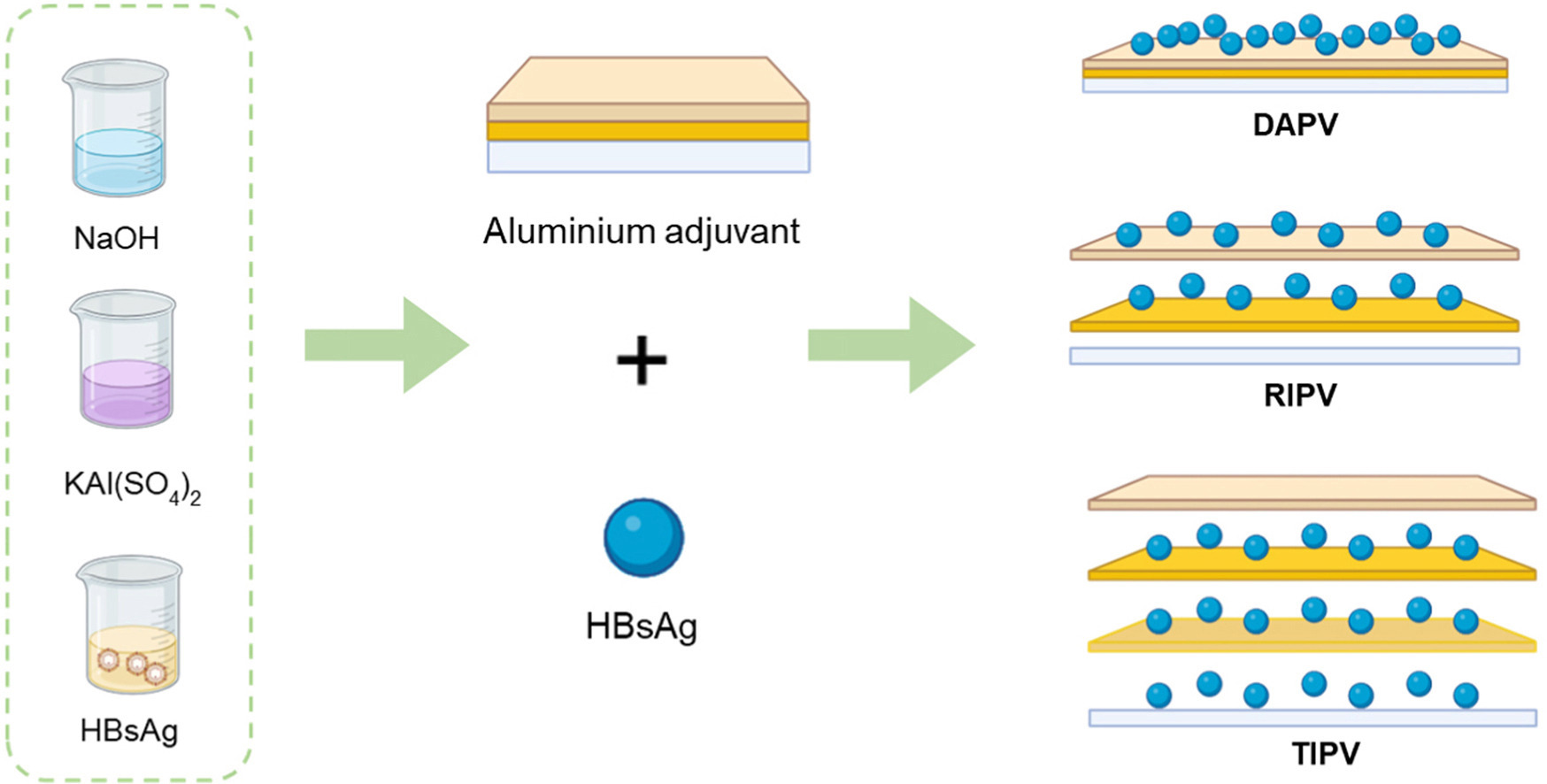
Aluminum hydroxide (AH) exerts adjuvanticity predominately through efficient antigen loading. While extensive studies have reported how antigen adsorption onto pre-formed AH influences vaccine immunogenicity, the impact of in-situ antigen adsorption during AH formation remains underexplored. In this study, hepatitis B vaccines were prepared using conventional direct adsorption and two in-situ methods (rapid in-situ process and slow-titration in-situ formation), and compared in terms of physicochemical properties, antigen adsorption capacity and binding strength, antigen distribution, sedimentation properties and in vitro/in vivo potency. We showed that in-situ adsorption enabled multilayer antigen incorporation within the AH matrix, increasing adsorption capacity while reducing adsorption strength. Furthermore, slow-growth in-situ formation of AH promoted more extensive antigen layering than rapid-growth conditions, leading to sustained antigen release and superior in vivo efficacy. Together, these findings establish in-situ adsorption as an effective strategy for engineering antigen-AH interactions, enabling enhanced aluminum-adjuvanted vaccines without the need for additional adjuvant components.
Graphical abstract
Keywords
Hepatitis B vaccine; Aluminum adjuvant; In-situ adsorption; Antigen depot
文章导读