
期刊文章
过刊浏览
- Volumes 108-119 (2025)
-
Volumes 96-107 (2025)
-
Volume 107
Pages 1-376 (December 2025)
-
Volume 106
Pages 1-336 (November 2025)
-
Volume 105
Pages 1-356 (October 2025)
-
Volume 104
Pages 1-332 (September 2025)
-
Volume 103
Pages 1-314 (August 2025)
-
Volume 102
Pages 1-276 (July 2025)
-
Volume 101
Pages 1-166 (June 2025)
-
Volume 100
Pages 1-256 (May 2025)
-
Volume 99
Pages 1-242 (April 2025)
-
Volume 98
Pages 1-288 (March 2025)
-
Volume 97
Pages 1-256 (February 2025)
-
Volume 96
Pages 1-340 (January 2025)
-
Volume 107
-
Volumes 84-95 (2024)
-
Volume 95
Pages 1-392 (December 2024)
-
Volume 94
Pages 1-400 (November 2024)
-
Volume 93
Pages 1-376 (October 2024)
-
Volume 92
Pages 1-316 (September 2024)
-
Volume 91
Pages 1-378 (August 2024)
-
Volume 90
Pages 1-580 (July 2024)
-
Volume 89
Pages 1-278 (June 2024)
-
Volume 88
Pages 1-350 (May 2024)
-
Volume 87
Pages 1-338 (April 2024)
-
Volume 86
Pages 1-312 (March 2024)
-
Volume 85
Pages 1-334 (February 2024)
-
Volume 84
Pages 1-308 (January 2024)
-
Volume 95
-
Volumes 72-83 (2023)
-
Volume 83
Pages 1-258 (December 2023)
-
Volume 82
Pages 1-204 (November 2023)
-
Volume 81
Pages 1-188 (October 2023)
-
Volume 80
Pages 1-202 (September 2023)
-
Volume 79
Pages 1-172 (August 2023)
-
Volume 78
Pages 1-146 (July 2023)
-
Volume 77
Pages 1-152 (June 2023)
-
Volume 76
Pages 1-176 (May 2023)
-
Volume 75
Pages 1-228 (April 2023)
-
Volume 74
Pages 1-200 (March 2023)
-
Volume 73
Pages 1-138 (February 2023)
-
Volume 72
Pages 1-144 (January 2023)
-
Volume 83
-
Volumes 60-71 (2022)
-
Volume 71
Pages 1-108 (December 2022)
-
Volume 70
Pages 1-106 (November 2022)
-
Volume 69
Pages 1-122 (October 2022)
-
Volume 68
Pages 1-124 (September 2022)
-
Volume 67
Pages 1-102 (August 2022)
-
Volume 66
Pages 1-112 (July 2022)
-
Volume 65
Pages 1-138 (June 2022)
-
Volume 64
Pages 1-186 (May 2022)
-
Volume 63
Pages 1-124 (April 2022)
-
Volume 62
Pages 1-104 (March 2022)
-
Volume 61
Pages 1-120 (February 2022)
-
Volume 60
Pages 1-124 (January 2022)
-
Volume 71
- Volumes 54-59 (2021)
- Volumes 48-53 (2020)
- Volumes 42-47 (2019)
- Volumes 36-41 (2018)
- Volumes 30-35 (2017)
- Volumes 24-29 (2016)
- Volumes 18-23 (2015)
- Volumes 12-17 (2014)
- Volume 11 (2013)
- Volume 10 (2012)
- Volume 9 (2011)
- Volume 8 (2010)
- Volume 7 (2009)
- Volume 6 (2008)
- Volume 5 (2007)
- Volume 4 (2006)
- Volume 3 (2005)
- Volume 2 (2004)
- Volume 1 (2003)
Volume 112
Saeed, M., Alhosani, M. H., Alam, K., Arshad, A., Mikhaylov, D., & Al Wahedi, Y. F. (2026). Computational insights into erosion dynamics: Wind speed, particle size, and mass effects on turbine blade degradation. Particuology, 112, 145-159. https://doi.org/10.1016/j.partic.2026.02.031
Computational insights into erosion dynamics: Wind speed, particle size, and mass effects on turbine blade degradation
Muhammad Saeed a *, Mohamed Husain Alhosani a, Khurshid Alam b *, Adeel Arshad c, Dmitry Mikhaylov a, Yasser F. Al Wahedi a
a Abu Dhabi Maritime Academy, P.O. Box 54477, Abu Dhabi, United Arab Emirates
b Department of Mechanical and Industrial Engineering, College of Engineering, Sultan Qaboos University, Al-Khoud 123, Sultanate of Oman
c Department of Mechatronics and Biomedical Engineering, College of Engineering and Physical Sciences, Aston University, Birmingham, B4 7ET, United Kingdom
10.1016/j.partic.2026.02.031
Volume 112,
May 2026,
Pages 145-159
Received 29 October 2025, Revised 22 January 2026, Accepted 7 February 2026, Available online 12 March 2026, Version of Record 19 March 2026.
E-mail:
muhammad.saeed@adports.ae; saeed.aarib@gmail.com; kalam@squ.edu.om
Highlights
• CFD-based study of wind turbine blade erosion in sandy environments.
• Wind speed, sand mass fraction, and particle size effects systematically analyzed.
• Nonlinear erosion and stress behavior identified from root to tip.
• Larger particles induce higher but complex erosion patterns.
• Results guide blade material design and erosion mitigation strategies.
Abstract
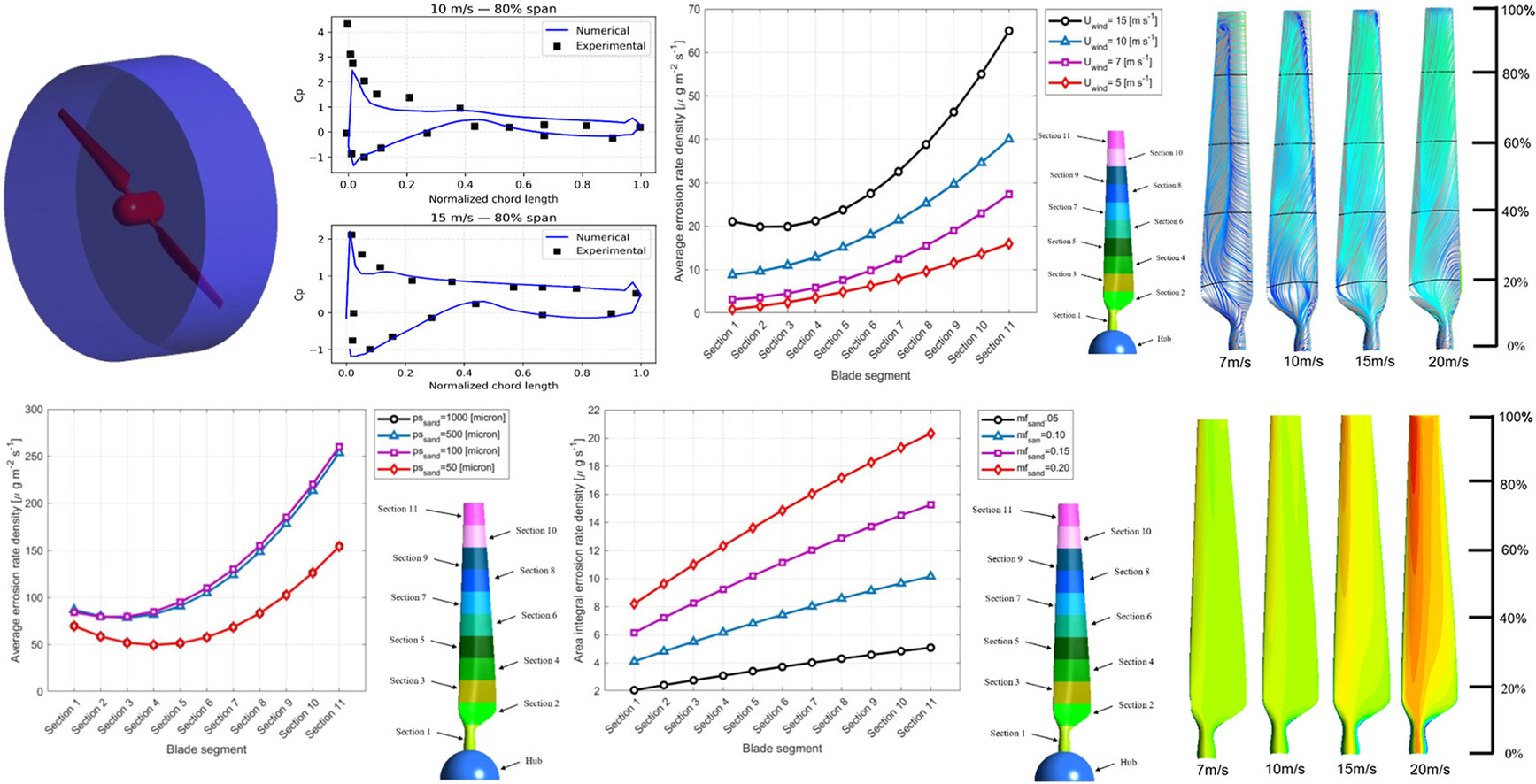
The durability and efficiency of wind turbines in sandy environments are crucial challenges for the renewable energy sector. Erosion poses a significant threat to these installations’ operational lifespan and economic viability. Understanding the factors influencing erosion rates and the resulting stresses on turbine blades is essential for advancing wind energy as a reliable and cost-effective power source. This study involves the complex dynamics between wind speed, sand particle size, and sand mass fraction, and their combined impact on erosion rate density and stress distribution across wind turbine blades. Through comprehensive computational simulations, the investigation of the erosion patterns from the blade root to the tip is carried out under varying conditions, i.e., wind speeds ranging from 5 to 15 m/s, sand mass fractions from 0.05 to 0.20, and particle sizes from 100 to 1000 μm. The computational study was conducted using a commercial code. The results reveal a direct relationship between increasing wind speeds and the intensification of erosion rate densities, with the blade tip experiencing significantly more erosion than the root. Moreover, higher sand mass fractions were associated with increased erosion rate densities and stresses along the entire blade. The analysis of particle size effects showed that larger particles predominantly induce greater erosion rates, though the largest particles exhibit non-linear behaviour, indicating complex aerodynamic interactions.
Graphical abstract
Keywords
Wind turbine; CFD; Blade erosion; 3D RANS model; Renewable energy
文章导读