
期刊文章
过刊浏览
- Volumes 108-119 (2025)
-
Volumes 96-107 (2025)
-
Volume 107
Pages 1-376 (December 2025)
-
Volume 106
Pages 1-336 (November 2025)
-
Volume 105
Pages 1-356 (October 2025)
-
Volume 104
Pages 1-332 (September 2025)
-
Volume 103
Pages 1-314 (August 2025)
-
Volume 102
Pages 1-276 (July 2025)
-
Volume 101
Pages 1-166 (June 2025)
-
Volume 100
Pages 1-256 (May 2025)
-
Volume 99
Pages 1-242 (April 2025)
-
Volume 98
Pages 1-288 (March 2025)
-
Volume 97
Pages 1-256 (February 2025)
-
Volume 96
Pages 1-340 (January 2025)
-
Volume 107
-
Volumes 84-95 (2024)
-
Volume 95
Pages 1-392 (December 2024)
-
Volume 94
Pages 1-400 (November 2024)
-
Volume 93
Pages 1-376 (October 2024)
-
Volume 92
Pages 1-316 (September 2024)
-
Volume 91
Pages 1-378 (August 2024)
-
Volume 90
Pages 1-580 (July 2024)
-
Volume 89
Pages 1-278 (June 2024)
-
Volume 88
Pages 1-350 (May 2024)
-
Volume 87
Pages 1-338 (April 2024)
-
Volume 86
Pages 1-312 (March 2024)
-
Volume 85
Pages 1-334 (February 2024)
-
Volume 84
Pages 1-308 (January 2024)
-
Volume 95
-
Volumes 72-83 (2023)
-
Volume 83
Pages 1-258 (December 2023)
-
Volume 82
Pages 1-204 (November 2023)
-
Volume 81
Pages 1-188 (October 2023)
-
Volume 80
Pages 1-202 (September 2023)
-
Volume 79
Pages 1-172 (August 2023)
-
Volume 78
Pages 1-146 (July 2023)
-
Volume 77
Pages 1-152 (June 2023)
-
Volume 76
Pages 1-176 (May 2023)
-
Volume 75
Pages 1-228 (April 2023)
-
Volume 74
Pages 1-200 (March 2023)
-
Volume 73
Pages 1-138 (February 2023)
-
Volume 72
Pages 1-144 (January 2023)
-
Volume 83
-
Volumes 60-71 (2022)
-
Volume 71
Pages 1-108 (December 2022)
-
Volume 70
Pages 1-106 (November 2022)
-
Volume 69
Pages 1-122 (October 2022)
-
Volume 68
Pages 1-124 (September 2022)
-
Volume 67
Pages 1-102 (August 2022)
-
Volume 66
Pages 1-112 (July 2022)
-
Volume 65
Pages 1-138 (June 2022)
-
Volume 64
Pages 1-186 (May 2022)
-
Volume 63
Pages 1-124 (April 2022)
-
Volume 62
Pages 1-104 (March 2022)
-
Volume 61
Pages 1-120 (February 2022)
-
Volume 60
Pages 1-124 (January 2022)
-
Volume 71
- Volumes 54-59 (2021)
- Volumes 48-53 (2020)
- Volumes 42-47 (2019)
- Volumes 36-41 (2018)
- Volumes 30-35 (2017)
- Volumes 24-29 (2016)
- Volumes 18-23 (2015)
- Volumes 12-17 (2014)
- Volume 11 (2013)
- Volume 10 (2012)
- Volume 9 (2011)
- Volume 8 (2010)
- Volume 7 (2009)
- Volume 6 (2008)
- Volume 5 (2007)
- Volume 4 (2006)
- Volume 3 (2005)
- Volume 2 (2004)
- Volume 1 (2003)
Volume 112
Zheng, Q., He, Y., Liu, G., Zhang, G., Liu, Y., Liu, X., . . . Zhang, P. (2026). Principles and optimization of magnetic minerals separation from lunar regolith by dry drum magnetic separator. Particuology, 112, 160-169. https://doi.org/10.1016/j.partic.2026.02.029
Principles and optimization of magnetic minerals separation from lunar regolith by dry drum magnetic separator
Quan Zheng a 1, Yizhuo He a 1, Guanghui Liu a *, Guang Zhang a *, Yiwei Liu a, Xin Liu a, Songzheng Yu a, Ziwei Tian a, Hanyu Wang a, Yongcan Deng a, Shuaishuai Li b, Peng Zhang a *
a Technology and Engineering Center for Space Utilization, Chinese Academy of Sciences, Beijing, 100094, China
b Department of Biology, McGill University, Montreal, H3A 1B1, Canada
10.1016/j.partic.2026.02.029
Volume 112,
May 2026,
Pages 160-169
Received 16 December 2025, Revised 30 January 2026, Accepted 22 February 2026, Available online 12 March 2026, Version of Record 19 March 2026.
E-mail:
liugh1991@126.com; zhangguang@csu.ac.cn; zhangpeng@csu.ac.cn
Highlights
• A separator was designed to separate magnetic mineral particles in lunar regolith.
• Motion trajectories and landing points distribution of the lunar particles revealed beneficiation principle.
• Kinematics mechanism and efficiency of lunar regolith magnetic beneficiation were analyzed.
Abstract
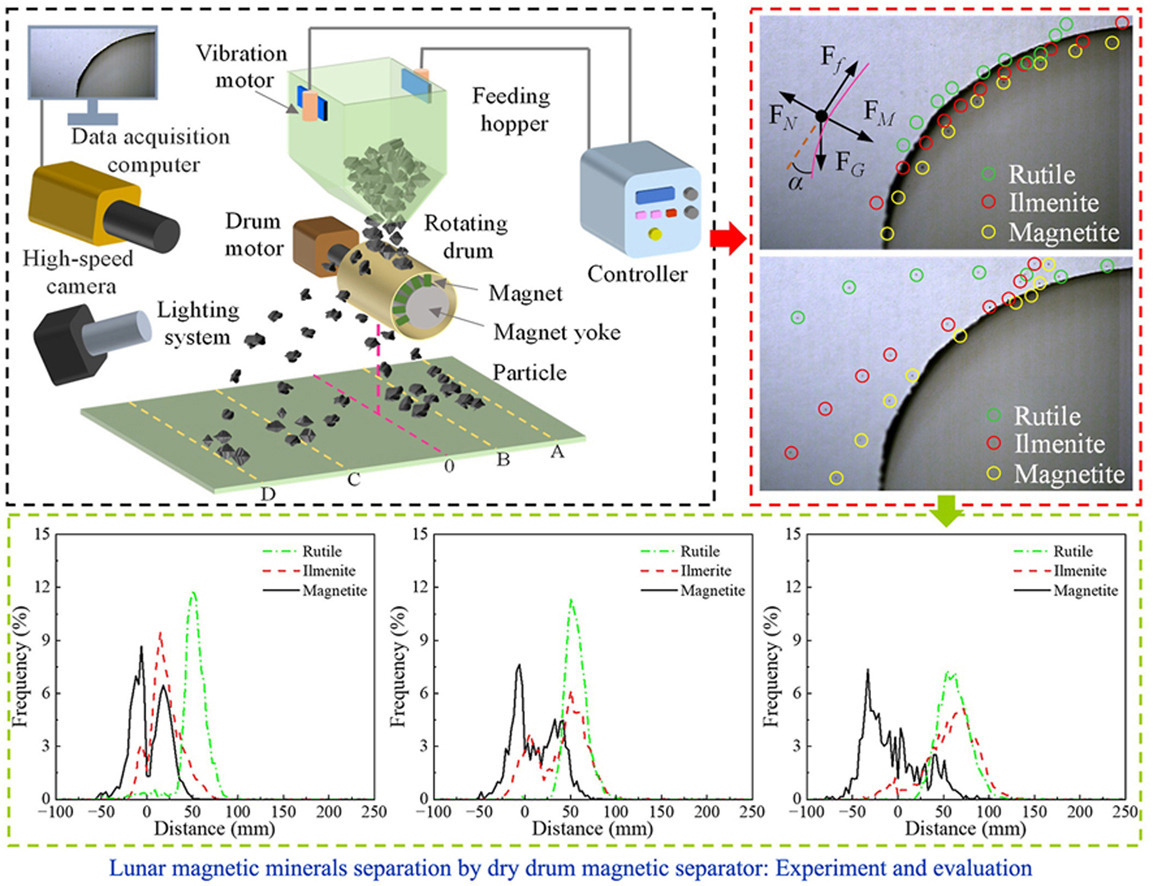
Recent trends in lunar scientific research have led to the proliferation of studies on utilizing lunar regolith as one of the most accessible resources. Magnetic minerals in lunar regolith play a key role in studying lunar geology, lunar evolution, and even cosmic events; they are also vital raw materials for the in-situ resource utilization and lunar base construction in the future. This study developed a ground prototype of the dry drum magnetic separation device with main components adapting to the harsh conditions on the lunar surface, to meet the separation and enrichment requirements of magnetic minerals from lunar regolith. Particle-scale kinematics was analyzed in ground verification experiments to explain the effect of different particle sizes, magnetic properties and drum speeds. The beneficiation performance for lunar regolith was calculated according to the magnetic minerals’ proportion in real lunar regolith, and separation parameters were optimized for different beneficiation targets. The results proved the high efficiency of dry drum magnetic separator in magnetic minerals separation from lunar regolith, and clarified the mechanism of particle motion in the process of mineral separation. This study can support magnetic minerals enrichment in lunar exploration project such as lunar detection sampling and payload production serving, as well as long-term lunar research missions such as water/oxygen production and titanium/iron metal smelting.
Graphical abstract
Keywords
Lunar regolith; Magnetic minerals; Dry drum magnetic separation; Kinematic mechanism
文章导读