
期刊文章
过刊浏览
- Volumes 108-119 (2025)
-
Volumes 96-107 (2025)
-
Volume 107
Pages 1-376 (December 2025)
-
Volume 106
Pages 1-336 (November 2025)
-
Volume 105
Pages 1-356 (October 2025)
-
Volume 104
Pages 1-332 (September 2025)
-
Volume 103
Pages 1-314 (August 2025)
-
Volume 102
Pages 1-276 (July 2025)
-
Volume 101
Pages 1-166 (June 2025)
-
Volume 100
Pages 1-256 (May 2025)
-
Volume 99
Pages 1-242 (April 2025)
-
Volume 98
Pages 1-288 (March 2025)
-
Volume 97
Pages 1-256 (February 2025)
-
Volume 96
Pages 1-340 (January 2025)
-
Volume 107
-
Volumes 84-95 (2024)
-
Volume 95
Pages 1-392 (December 2024)
-
Volume 94
Pages 1-400 (November 2024)
-
Volume 93
Pages 1-376 (October 2024)
-
Volume 92
Pages 1-316 (September 2024)
-
Volume 91
Pages 1-378 (August 2024)
-
Volume 90
Pages 1-580 (July 2024)
-
Volume 89
Pages 1-278 (June 2024)
-
Volume 88
Pages 1-350 (May 2024)
-
Volume 87
Pages 1-338 (April 2024)
-
Volume 86
Pages 1-312 (March 2024)
-
Volume 85
Pages 1-334 (February 2024)
-
Volume 84
Pages 1-308 (January 2024)
-
Volume 95
-
Volumes 72-83 (2023)
-
Volume 83
Pages 1-258 (December 2023)
-
Volume 82
Pages 1-204 (November 2023)
-
Volume 81
Pages 1-188 (October 2023)
-
Volume 80
Pages 1-202 (September 2023)
-
Volume 79
Pages 1-172 (August 2023)
-
Volume 78
Pages 1-146 (July 2023)
-
Volume 77
Pages 1-152 (June 2023)
-
Volume 76
Pages 1-176 (May 2023)
-
Volume 75
Pages 1-228 (April 2023)
-
Volume 74
Pages 1-200 (March 2023)
-
Volume 73
Pages 1-138 (February 2023)
-
Volume 72
Pages 1-144 (January 2023)
-
Volume 83
-
Volumes 60-71 (2022)
-
Volume 71
Pages 1-108 (December 2022)
-
Volume 70
Pages 1-106 (November 2022)
-
Volume 69
Pages 1-122 (October 2022)
-
Volume 68
Pages 1-124 (September 2022)
-
Volume 67
Pages 1-102 (August 2022)
-
Volume 66
Pages 1-112 (July 2022)
-
Volume 65
Pages 1-138 (June 2022)
-
Volume 64
Pages 1-186 (May 2022)
-
Volume 63
Pages 1-124 (April 2022)
-
Volume 62
Pages 1-104 (March 2022)
-
Volume 61
Pages 1-120 (February 2022)
-
Volume 60
Pages 1-124 (January 2022)
-
Volume 71
- Volumes 54-59 (2021)
- Volumes 48-53 (2020)
- Volumes 42-47 (2019)
- Volumes 36-41 (2018)
- Volumes 30-35 (2017)
- Volumes 24-29 (2016)
- Volumes 18-23 (2015)
- Volumes 12-17 (2014)
- Volume 11 (2013)
- Volume 10 (2012)
- Volume 9 (2011)
- Volume 8 (2010)
- Volume 7 (2009)
- Volume 6 (2008)
- Volume 5 (2007)
- Volume 4 (2006)
- Volume 3 (2005)
- Volume 2 (2004)
- Volume 1 (2003)
Volume 112
Lima Martins, L. F., Lobato, F. S., Dantas, S. C., & Hori, C. E. (2026). Experimental and numerical study of calcium carbonate precipitation for CO2 trapping in an industrial unit using a semi-batch reactor: Parameter estimation and multi-objective optimization. Particuology, 112, 170-182. https://doi.org/10.1016/j.partic.2026.02.028
Experimental and numerical study of calcium carbonate precipitation for CO2 trapping in an industrial unit using a semi-batch reactor: Parameter estimation and multi-objective optimization
Luiz Filipe Lima Martins a, Fran Sérgio Lobato a *, Sandra Cristina Dantas b, Carla Eponina Hori a
a School of Chemical Engineering, Federal University of Uberlândia, Uberlândia, Brazil
b Department of Chemical Engineering, Federal University of Triângulo Mineiro, Uberaba, Brazil
10.1016/j.partic.2026.02.028
Volume 112,
May 2026,
Pages 170-182
Received 13 November 2025, Revised 20 February 2026, Accepted 23 February 2026, Available online 14 March 2026, Version of Record 21 March 2026.
E-mail:
fslobato@ufu.br
Highlights
• CO2 absorption and CaCO3 precipitation modeled in a semi-batch reactor.
• Phenomenological and kinetic parameters estimated via inverse problem.
• Process variables analyzed using central composite design and meta-models.
• CO2 mass transfer coefficients consistent with literature values.
• Multi-objective optimization identified optimal operating conditions.
Abstract
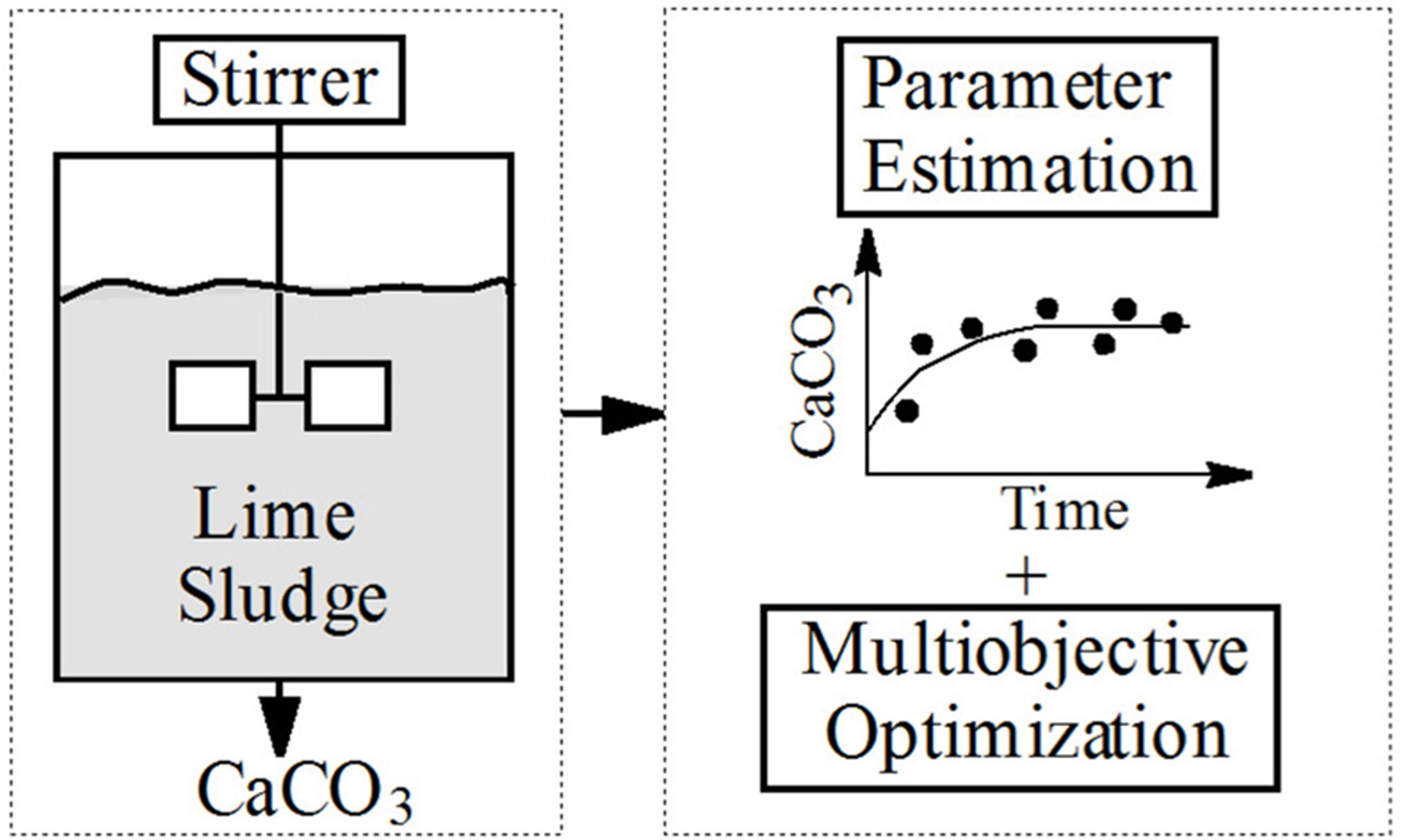
The search for sustainable carbon dioxide (CO2) capture and reutilization strategies has intensified due to the environmental impact of industrial emissions. In this study, the calcium carbonate precipitation process via CO2 absorption into an aqueous solution of calcium hydroxide in a stirred semi-batch reactor is investigated. The mathematical model describing this process incorporates both absorption and reaction kinetics, as well as hydrodynamic conditions. Phenomenological and kinetic parameters are estimated by formulating and solving an inverse problem based on experimental data from the industrial unit, considering different initial calcium ion concentrations. Furthermore, the influence of operational variables (solid content, CO2 concentration, and mixing speed) on time to completion and the mass of carbonates formed was assessed using a central composite design. A multi-objective optimization problem was formulated to determine the operational conditions that minimize time to completion and maximize the mass of carbonates formed. The results demonstrate that the proposed methodology provides accurate estimates for the CO2 mass transfer coefficient, which are in good agreement with literature values. However, for the kinetic parameters, the obtained ranges were not consistent with those reported in the literature. This discrepancy is likely due to the fact that the sample used was not pure. From a statistical perspective, the obtained meta-models were not influenced by the mixing speed. The points forming the Pareto curve correspond to higher values of CO2 concentration and solid content within the defined domain. Finally, a trade-off solution between the objectives was determined, allowing for the selection of a point on the Pareto curve for practical application.
Graphical abstract
Keywords
Calcium carbonate precipitation; CO2 Trapping; Phenomenological model; Inverse problem; Differential evolution; Multi-objective optimization
文章导读