
期刊文章
过刊浏览
- Volumes 108-119 (2025)
-
Volumes 96-107 (2025)
-
Volume 107
Pages 1-376 (December 2025)
-
Volume 106
Pages 1-336 (November 2025)
-
Volume 105
Pages 1-356 (October 2025)
-
Volume 104
Pages 1-332 (September 2025)
-
Volume 103
Pages 1-314 (August 2025)
-
Volume 102
Pages 1-276 (July 2025)
-
Volume 101
Pages 1-166 (June 2025)
-
Volume 100
Pages 1-256 (May 2025)
-
Volume 99
Pages 1-242 (April 2025)
-
Volume 98
Pages 1-288 (March 2025)
-
Volume 97
Pages 1-256 (February 2025)
-
Volume 96
Pages 1-340 (January 2025)
-
Volume 107
-
Volumes 84-95 (2024)
-
Volume 95
Pages 1-392 (December 2024)
-
Volume 94
Pages 1-400 (November 2024)
-
Volume 93
Pages 1-376 (October 2024)
-
Volume 92
Pages 1-316 (September 2024)
-
Volume 91
Pages 1-378 (August 2024)
-
Volume 90
Pages 1-580 (July 2024)
-
Volume 89
Pages 1-278 (June 2024)
-
Volume 88
Pages 1-350 (May 2024)
-
Volume 87
Pages 1-338 (April 2024)
-
Volume 86
Pages 1-312 (March 2024)
-
Volume 85
Pages 1-334 (February 2024)
-
Volume 84
Pages 1-308 (January 2024)
-
Volume 95
-
Volumes 72-83 (2023)
-
Volume 83
Pages 1-258 (December 2023)
-
Volume 82
Pages 1-204 (November 2023)
-
Volume 81
Pages 1-188 (October 2023)
-
Volume 80
Pages 1-202 (September 2023)
-
Volume 79
Pages 1-172 (August 2023)
-
Volume 78
Pages 1-146 (July 2023)
-
Volume 77
Pages 1-152 (June 2023)
-
Volume 76
Pages 1-176 (May 2023)
-
Volume 75
Pages 1-228 (April 2023)
-
Volume 74
Pages 1-200 (March 2023)
-
Volume 73
Pages 1-138 (February 2023)
-
Volume 72
Pages 1-144 (January 2023)
-
Volume 83
-
Volumes 60-71 (2022)
-
Volume 71
Pages 1-108 (December 2022)
-
Volume 70
Pages 1-106 (November 2022)
-
Volume 69
Pages 1-122 (October 2022)
-
Volume 68
Pages 1-124 (September 2022)
-
Volume 67
Pages 1-102 (August 2022)
-
Volume 66
Pages 1-112 (July 2022)
-
Volume 65
Pages 1-138 (June 2022)
-
Volume 64
Pages 1-186 (May 2022)
-
Volume 63
Pages 1-124 (April 2022)
-
Volume 62
Pages 1-104 (March 2022)
-
Volume 61
Pages 1-120 (February 2022)
-
Volume 60
Pages 1-124 (January 2022)
-
Volume 71
- Volumes 54-59 (2021)
- Volumes 48-53 (2020)
- Volumes 42-47 (2019)
- Volumes 36-41 (2018)
- Volumes 30-35 (2017)
- Volumes 24-29 (2016)
- Volumes 18-23 (2015)
- Volumes 12-17 (2014)
- Volume 11 (2013)
- Volume 10 (2012)
- Volume 9 (2011)
- Volume 8 (2010)
- Volume 7 (2009)
- Volume 6 (2008)
- Volume 5 (2007)
- Volume 4 (2006)
- Volume 3 (2005)
- Volume 2 (2004)
- Volume 1 (2003)
Volume 112
Xu, Z., Zhang, M., Wang, X., Cao, C., Li, J., Li, Z., & Hu, S. (2026). Resource recovery from fly ash via alkali fusion: Synthesis and silicon sustained-release behavior of calcium silicate hydrate. Particuology, 112, 183-196. https://doi.org/10.1016/j.partic.2026.03.002
Resource recovery from fly ash via alkali fusion: Synthesis and silicon sustained-release behavior of calcium silicate hydrate
Zifang Xu a b, Mengtian Zhang a, Xuekai Wang a c *, Chenzhen Cao a, Jiawei Li a, Zheng Li a, Shuangyue Hu a
a School of Materials Science and Engineering, Anhui University of Science and Technology, Huainan, 232001, China
b National Key Laboratory of Safe Mining and Environmental Protection in Deep Coal Resources, Huainan, 232000, China
c Anhui Industrial Generic Technology Research Center for New Materials from Coal-based Solid Wastes, Huainan, 232001, China
10.1016/j.partic.2026.03.002
Volume 112,
May 2026,
Pages 183-196
Received 5 December 2025, Revised 2 February 2026, Accepted 1 March 2026, Available online 17 March 2026, Version of Record 24 March 2026.
E-mail:
wangxuekai@aust.edu.cn
Highlights
• Developed an acid-free Na2CO3 alkali fusion process for CFA, producing functional C-S-H.
• Synthesized C-S-H slow-release silicon fertilizer, regulated by an in-situ forming CaCO3 barrier layer.
• Elucidated the silicon phase transformation mechanism in CFA during alkali fusion, highlighting side-reaction inhibition.
Abstract
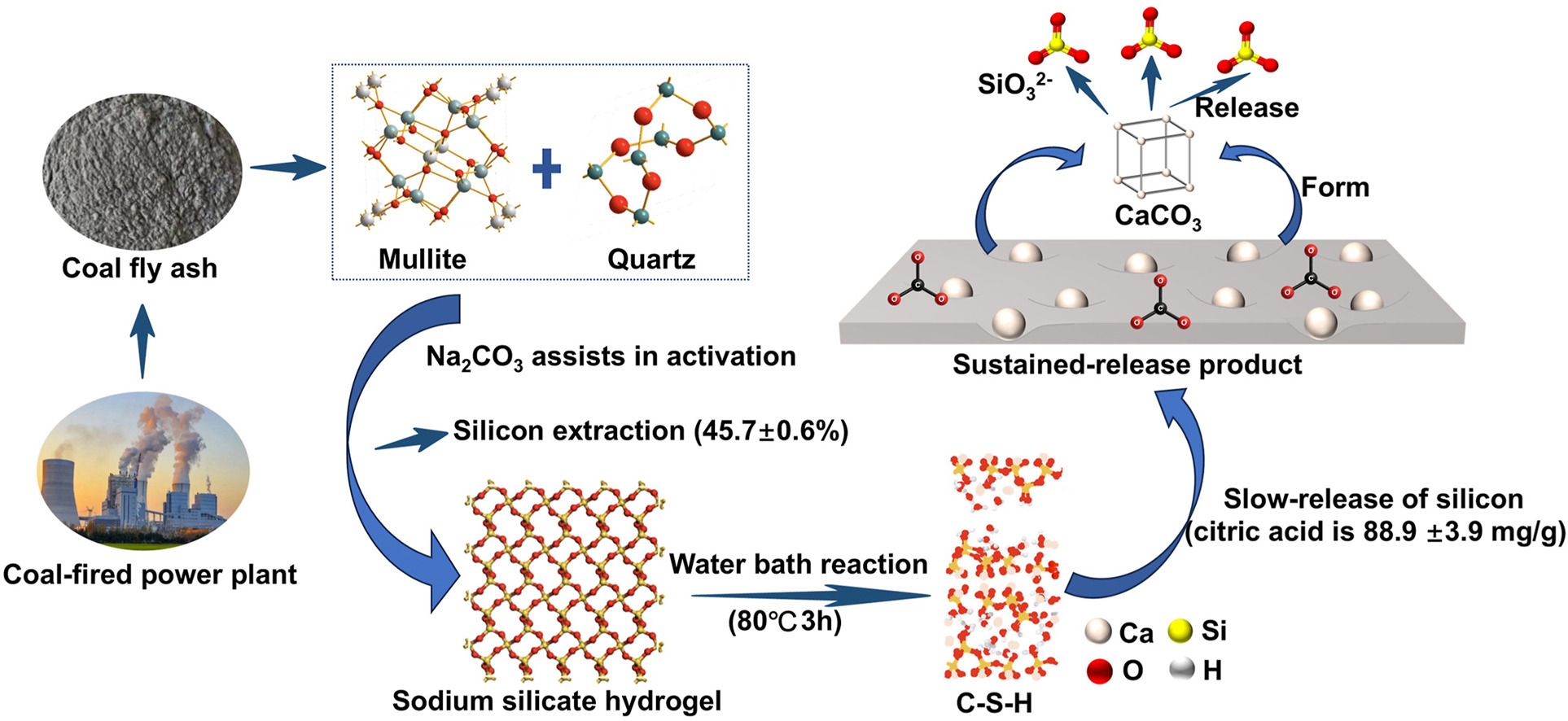
The large-scale accumulation of coal fly ash (CFA) poses serious environmental risks. Its high-value utilization remains a key challenge for sustainable development. This study employed an acid-free process to extract silicate ions from CFA and convert them into high-value calcium silicate hydrate (C-S-H) with silicon-releasing functionality. An optimal silicon extraction yield of 45.7 ± 0.6% was achieved at a calcination temperature of 850 °C with a CFA:Na2CO3 mass ratio of 1:1. The maximum citric acid-soluble silicon release of C-S-H reached 88.9 ± 3.9 mg/g. The release kinetics analysis indicated that the silicon release was controlled by diffusion through an in situ formed calcium carbonate barrier layer. This acid-free approach introduces an environmentally friendly alternative for utilizing CFA. The obtained C-S-H material acts as an efficient slow-release fertilizer, whose nutrient release can be tuned by the surrounding pH. Additionally, the well-crystallized β-nepheline byproduct also holds promising industrial prospects. All of these research findings together provide a theoretical basis and a practical approach for converting CFA into high-value products, as well as for developing pH-responsive controlled-release materials to serve sustainable agriculture.
Graphical abstract
Keywords
Coal fly ash; C-S-H; Alkali fusion; Sustained-release fertilizer; Silicate release kinetics; Nepheline
文章导读