
期刊文章
过刊浏览
- Volumes 108-119 (2025)
-
Volumes 96-107 (2025)
-
Volume 107
Pages 1-376 (December 2025)
-
Volume 106
Pages 1-336 (November 2025)
-
Volume 105
Pages 1-356 (October 2025)
-
Volume 104
Pages 1-332 (September 2025)
-
Volume 103
Pages 1-314 (August 2025)
-
Volume 102
Pages 1-276 (July 2025)
-
Volume 101
Pages 1-166 (June 2025)
-
Volume 100
Pages 1-256 (May 2025)
-
Volume 99
Pages 1-242 (April 2025)
-
Volume 98
Pages 1-288 (March 2025)
-
Volume 97
Pages 1-256 (February 2025)
-
Volume 96
Pages 1-340 (January 2025)
-
Volume 107
-
Volumes 84-95 (2024)
-
Volume 95
Pages 1-392 (December 2024)
-
Volume 94
Pages 1-400 (November 2024)
-
Volume 93
Pages 1-376 (October 2024)
-
Volume 92
Pages 1-316 (September 2024)
-
Volume 91
Pages 1-378 (August 2024)
-
Volume 90
Pages 1-580 (July 2024)
-
Volume 89
Pages 1-278 (June 2024)
-
Volume 88
Pages 1-350 (May 2024)
-
Volume 87
Pages 1-338 (April 2024)
-
Volume 86
Pages 1-312 (March 2024)
-
Volume 85
Pages 1-334 (February 2024)
-
Volume 84
Pages 1-308 (January 2024)
-
Volume 95
-
Volumes 72-83 (2023)
-
Volume 83
Pages 1-258 (December 2023)
-
Volume 82
Pages 1-204 (November 2023)
-
Volume 81
Pages 1-188 (October 2023)
-
Volume 80
Pages 1-202 (September 2023)
-
Volume 79
Pages 1-172 (August 2023)
-
Volume 78
Pages 1-146 (July 2023)
-
Volume 77
Pages 1-152 (June 2023)
-
Volume 76
Pages 1-176 (May 2023)
-
Volume 75
Pages 1-228 (April 2023)
-
Volume 74
Pages 1-200 (March 2023)
-
Volume 73
Pages 1-138 (February 2023)
-
Volume 72
Pages 1-144 (January 2023)
-
Volume 83
-
Volumes 60-71 (2022)
-
Volume 71
Pages 1-108 (December 2022)
-
Volume 70
Pages 1-106 (November 2022)
-
Volume 69
Pages 1-122 (October 2022)
-
Volume 68
Pages 1-124 (September 2022)
-
Volume 67
Pages 1-102 (August 2022)
-
Volume 66
Pages 1-112 (July 2022)
-
Volume 65
Pages 1-138 (June 2022)
-
Volume 64
Pages 1-186 (May 2022)
-
Volume 63
Pages 1-124 (April 2022)
-
Volume 62
Pages 1-104 (March 2022)
-
Volume 61
Pages 1-120 (February 2022)
-
Volume 60
Pages 1-124 (January 2022)
-
Volume 71
- Volumes 54-59 (2021)
- Volumes 48-53 (2020)
- Volumes 42-47 (2019)
- Volumes 36-41 (2018)
- Volumes 30-35 (2017)
- Volumes 24-29 (2016)
- Volumes 18-23 (2015)
- Volumes 12-17 (2014)
- Volume 11 (2013)
- Volume 10 (2012)
- Volume 9 (2011)
- Volume 8 (2010)
- Volume 7 (2009)
- Volume 6 (2008)
- Volume 5 (2007)
- Volume 4 (2006)
- Volume 3 (2005)
- Volume 2 (2004)
- Volume 1 (2003)
Volume 112
Wang, Y., Wang, W., Ghebretatios, N., Dong, B., Lei, H., Sun, Q., . . . Chang, Z. (2026). Selective extraction of lithium by in-situ oxidation of LiFexMn1-xPO4 battery cathode waste using peroxymonosulfate system. Particuology, 112, 197-208. https://doi.org/10.1016/j.partic.2026.03.005
Selective extraction of lithium by in-situ oxidation of LiFexMn1-xPO4 battery cathode waste using peroxymonosulfate system
Yaqi Wang a, Wei Wang b *, Natnael Ghebretatios a, Bin Dong a *, Hao Lei a, Qinglong Sun a, Jialong Li a, Leiying Zhang a, Zhidong Chang a *
a School of Chemistry and Biological Engineering, University of Science and Technology Beijing, Beijing, 100083, China
b Institute of Process Engineering, Chinese Academy of Sciences, Beijing, 100190, China
10.1016/j.partic.2026.03.005
Volume 112,
May 2026,
Pages 197-208
Received 13 January 2026, Revised 25 February 2026, Accepted 3 March 2026, Available online 19 March 2026, Version of Record 24 March 2026.
E-mail:
weiwang@ipe.ac.cn; dongbin@ustb.edu.cn; zdchang@ustb.edu.cn
Highlights
• A PMS system is developed for preferential Li leaching from spent LiMnxFe1-xPO4 cathode and direct Fe/Mn recovery.
• Thermodynamic modeling of Li-Fe-Mn-H2O system provided foundational rationale and guidance for experimental design.
• Kinetic results indicate the leaching process follows mixed control of interfacial reaction and product layer diffusion.
• Under optimized conditions, this process achieves 96.68% Li recovery efficiency with an excellent selectivity of 96.06%.
Abstract
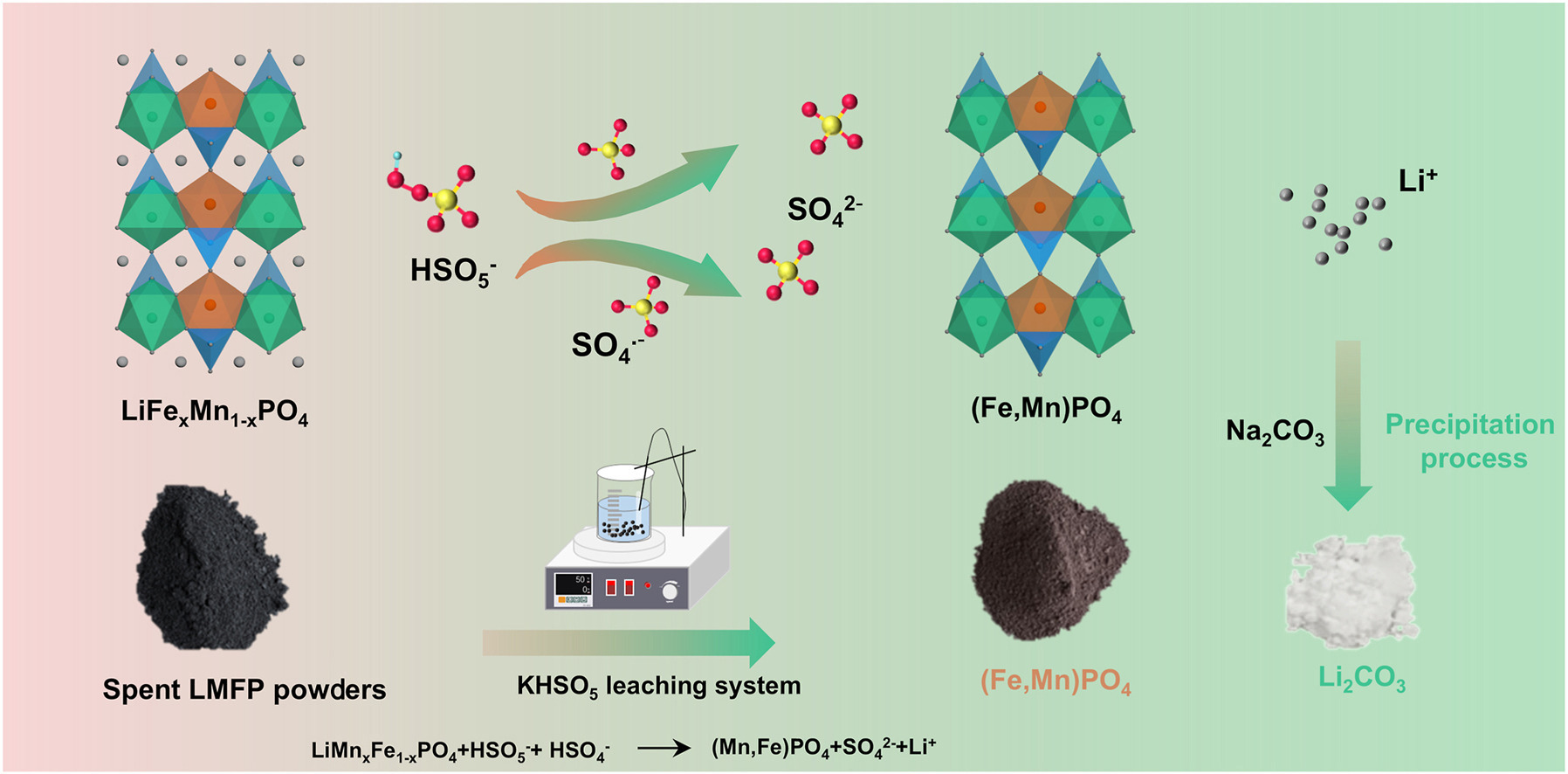
The selective recovery of lithium from spent lithium manganese iron phosphate (LMFP) cathode material is of significant economic and strategic importance, yet it is challenged by the material's complex multi-metal composition, which complicates conventional oxidative leaching processes. This work presents a novel hydrometallurgical strategy for the selective extraction of lithium from spent LMFP powders using a potassium peroxymonosulfate (PMS) system (KHSO5-KHSO4-K2SO4). The process achieves high selectivity by preferentially oxidizing and leaching lithium, while concurrently precipitating the transition metals as an (Fe,Mn)PO4 solid residue. Under optimized conditions, a lithium leaching efficiency of 96.68% and a selectivity for Li over Fe/Mn of 96.06% were attained. Thermodynamic analysis provided a theoretical basis for the feasibility of selective leaching, while kinetic studies revealed that the reaction rate is governed by a mixed-control mechanism, involving both surface chemical reaction and solid-layer diffusion. Furthermore, the high-purity Li2CO3 product regenerated via evaporation crystallization conforms to battery-grade specifications. This work demonstrates an efficient and selective closed-loop recycling pathway for LMFP battery waste.
Graphical abstract
Keywords
Spent lithium iron manganese phosphates; Selective leaching; Peroxymonosulfate; In-situ oxidation
文章导读