
期刊文章
过刊浏览
- Volumes 108-119 (2025)
-
Volumes 96-107 (2025)
-
Volume 107
Pages 1-376 (December 2025)
-
Volume 106
Pages 1-336 (November 2025)
-
Volume 105
Pages 1-356 (October 2025)
-
Volume 104
Pages 1-332 (September 2025)
-
Volume 103
Pages 1-314 (August 2025)
-
Volume 102
Pages 1-276 (July 2025)
-
Volume 101
Pages 1-166 (June 2025)
-
Volume 100
Pages 1-256 (May 2025)
-
Volume 99
Pages 1-242 (April 2025)
-
Volume 98
Pages 1-288 (March 2025)
-
Volume 97
Pages 1-256 (February 2025)
-
Volume 96
Pages 1-340 (January 2025)
-
Volume 107
-
Volumes 84-95 (2024)
-
Volume 95
Pages 1-392 (December 2024)
-
Volume 94
Pages 1-400 (November 2024)
-
Volume 93
Pages 1-376 (October 2024)
-
Volume 92
Pages 1-316 (September 2024)
-
Volume 91
Pages 1-378 (August 2024)
-
Volume 90
Pages 1-580 (July 2024)
-
Volume 89
Pages 1-278 (June 2024)
-
Volume 88
Pages 1-350 (May 2024)
-
Volume 87
Pages 1-338 (April 2024)
-
Volume 86
Pages 1-312 (March 2024)
-
Volume 85
Pages 1-334 (February 2024)
-
Volume 84
Pages 1-308 (January 2024)
-
Volume 95
-
Volumes 72-83 (2023)
-
Volume 83
Pages 1-258 (December 2023)
-
Volume 82
Pages 1-204 (November 2023)
-
Volume 81
Pages 1-188 (October 2023)
-
Volume 80
Pages 1-202 (September 2023)
-
Volume 79
Pages 1-172 (August 2023)
-
Volume 78
Pages 1-146 (July 2023)
-
Volume 77
Pages 1-152 (June 2023)
-
Volume 76
Pages 1-176 (May 2023)
-
Volume 75
Pages 1-228 (April 2023)
-
Volume 74
Pages 1-200 (March 2023)
-
Volume 73
Pages 1-138 (February 2023)
-
Volume 72
Pages 1-144 (January 2023)
-
Volume 83
-
Volumes 60-71 (2022)
-
Volume 71
Pages 1-108 (December 2022)
-
Volume 70
Pages 1-106 (November 2022)
-
Volume 69
Pages 1-122 (October 2022)
-
Volume 68
Pages 1-124 (September 2022)
-
Volume 67
Pages 1-102 (August 2022)
-
Volume 66
Pages 1-112 (July 2022)
-
Volume 65
Pages 1-138 (June 2022)
-
Volume 64
Pages 1-186 (May 2022)
-
Volume 63
Pages 1-124 (April 2022)
-
Volume 62
Pages 1-104 (March 2022)
-
Volume 61
Pages 1-120 (February 2022)
-
Volume 60
Pages 1-124 (January 2022)
-
Volume 71
- Volumes 54-59 (2021)
- Volumes 48-53 (2020)
- Volumes 42-47 (2019)
- Volumes 36-41 (2018)
- Volumes 30-35 (2017)
- Volumes 24-29 (2016)
- Volumes 18-23 (2015)
- Volumes 12-17 (2014)
- Volume 11 (2013)
- Volume 10 (2012)
- Volume 9 (2011)
- Volume 8 (2010)
- Volume 7 (2009)
- Volume 6 (2008)
- Volume 5 (2007)
- Volume 4 (2006)
- Volume 3 (2005)
- Volume 2 (2004)
- Volume 1 (2003)
Volume 112
Šućurović, K., Jaćimovski, D., Brzić, D., Đuriš, M., Arsenijević, Z., Radoičić, T. K., & Bošković Vragolović, N. (2026). Hydrodynamics of a draft-tube spout–fluid bed with a hydraulic barrier: Minimum spouting velocity, flow regimes, and solids circulation. Particuology, 112, 209-221. https://doi.org/10.1016/j.partic.2026.03.006
Hydrodynamics of a draft-tube spout–fluid bed with a hydraulic barrier: Minimum spouting velocity, flow regimes, and solids circulation
Katarina Šućurović a *, Darko Jaćimovski a, Danica Brzić b, Mihal Đuriš a, Zorana Arsenijević a, Tatjana Kaluđerović Radoičić b, Nevenka Bošković Vragolović b
a Institute of Chemistry, Technology and Metallurgy, National Institute of the Republic of Serbia, University of Belgrade, Njegoševa 12, Belgrade, 11000, Serbia
b Faculty of Technology and Metallurgy, University of Belgrade, Karnegijeva 4, Belgrade, 11000, Serbia
10.1016/j.partic.2026.03.006
Volume 112,
May 2026,
Pages 209-221
Received 27 January 2026, Revised 26 February 2026, Accepted 4 March 2026, Available online 19 March 2026, Version of Record 24 March 2026.
E-mail:
katarina.sucurovic@ihtm.bg.ac.rs
Highlights
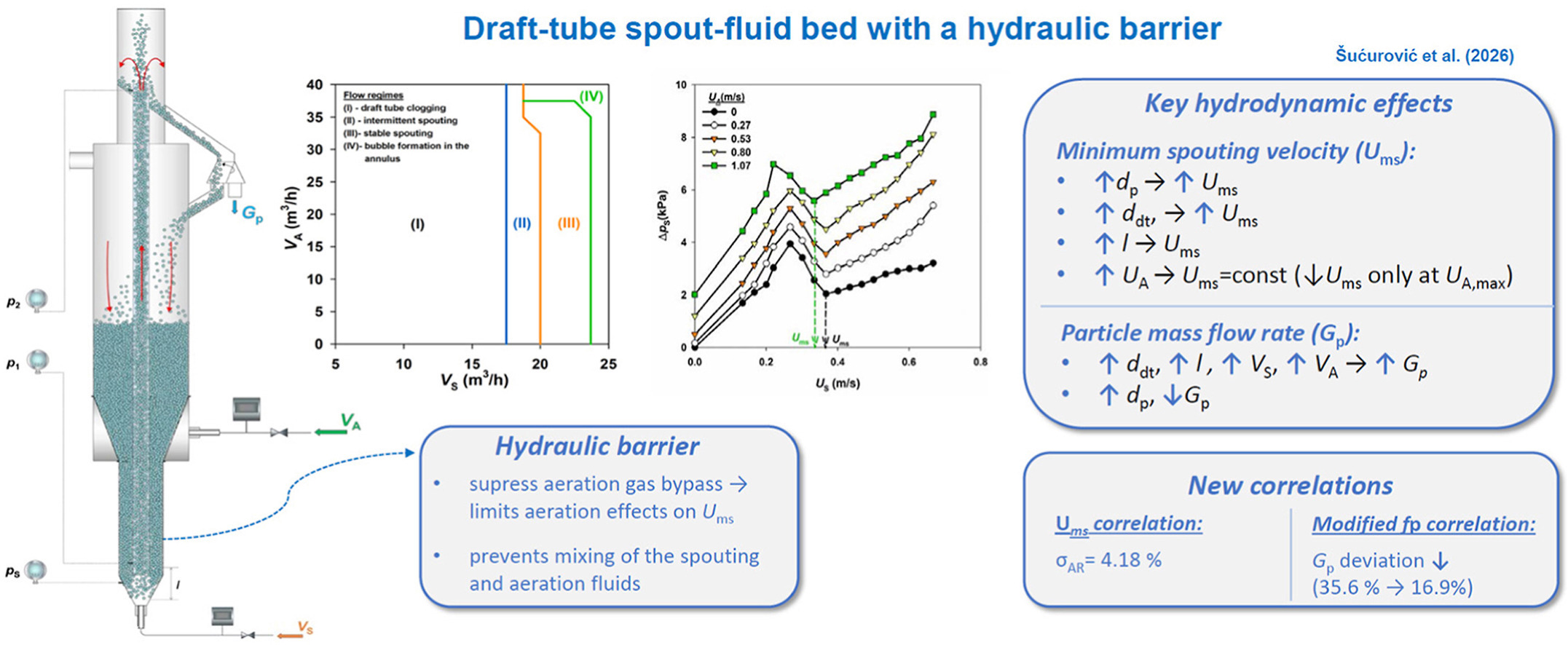
• Flow regimes, minimum spouting velocity (Ums) and particle mass flow rate in DTSFB with hydraulic barrier were determined.
• Four flow regimes identified at different spouting and aeration fluid flow rates.
• Hydraulic barrier reduces the influence of the aeration fluid on Ums.
• A new correlation for Ums is proposed for systems with a hydraulic barrier.
• A modified correlation for the dimensionless particle–wall friction factor is proposed.
Abstract
The Draft Tube Spout-Fluid Bed (DTSFB) with a hydraulic barrier represents an advanced modification designed to minimize gas bypass and prevent mixing of spouting and aeration gas streams. Experimental tests on flow regime, minimum spouting velocity (Ums), and particle mass flow rate (Gp) were conducted in a cylindrical column with a diameter of 115 mm, using glass particles and air as the spouting and aeration fluids. Four flow regimes were visually identified at different spouting and aeration fluid flow rates: draft tube clogging, intermittent spouting, stable spouting with aeration, and bubble formation in the annulus. The effects of operating conditions and geometric parameters on the flow regimes, minimum spouting velocity, and particle mass flow rate were analyzed. The results showed that, due to the hydraulic barrier, the aeration fluid flow rate had a limited effect on Ums over a wide range of operating conditions, with a noticeable decrease only at high aeration fluid flow rates. A new correlation for calculating Ums is proposed, yielding an average relative deviation of 4.18%. In addition, a modified correlation for the dimensionless particle–wall friction factor is proposed, enabling reliable prediction of the particle mass flow rate.
Graphical abstract
Keywords
Spout-fluid bed; Hydraylic barrier; Solid circulation; Flow regimes
文章导读