
期刊文章
过刊浏览
- Volumes 108-119 (2025)
-
Volumes 96-107 (2025)
-
Volume 107
Pages 1-376 (December 2025)
-
Volume 106
Pages 1-336 (November 2025)
-
Volume 105
Pages 1-356 (October 2025)
-
Volume 104
Pages 1-332 (September 2025)
-
Volume 103
Pages 1-314 (August 2025)
-
Volume 102
Pages 1-276 (July 2025)
-
Volume 101
Pages 1-166 (June 2025)
-
Volume 100
Pages 1-256 (May 2025)
-
Volume 99
Pages 1-242 (April 2025)
-
Volume 98
Pages 1-288 (March 2025)
-
Volume 97
Pages 1-256 (February 2025)
-
Volume 96
Pages 1-340 (January 2025)
-
Volume 107
-
Volumes 84-95 (2024)
-
Volume 95
Pages 1-392 (December 2024)
-
Volume 94
Pages 1-400 (November 2024)
-
Volume 93
Pages 1-376 (October 2024)
-
Volume 92
Pages 1-316 (September 2024)
-
Volume 91
Pages 1-378 (August 2024)
-
Volume 90
Pages 1-580 (July 2024)
-
Volume 89
Pages 1-278 (June 2024)
-
Volume 88
Pages 1-350 (May 2024)
-
Volume 87
Pages 1-338 (April 2024)
-
Volume 86
Pages 1-312 (March 2024)
-
Volume 85
Pages 1-334 (February 2024)
-
Volume 84
Pages 1-308 (January 2024)
-
Volume 95
-
Volumes 72-83 (2023)
-
Volume 83
Pages 1-258 (December 2023)
-
Volume 82
Pages 1-204 (November 2023)
-
Volume 81
Pages 1-188 (October 2023)
-
Volume 80
Pages 1-202 (September 2023)
-
Volume 79
Pages 1-172 (August 2023)
-
Volume 78
Pages 1-146 (July 2023)
-
Volume 77
Pages 1-152 (June 2023)
-
Volume 76
Pages 1-176 (May 2023)
-
Volume 75
Pages 1-228 (April 2023)
-
Volume 74
Pages 1-200 (March 2023)
-
Volume 73
Pages 1-138 (February 2023)
-
Volume 72
Pages 1-144 (January 2023)
-
Volume 83
-
Volumes 60-71 (2022)
-
Volume 71
Pages 1-108 (December 2022)
-
Volume 70
Pages 1-106 (November 2022)
-
Volume 69
Pages 1-122 (October 2022)
-
Volume 68
Pages 1-124 (September 2022)
-
Volume 67
Pages 1-102 (August 2022)
-
Volume 66
Pages 1-112 (July 2022)
-
Volume 65
Pages 1-138 (June 2022)
-
Volume 64
Pages 1-186 (May 2022)
-
Volume 63
Pages 1-124 (April 2022)
-
Volume 62
Pages 1-104 (March 2022)
-
Volume 61
Pages 1-120 (February 2022)
-
Volume 60
Pages 1-124 (January 2022)
-
Volume 71
- Volumes 54-59 (2021)
- Volumes 48-53 (2020)
- Volumes 42-47 (2019)
- Volumes 36-41 (2018)
- Volumes 30-35 (2017)
- Volumes 24-29 (2016)
- Volumes 18-23 (2015)
- Volumes 12-17 (2014)
- Volume 11 (2013)
- Volume 10 (2012)
- Volume 9 (2011)
- Volume 8 (2010)
- Volume 7 (2009)
- Volume 6 (2008)
- Volume 5 (2007)
- Volume 4 (2006)
- Volume 3 (2005)
- Volume 2 (2004)
- Volume 1 (2003)
Volume 112
Chen, M., Huang, Y., Huang, X., Yuan, M., Wang, T., Wang, N., & Hao, H. (2026). Synergistic structural optimization of stirred tanks based on CFD-DEM simulation for improved solid–liquid suspension. Particuology, 112, 222-234. https://doi.org/10.1016/j.partic.2026.03.003
Synergistic structural optimization of stirred tanks based on CFD-DEM simulation for improved solid–liquid suspension
Mingyu Chen a, Yunhai Huang b, Xin Huang a c d *, Mingpu Yuan a, Ting Wang a c d, Na Wang a c d, Hongxun Hao a c d *
a National Engineering Research Center of Industrial Crystallization Technology, School of Chemical Engineering and Technology, Tianjin University, Tianjin, 300072, China
b China Nuclear Power Engineering Co., Ltd, Beijing, 100840, China
c Collaborative Innovation Center of Chemical Science and Engineering (Tianjin), Tianjin, 300072, China
d State Key Laboratory of Chemical Engineering, School of Chemical Engineering and Technology, Tianjin University, Tianjin, 300072, China
10.1016/j.partic.2026.03.003
Volume 112,
May 2026,
222-234
Received 2 December 2025, Revised 24 February 2026, Accepted 2 March 2026, Available online 18 March 2026, Version of Record 26 March 2026.
E-mail:
x_huang@tju.edu.cn; hongxunhao@tju.edu.cn
Highlights
• A CFD–DEM–VOF model was used for solid–liquid mixing in stirred tanks.
• Tank bottom, baffle, and impeller inlet were jointly optimized for better suspension.
• Profiled bottom improved axial flow and minimized dead zones.
• The optimized design achieved uniform particle distribution and high turbulence.
Abstract
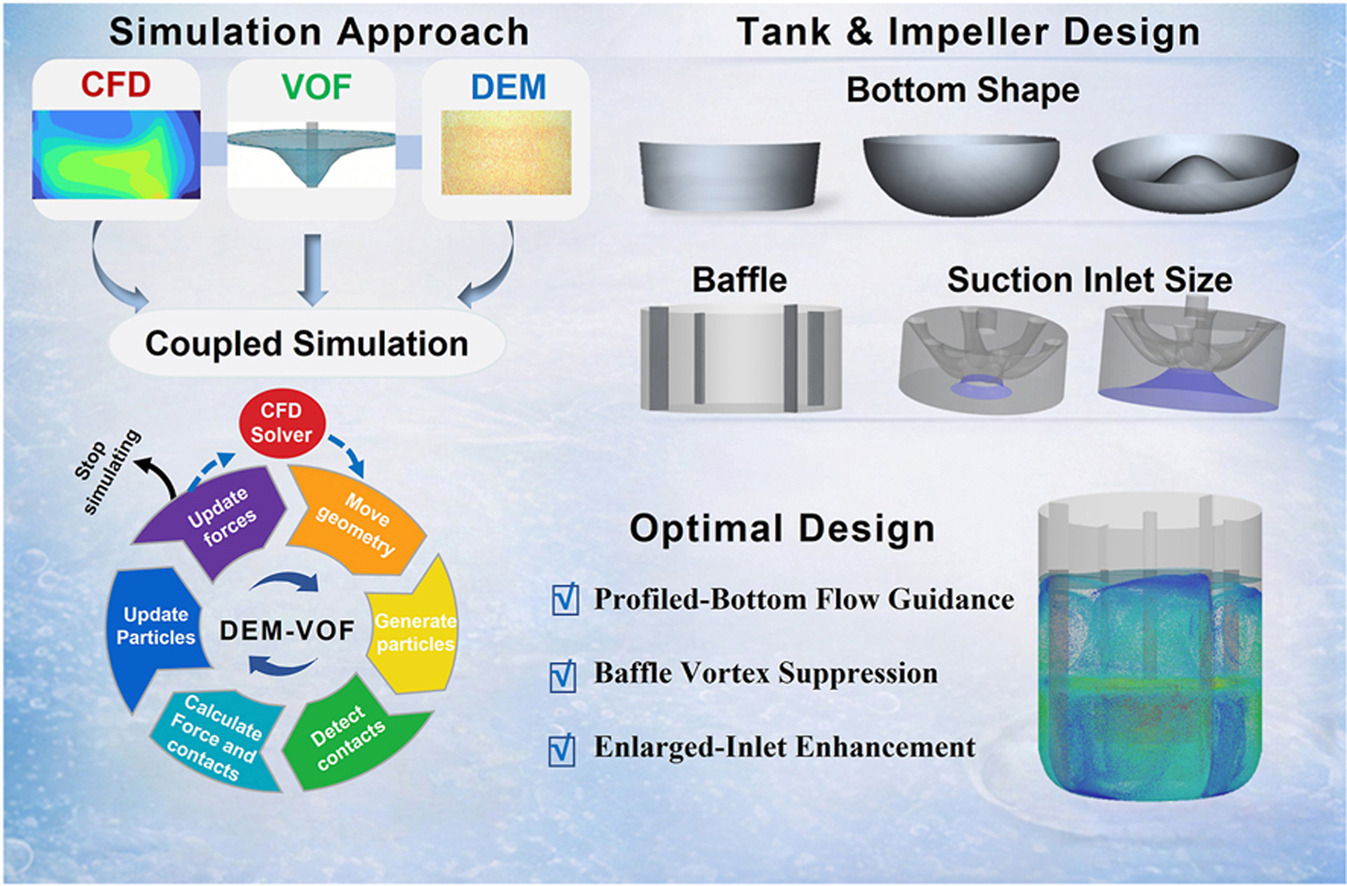
Efficient solid-liquid suspension in stirred tanks is critical for mass and heat transfer in various industrial applications. However, insufficient suspension uniformity remains a common challenge, leading to reduced process efficiency and increased energy consumption. This study investigates the mixing performance of a novel channel-type impeller in stirred tanks with different structural configurations through CFD-DEM coupled simulations. Multiple geometries were examined, including the bottom shapes and baffle forms for tank and the size of suction inlet for impeller. The simulation results revealed that the profiled bottom played a crucial role in facilitating the smooth conveyance of fluid to the impeller and eliminating dead zones. Besides, the introduced baffles significantly restructured the flow, suppressing free-surface vortices. Meanwhile, the enlarged suction inlet of impeller could further increase axial flow supply. Finally, a synergistic optimization strategy, including profiled bottom flow guidance, baffle vortex suppression, and enlarged-inlet enhancement was proposed. The optimal design (PCTBE) could lead to near-uniform particle suspension and highest turbulent kinetic energy coverage. This combined strategy significantly enhances suspension uniformity and circulation efficiency, offering practical guidance for improved stirred-tank design and operation.
Graphical abstract
Keywords
Stirred tank; Impeller design; Computational fluid dynamics; Discrete element method
文章导读