
期刊文章
过刊浏览
- Volumes 108-119 (2025)
-
Volumes 96-107 (2025)
-
Volume 107
Pages 1-376 (December 2025)
-
Volume 106
Pages 1-336 (November 2025)
-
Volume 105
Pages 1-356 (October 2025)
-
Volume 104
Pages 1-332 (September 2025)
-
Volume 103
Pages 1-314 (August 2025)
-
Volume 102
Pages 1-276 (July 2025)
-
Volume 101
Pages 1-166 (June 2025)
-
Volume 100
Pages 1-256 (May 2025)
-
Volume 99
Pages 1-242 (April 2025)
-
Volume 98
Pages 1-288 (March 2025)
-
Volume 97
Pages 1-256 (February 2025)
-
Volume 96
Pages 1-340 (January 2025)
-
Volume 107
-
Volumes 84-95 (2024)
-
Volume 95
Pages 1-392 (December 2024)
-
Volume 94
Pages 1-400 (November 2024)
-
Volume 93
Pages 1-376 (October 2024)
-
Volume 92
Pages 1-316 (September 2024)
-
Volume 91
Pages 1-378 (August 2024)
-
Volume 90
Pages 1-580 (July 2024)
-
Volume 89
Pages 1-278 (June 2024)
-
Volume 88
Pages 1-350 (May 2024)
-
Volume 87
Pages 1-338 (April 2024)
-
Volume 86
Pages 1-312 (March 2024)
-
Volume 85
Pages 1-334 (February 2024)
-
Volume 84
Pages 1-308 (January 2024)
-
Volume 95
-
Volumes 72-83 (2023)
-
Volume 83
Pages 1-258 (December 2023)
-
Volume 82
Pages 1-204 (November 2023)
-
Volume 81
Pages 1-188 (October 2023)
-
Volume 80
Pages 1-202 (September 2023)
-
Volume 79
Pages 1-172 (August 2023)
-
Volume 78
Pages 1-146 (July 2023)
-
Volume 77
Pages 1-152 (June 2023)
-
Volume 76
Pages 1-176 (May 2023)
-
Volume 75
Pages 1-228 (April 2023)
-
Volume 74
Pages 1-200 (March 2023)
-
Volume 73
Pages 1-138 (February 2023)
-
Volume 72
Pages 1-144 (January 2023)
-
Volume 83
-
Volumes 60-71 (2022)
-
Volume 71
Pages 1-108 (December 2022)
-
Volume 70
Pages 1-106 (November 2022)
-
Volume 69
Pages 1-122 (October 2022)
-
Volume 68
Pages 1-124 (September 2022)
-
Volume 67
Pages 1-102 (August 2022)
-
Volume 66
Pages 1-112 (July 2022)
-
Volume 65
Pages 1-138 (June 2022)
-
Volume 64
Pages 1-186 (May 2022)
-
Volume 63
Pages 1-124 (April 2022)
-
Volume 62
Pages 1-104 (March 2022)
-
Volume 61
Pages 1-120 (February 2022)
-
Volume 60
Pages 1-124 (January 2022)
-
Volume 71
- Volumes 54-59 (2021)
- Volumes 48-53 (2020)
- Volumes 42-47 (2019)
- Volumes 36-41 (2018)
- Volumes 30-35 (2017)
- Volumes 24-29 (2016)
- Volumes 18-23 (2015)
- Volumes 12-17 (2014)
- Volume 11 (2013)
- Volume 10 (2012)
- Volume 9 (2011)
- Volume 8 (2010)
- Volume 7 (2009)
- Volume 6 (2008)
- Volume 5 (2007)
- Volume 4 (2006)
- Volume 3 (2005)
- Volume 2 (2004)
- Volume 1 (2003)
Volume 112
Zhang, Y., Hu, L., & Lu, Y. (2026). A multi-dimensional analysis of microporous materials for advancing CO2 capture. Particuology, 112, 235-246. https://doi.org/10.1016/j.partic.2026.03.004
A multi-dimensional analysis of microporous materials for advancing CO2 capture
Yi Zhang a b 1, Liangwei Hu a b 1, Yuan Lu a b *
a State Key Laboratory of Green Biomanufacturing, Department of Chemical Engineering, Tsinghua University, Beijing, 100084, China
b Key Laboratory of Industrial Biocatalysis, Ministry of Education, Department of Chemical Engineering, Tsinghua University, Beijing, 100084, China
10.1016/j.partic.2026.03.004
Volume 112,
May 2026,
Pages 235-246
Received 29 December 2025, Revised 15 February 2026, Accepted 3 March 2026, Available online 17 March 2026, Version of Record 26 March 2026.
E-mail:
yuanlu@tsinghua.edu.cn
Highlights
• Zeolites and metal-organic frameworks were synthesized for CO2 capture.
• The material adsorption capacity, stability, and selectivity were evaluated.
• The effect of modification on adsorption in a humid environment was investigated.
• The challenge of SO2 co-adsorption for CO2 adsorbents was revealed.
Abstract
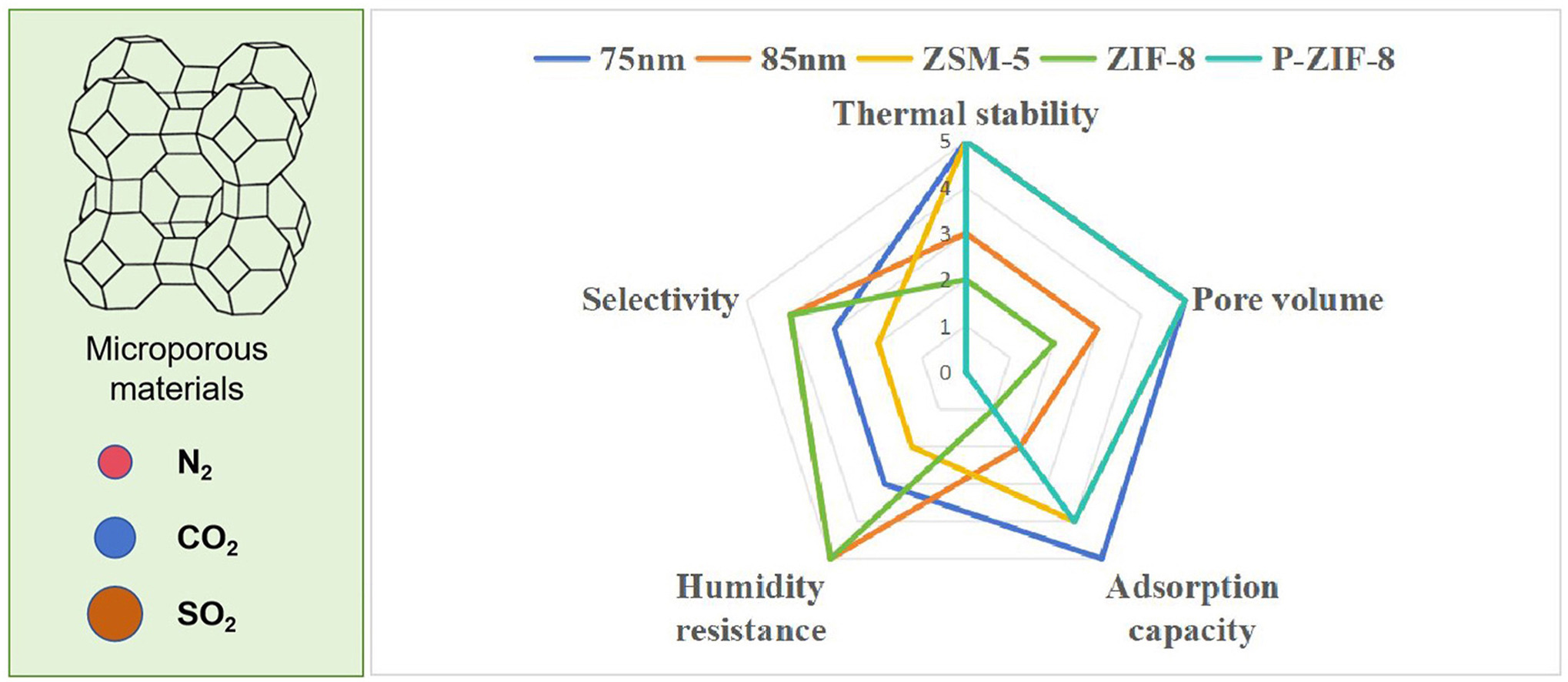
The escalating atmospheric CO2 concentration calls for advanced carbon capture solutions. However, developing a stable and efficient adsorbent with high selectivity for CO2 capture remains a significant challenge. Microporous materials capture CO2 primarily through physisorption based on pore structure and van der Waals forces. In this study, three silicon-aluminum zeolite molecular sieve materials were synthesized and hydrophilic modification of ZIF-8 was achieved through post-synthetic coordination with polyethylene glycol. A systematic comparison of the CO2 adsorption performance of these materials under different conditions was then conducted. Zeolites exhibited exceptional thermal stability (<5% mass loss from 25 to 800 °C under an air atmosphere) and cyclability (retaining >95% of initial adsorption capacity throughout cycling), outperforming ZIF-8 analogues. 85-nm zeolite achieved the optimal CO2 uptake (1.8 mmol g−1) at 25 °C and ZIF-8 showed the best humidity resistance (40% decrease at 80% RH). Additionally, ZSM-5 exhibited enhanced gas retention of 1498 s, indicating superior CO2 adsorption affinity. These results demonstrate the excellent thermal stability and cycling stability of the zeolite materials. This study provides actionable insights for future material design: 1) prioritizing zeolite-based frameworks for scenarios requiring long-term cyclic stability and thermal robustness; 2) optimizing pore size and surface properties to balance adsorption capacity and selectivity; 3) developing anti-poisoning modifications targeting SO2 competitive adsorption in flue gas.
Graphical abstract
Keywords
Carbon capture; Adsorption; Microporous materials; Zeolite; Metal-organic framework
文章导读