
期刊文章
过刊浏览
- Volumes 108-119 (2025)
-
Volumes 96-107 (2025)
-
Volume 107
Pages 1-376 (December 2025)
-
Volume 106
Pages 1-336 (November 2025)
-
Volume 105
Pages 1-356 (October 2025)
-
Volume 104
Pages 1-332 (September 2025)
-
Volume 103
Pages 1-314 (August 2025)
-
Volume 102
Pages 1-276 (July 2025)
-
Volume 101
Pages 1-166 (June 2025)
-
Volume 100
Pages 1-256 (May 2025)
-
Volume 99
Pages 1-242 (April 2025)
-
Volume 98
Pages 1-288 (March 2025)
-
Volume 97
Pages 1-256 (February 2025)
-
Volume 96
Pages 1-340 (January 2025)
-
Volume 107
-
Volumes 84-95 (2024)
-
Volume 95
Pages 1-392 (December 2024)
-
Volume 94
Pages 1-400 (November 2024)
-
Volume 93
Pages 1-376 (October 2024)
-
Volume 92
Pages 1-316 (September 2024)
-
Volume 91
Pages 1-378 (August 2024)
-
Volume 90
Pages 1-580 (July 2024)
-
Volume 89
Pages 1-278 (June 2024)
-
Volume 88
Pages 1-350 (May 2024)
-
Volume 87
Pages 1-338 (April 2024)
-
Volume 86
Pages 1-312 (March 2024)
-
Volume 85
Pages 1-334 (February 2024)
-
Volume 84
Pages 1-308 (January 2024)
-
Volume 95
-
Volumes 72-83 (2023)
-
Volume 83
Pages 1-258 (December 2023)
-
Volume 82
Pages 1-204 (November 2023)
-
Volume 81
Pages 1-188 (October 2023)
-
Volume 80
Pages 1-202 (September 2023)
-
Volume 79
Pages 1-172 (August 2023)
-
Volume 78
Pages 1-146 (July 2023)
-
Volume 77
Pages 1-152 (June 2023)
-
Volume 76
Pages 1-176 (May 2023)
-
Volume 75
Pages 1-228 (April 2023)
-
Volume 74
Pages 1-200 (March 2023)
-
Volume 73
Pages 1-138 (February 2023)
-
Volume 72
Pages 1-144 (January 2023)
-
Volume 83
-
Volumes 60-71 (2022)
-
Volume 71
Pages 1-108 (December 2022)
-
Volume 70
Pages 1-106 (November 2022)
-
Volume 69
Pages 1-122 (October 2022)
-
Volume 68
Pages 1-124 (September 2022)
-
Volume 67
Pages 1-102 (August 2022)
-
Volume 66
Pages 1-112 (July 2022)
-
Volume 65
Pages 1-138 (June 2022)
-
Volume 64
Pages 1-186 (May 2022)
-
Volume 63
Pages 1-124 (April 2022)
-
Volume 62
Pages 1-104 (March 2022)
-
Volume 61
Pages 1-120 (February 2022)
-
Volume 60
Pages 1-124 (January 2022)
-
Volume 71
- Volumes 54-59 (2021)
- Volumes 48-53 (2020)
- Volumes 42-47 (2019)
- Volumes 36-41 (2018)
- Volumes 30-35 (2017)
- Volumes 24-29 (2016)
- Volumes 18-23 (2015)
- Volumes 12-17 (2014)
- Volume 11 (2013)
- Volume 10 (2012)
- Volume 9 (2011)
- Volume 8 (2010)
- Volume 7 (2009)
- Volume 6 (2008)
- Volume 5 (2007)
- Volume 4 (2006)
- Volume 3 (2005)
- Volume 2 (2004)
- Volume 1 (2003)
Volume 112
Li, Q., Ouyang, Z., & Ku, X. (2026). Drag and lift on two-dimensional super-elliptical particles in low-Reynolds-number flows. Particuology, 112, 247-259. https://doi.org/10.1016/j.partic.2026.03.007
Drag and lift on two-dimensional super-elliptical particles in low-Reynolds-number flows
Qinghua Li a, Zhenyu Ouyang b, Xiaoke Ku a c *
a Department of Engineering Mechanics, Zhejiang University, Hangzhou, 310027, China
b China Laboratory of Impact and Safety Engineering (Ningbo University), Ministry of Education, Ningbo, 315201, China
c State Key Laboratory of Clean Energy Utilization, Zhejiang University, Hangzhou, 310027, China
10.1016/j.partic.2026.03.007
Volume 112,
May 2026,
Pages 247-259
Received 27 November 2025, Revised 28 February 2026, Accepted 4 March 2026, Available online 19 March 2026, Version of Record 26 March 2026.
E-mail:
xiaokeku@zju.edu.cn
Highlights
• Drag and lift coefficients of two-dimensional super-elliptical particles are studied.
• Effects of particle aspect ratio and shape factor are analyzed.
• Effects of angle of attack and particle Reynolds number are also explored.
• Representative functional forms for lift and drag coefficients are identified and fitted.
Abstract
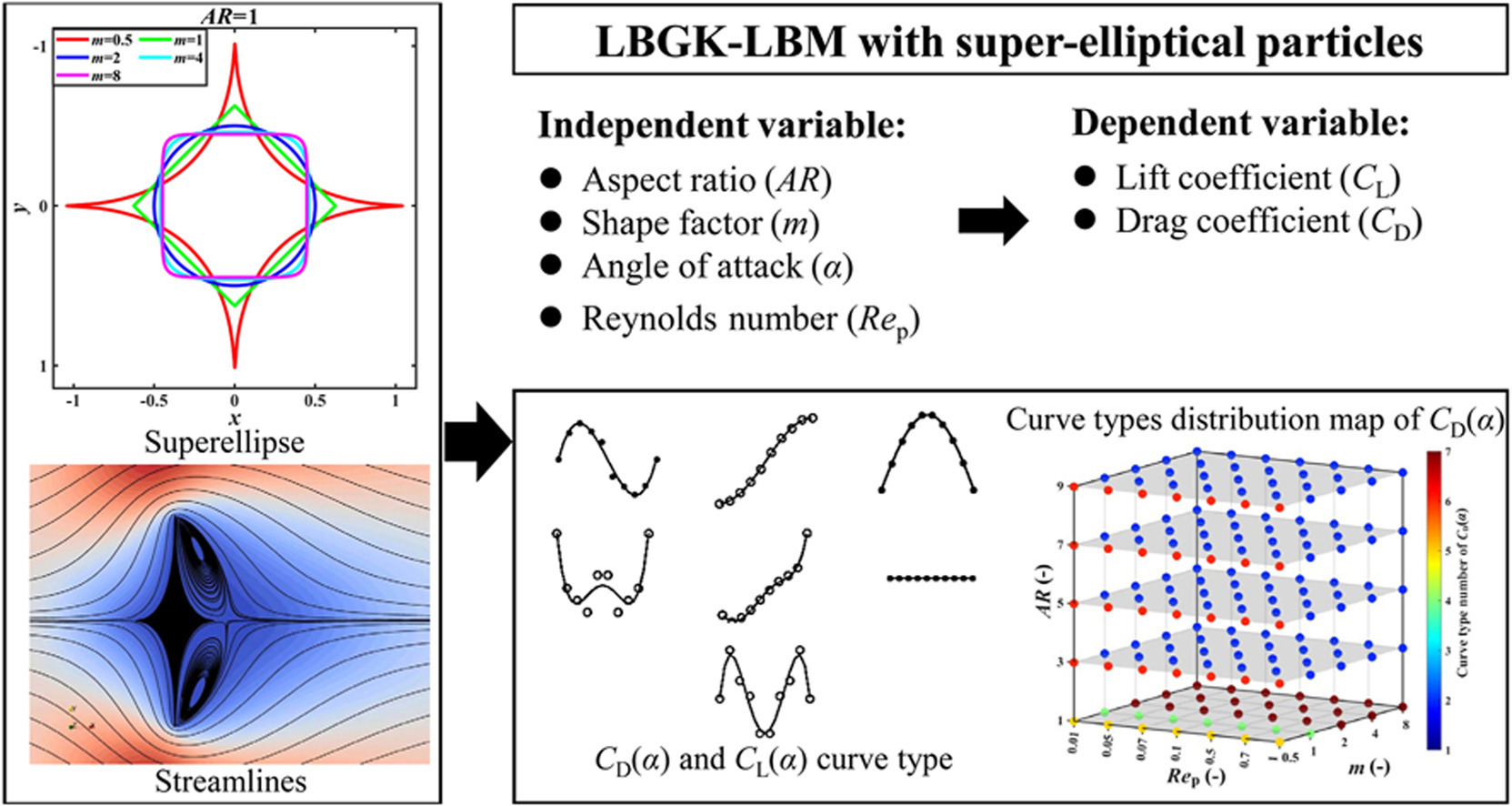
This study investigates the hydrodynamic forces acting on two-dimensional super-elliptical particles in low-Reynolds-number flows using the lattice Boltzmann method. The effects of particle aspect ratio, shape factor, angle of attack, and particle Reynolds number on the drag and lift coefficients are systematically analyzed. The drag and lift coefficients averaged over the angle of attack are defined as the mean drag coefficient and mean lift coefficient, respectively. The results reveal that the mean drag coefficient increases with increasing aspect ratio and decreasing shape factor and particle Reynolds number, and the variation trends of the mean lift coefficient are generally consistent with those of the mean drag coefficient. Moreover, the shape of the drag coefficient-angle of attack curve is primarily governed by the shape factor and aspect ratio, leading to five distinct curve types. In contrast, the shape of the lift coefficient-angle of attack curve is also influenced by the particle Reynolds number, resulting in four curve types. In total, seven representative functional forms for the drag and lift coefficients are identified and fitted, offering correlations for future applications.
Graphical abstract
Keywords
Super-elliptical particles; Drag coefficient; Lift coefficient; Low-Reynolds-number flow
文章导读