
期刊文章
过刊浏览
- Volumes 108-119 (2025)
-
Volumes 96-107 (2025)
-
Volume 107
Pages 1-376 (December 2025)
-
Volume 106
Pages 1-336 (November 2025)
-
Volume 105
Pages 1-356 (October 2025)
-
Volume 104
Pages 1-332 (September 2025)
-
Volume 103
Pages 1-314 (August 2025)
-
Volume 102
Pages 1-276 (July 2025)
-
Volume 101
Pages 1-166 (June 2025)
-
Volume 100
Pages 1-256 (May 2025)
-
Volume 99
Pages 1-242 (April 2025)
-
Volume 98
Pages 1-288 (March 2025)
-
Volume 97
Pages 1-256 (February 2025)
-
Volume 96
Pages 1-340 (January 2025)
-
Volume 107
-
Volumes 84-95 (2024)
-
Volume 95
Pages 1-392 (December 2024)
-
Volume 94
Pages 1-400 (November 2024)
-
Volume 93
Pages 1-376 (October 2024)
-
Volume 92
Pages 1-316 (September 2024)
-
Volume 91
Pages 1-378 (August 2024)
-
Volume 90
Pages 1-580 (July 2024)
-
Volume 89
Pages 1-278 (June 2024)
-
Volume 88
Pages 1-350 (May 2024)
-
Volume 87
Pages 1-338 (April 2024)
-
Volume 86
Pages 1-312 (March 2024)
-
Volume 85
Pages 1-334 (February 2024)
-
Volume 84
Pages 1-308 (January 2024)
-
Volume 95
-
Volumes 72-83 (2023)
-
Volume 83
Pages 1-258 (December 2023)
-
Volume 82
Pages 1-204 (November 2023)
-
Volume 81
Pages 1-188 (October 2023)
-
Volume 80
Pages 1-202 (September 2023)
-
Volume 79
Pages 1-172 (August 2023)
-
Volume 78
Pages 1-146 (July 2023)
-
Volume 77
Pages 1-152 (June 2023)
-
Volume 76
Pages 1-176 (May 2023)
-
Volume 75
Pages 1-228 (April 2023)
-
Volume 74
Pages 1-200 (March 2023)
-
Volume 73
Pages 1-138 (February 2023)
-
Volume 72
Pages 1-144 (January 2023)
-
Volume 83
-
Volumes 60-71 (2022)
-
Volume 71
Pages 1-108 (December 2022)
-
Volume 70
Pages 1-106 (November 2022)
-
Volume 69
Pages 1-122 (October 2022)
-
Volume 68
Pages 1-124 (September 2022)
-
Volume 67
Pages 1-102 (August 2022)
-
Volume 66
Pages 1-112 (July 2022)
-
Volume 65
Pages 1-138 (June 2022)
-
Volume 64
Pages 1-186 (May 2022)
-
Volume 63
Pages 1-124 (April 2022)
-
Volume 62
Pages 1-104 (March 2022)
-
Volume 61
Pages 1-120 (February 2022)
-
Volume 60
Pages 1-124 (January 2022)
-
Volume 71
- Volumes 54-59 (2021)
- Volumes 48-53 (2020)
- Volumes 42-47 (2019)
- Volumes 36-41 (2018)
- Volumes 30-35 (2017)
- Volumes 24-29 (2016)
- Volumes 18-23 (2015)
- Volumes 12-17 (2014)
- Volume 11 (2013)
- Volume 10 (2012)
- Volume 9 (2011)
- Volume 8 (2010)
- Volume 7 (2009)
- Volume 6 (2008)
- Volume 5 (2007)
- Volume 4 (2006)
- Volume 3 (2005)
- Volume 2 (2004)
- Volume 1 (2003)
Volume 112
Ramírez, J. G., Tang, Y., van Sint Annaland, M., Deen, N. G., & Roghair, I. (2026). Effect of particle agglomeration in iron oxide reduction – A CFD-DEM approach. Particuology, 112, 260-270. https://doi.org/10.1016/j.partic.2026.02.026
Effect of particle agglomeration in iron oxide reduction – A CFD-DEM approach (Open Access)
Juan G. Ramírez a b, Y. Tang a c, Martin van Sint Annaland a b, Niels G. Deen a c, Ivo Roghair a b d *
a Eindhoven Institute for Renewable Energy Systems (EIRES), Eindhoven University of Technology, Eindhoven, the Netherlands
b Chemical Process Intensification, Department of Chemical Engineering & Chemistry, Eindhoven University of Technology, Eindhoven, the Netherlands
c Power and Flow Group, Department of Mechanical Engineering, Eindhoven University of Technology, Eindhoven, the Netherlands
d Complex Fluids and Interfaces, Department of Chemical Engineering & Chemistry, Eindhoven University of Technology, Eindhoven, the Netherlands
10.1016/j.partic.2026.02.026
Volume 112,
May 2026,
Pages 260-270
Received 3 December 2025, Revised 6 February 2026, Accepted 24 February 2026, Available online 13 March 2026, Version of Record 26 March 2026.
E-mail:
i.roghair@tue.nl
Highlights
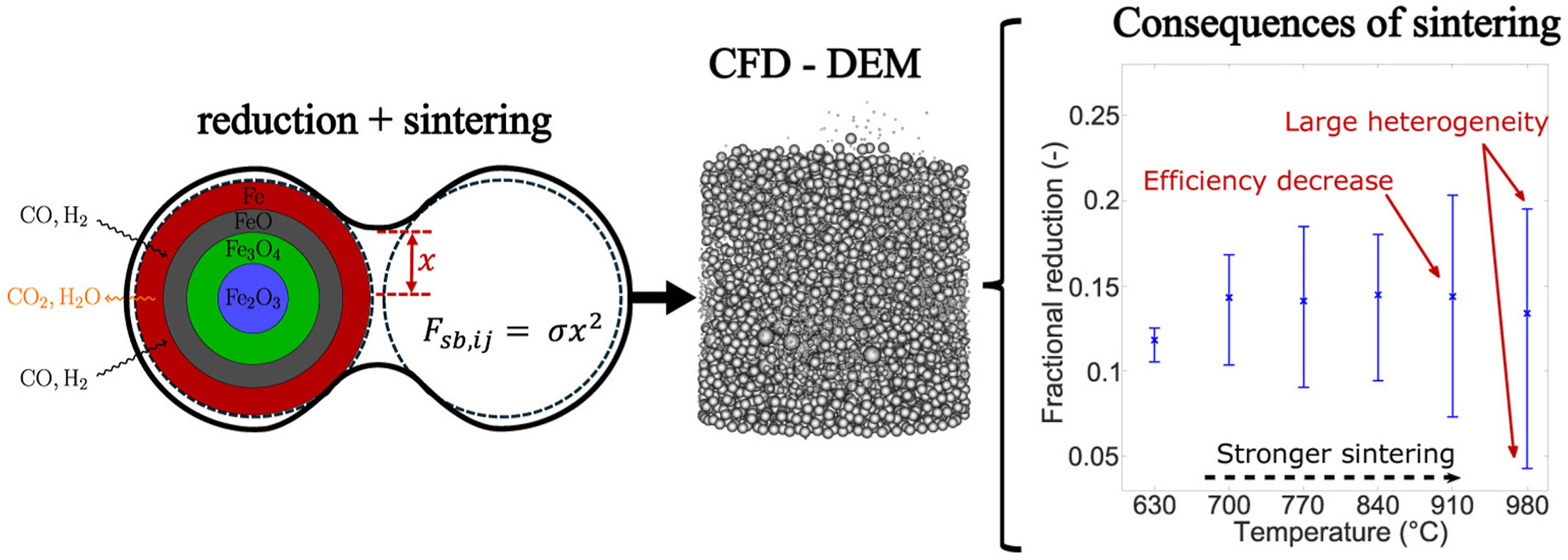
• A sintering model and iron reduction kinetics are integrated into a CFD-DEM framework.
• Agglomeration effects on reduction efficiency were studied for inflow temperatures ranging from 630 °Cto 980 °C.
• Temperatures above 630 °C cause rapid defluidization due to particle sintering.
• Above 770 °C, sintering lowers reduction efficiency by over 20 %.
• Sintering-driven channeling increases significantly the product heterogeneity.
Abstract
Iron powders are a promising carbon-neutral energy carrier via closed oxidation-reduction cycles, offering a unique solution to long-duration storage and long-distance transport of renewable energy. After releasing energy through oxidation, the iron must be regenerated (reduced) from the oxidation product (iron oxide), ideally using renewable energy sources such as green hydrogen. However, this high-temperature reduction process, typically carried out in fluidized beds, is strongly hindered by particle agglomeration caused by sintering of solid materials at elevated temperatures. In this work, a Computational Fluid Dynamics–Discrete Element Method (CFD-DEM) framework is employed to investigate how agglomeration affects reduction efficiency at different operating temperatures. Chemical reduction is modeled using a shrinking-core formulation, while sintering is represented through a solid-bridge model based on surface-diffusion mechanisms. The results show that operating temperatures above 630 °C lead to rapid defluidization. If the temperature is increased beyond 840 °C, the overall reduction degree is decreased, despite the higher reactivity. This is due to intensified sintering. This behavior is likely linked to gas channeling within the bed, which not only lowers reduction efficiency (by more than 20% for T > 840 °C) but also significantly increases the heterogeneity in the final reduction state of the product.
Graphical abstract
Keywords
Direct reduced iron; Sintering; Fluidized beds; CFD-DEM; Shrinking core model; Metal fuels
文章导读