
期刊文章
过刊浏览
- Volumes 108-119 (2025)
-
Volumes 96-107 (2025)
-
Volume 107
Pages 1-376 (December 2025)
-
Volume 106
Pages 1-336 (November 2025)
-
Volume 105
Pages 1-356 (October 2025)
-
Volume 104
Pages 1-332 (September 2025)
-
Volume 103
Pages 1-314 (August 2025)
-
Volume 102
Pages 1-276 (July 2025)
-
Volume 101
Pages 1-166 (June 2025)
-
Volume 100
Pages 1-256 (May 2025)
-
Volume 99
Pages 1-242 (April 2025)
-
Volume 98
Pages 1-288 (March 2025)
-
Volume 97
Pages 1-256 (February 2025)
-
Volume 96
Pages 1-340 (January 2025)
-
Volume 107
-
Volumes 84-95 (2024)
-
Volume 95
Pages 1-392 (December 2024)
-
Volume 94
Pages 1-400 (November 2024)
-
Volume 93
Pages 1-376 (October 2024)
-
Volume 92
Pages 1-316 (September 2024)
-
Volume 91
Pages 1-378 (August 2024)
-
Volume 90
Pages 1-580 (July 2024)
-
Volume 89
Pages 1-278 (June 2024)
-
Volume 88
Pages 1-350 (May 2024)
-
Volume 87
Pages 1-338 (April 2024)
-
Volume 86
Pages 1-312 (March 2024)
-
Volume 85
Pages 1-334 (February 2024)
-
Volume 84
Pages 1-308 (January 2024)
-
Volume 95
-
Volumes 72-83 (2023)
-
Volume 83
Pages 1-258 (December 2023)
-
Volume 82
Pages 1-204 (November 2023)
-
Volume 81
Pages 1-188 (October 2023)
-
Volume 80
Pages 1-202 (September 2023)
-
Volume 79
Pages 1-172 (August 2023)
-
Volume 78
Pages 1-146 (July 2023)
-
Volume 77
Pages 1-152 (June 2023)
-
Volume 76
Pages 1-176 (May 2023)
-
Volume 75
Pages 1-228 (April 2023)
-
Volume 74
Pages 1-200 (March 2023)
-
Volume 73
Pages 1-138 (February 2023)
-
Volume 72
Pages 1-144 (January 2023)
-
Volume 83
-
Volumes 60-71 (2022)
-
Volume 71
Pages 1-108 (December 2022)
-
Volume 70
Pages 1-106 (November 2022)
-
Volume 69
Pages 1-122 (October 2022)
-
Volume 68
Pages 1-124 (September 2022)
-
Volume 67
Pages 1-102 (August 2022)
-
Volume 66
Pages 1-112 (July 2022)
-
Volume 65
Pages 1-138 (June 2022)
-
Volume 64
Pages 1-186 (May 2022)
-
Volume 63
Pages 1-124 (April 2022)
-
Volume 62
Pages 1-104 (March 2022)
-
Volume 61
Pages 1-120 (February 2022)
-
Volume 60
Pages 1-124 (January 2022)
-
Volume 71
- Volumes 54-59 (2021)
- Volumes 48-53 (2020)
- Volumes 42-47 (2019)
- Volumes 36-41 (2018)
- Volumes 30-35 (2017)
- Volumes 24-29 (2016)
- Volumes 18-23 (2015)
- Volumes 12-17 (2014)
- Volume 11 (2013)
- Volume 10 (2012)
- Volume 9 (2011)
- Volume 8 (2010)
- Volume 7 (2009)
- Volume 6 (2008)
- Volume 5 (2007)
- Volume 4 (2006)
- Volume 3 (2005)
- Volume 2 (2004)
- Volume 1 (2003)
Volume 112
Casarella, A., Pinzón, G., Sadasivan, V., Stamati, O., Villanova, J., Lukić, B., & Dijkstra, J. (2026). 3D particle aggregation in consolidated clay systems: Insights from phase-contrast nano-holo-tomography. Particuology, 112, 271-283. https://doi.org/10.1016/j.partic.2026.02.002
3D particle aggregation in consolidated clay systems: Insights from phase-contrast nano-holo-tomography
Angela Casarella a b *, Gustavo Pinzón c, Vijayshree Sadasivan a, Olga Stamati d, Julie Villanova c, Bratislav Lukić c e, Jelke Dijkstra a
a Chalmers University of Technology, Department of Architecture and Civil Engineering, Gothenburg, 43218, Sweden
b Imperial College London, Department of Civil and Environmental Engineering, London, SW72AZ, UK
c ESRF – The European Synchrotron, Grenoble, 38043, France
d Univ. Grenoble Alpes, CNRS, Grenoble INP, 3SR, Grenoble, 38000, France
e Institut Laue-Langevin, Grenoble, France
10.1016/j.partic.2026.02.002
Volume 112,
May 2026,
Pages 271-283
Received 15 October 2025, Revised 25 January 2026, Accepted 1 February 2026, Available online 9 February 2026, Version of Record 27 March 2026.
E-mail:
a.casarella@imperial.ac.uk
Highlights
• First-ever non-destructive 3D imaging of saturated kaolin clay fabric.
• Face-to-face clay platelet stacks form in consolidated clay regardless of fluid.
• Pore fluid pH controls aggregates arrangement: edge-to-face (acidic) vs face-to-face (alkaline).
• Autocorrelation and local orientation methods quantify anisotropy without segmentation.
• Findings enable particle-scale evidence to inform and validate DEM.
Abstract
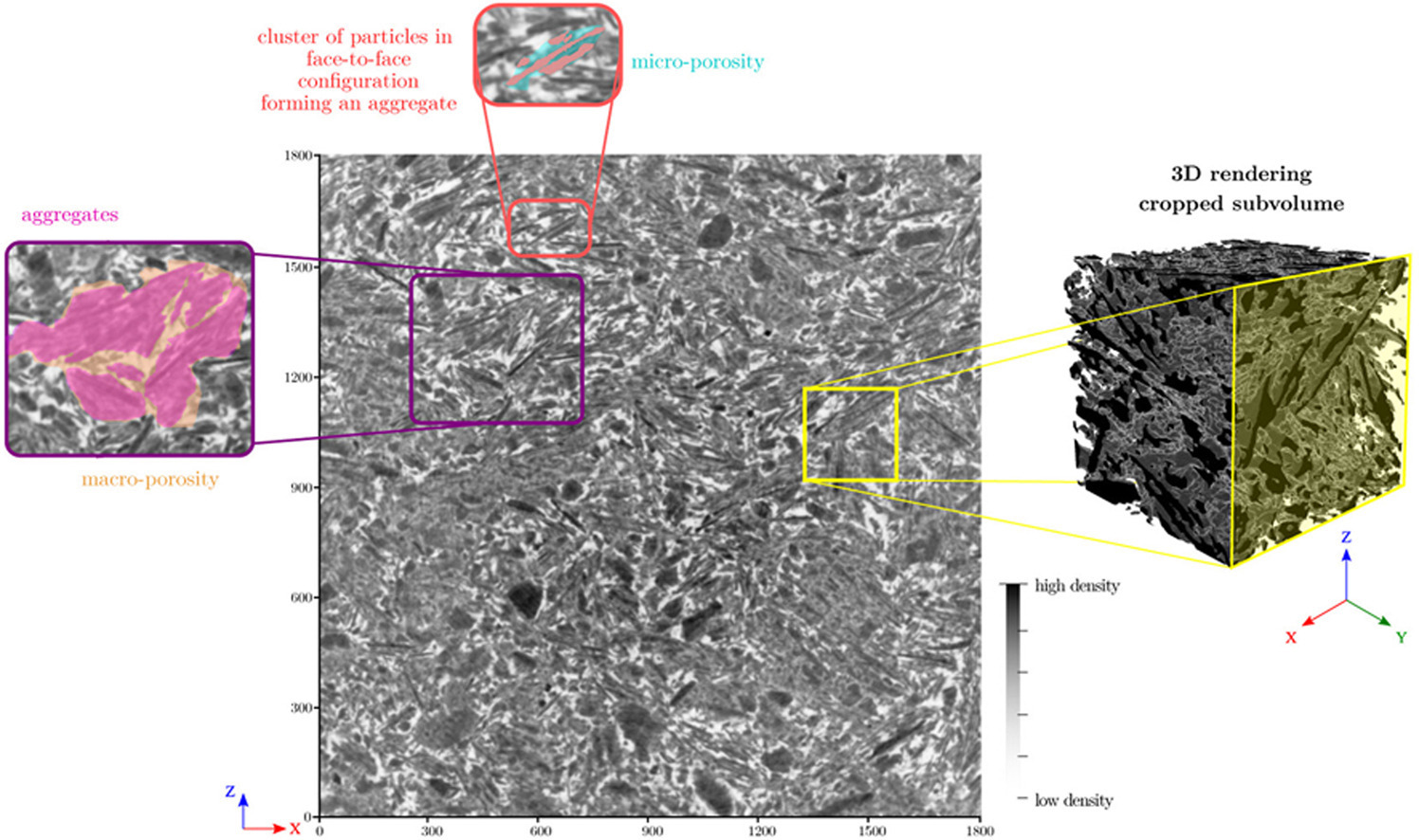
The microstructural arrangement of clay platelets governs their macroscopic properties, yet 3D observations at the particle scale remain limited. This study employs radiation-based X-ray phase-contrast nano-holo-tomography (nano-CT) to achieve an unprecedented three-dimensional (3D) characterisation of clay particle fabric in saturated kaolin clay samples subjected to one-dimensional (1D) compression. Two samples were prepared with acidic (pH = 4.1) and alkaline (pH = 9.1) pore fluids to examine the influence of electrochemical conditions on the association of clay particle. Phase-contrast nano-CT resolves individual kaolin platelets and their spatial arrangement, enabling quantitative analysis of fabric. Autocorrelation function analyses are used to study the alignment of a macroscopically isotropic, yet locally anisotropic structure for the acidic sample, where the edge-to-face (EF) associations of stacks of particles (i.e., aggregates) dominate. In contrast, the alkaline sample exhibits a highly anisotropic, face-to-face (FF) aligned aggregate configuration. These findings contribute to a deeper understanding of clay fabric characterisation and highlight the potential of non-destructive synchrotron X-ray 3D nano-imaging techniques for advancing clayey materials characterisation.
Graphical abstract
Keywords
Clay microstructure; X-ray nano-tomography; Fabric; Kaolin; Pore fluid pH; Orientation
文章导读