
期刊文章
过刊浏览
- Volumes 108-119 (2025)
-
Volumes 96-107 (2025)
-
Volume 107
Pages 1-376 (December 2025)
-
Volume 106
Pages 1-336 (November 2025)
-
Volume 105
Pages 1-356 (October 2025)
-
Volume 104
Pages 1-332 (September 2025)
-
Volume 103
Pages 1-314 (August 2025)
-
Volume 102
Pages 1-276 (July 2025)
-
Volume 101
Pages 1-166 (June 2025)
-
Volume 100
Pages 1-256 (May 2025)
-
Volume 99
Pages 1-242 (April 2025)
-
Volume 98
Pages 1-288 (March 2025)
-
Volume 97
Pages 1-256 (February 2025)
-
Volume 96
Pages 1-340 (January 2025)
-
Volume 107
-
Volumes 84-95 (2024)
-
Volume 95
Pages 1-392 (December 2024)
-
Volume 94
Pages 1-400 (November 2024)
-
Volume 93
Pages 1-376 (October 2024)
-
Volume 92
Pages 1-316 (September 2024)
-
Volume 91
Pages 1-378 (August 2024)
-
Volume 90
Pages 1-580 (July 2024)
-
Volume 89
Pages 1-278 (June 2024)
-
Volume 88
Pages 1-350 (May 2024)
-
Volume 87
Pages 1-338 (April 2024)
-
Volume 86
Pages 1-312 (March 2024)
-
Volume 85
Pages 1-334 (February 2024)
-
Volume 84
Pages 1-308 (January 2024)
-
Volume 95
-
Volumes 72-83 (2023)
-
Volume 83
Pages 1-258 (December 2023)
-
Volume 82
Pages 1-204 (November 2023)
-
Volume 81
Pages 1-188 (October 2023)
-
Volume 80
Pages 1-202 (September 2023)
-
Volume 79
Pages 1-172 (August 2023)
-
Volume 78
Pages 1-146 (July 2023)
-
Volume 77
Pages 1-152 (June 2023)
-
Volume 76
Pages 1-176 (May 2023)
-
Volume 75
Pages 1-228 (April 2023)
-
Volume 74
Pages 1-200 (March 2023)
-
Volume 73
Pages 1-138 (February 2023)
-
Volume 72
Pages 1-144 (January 2023)
-
Volume 83
-
Volumes 60-71 (2022)
-
Volume 71
Pages 1-108 (December 2022)
-
Volume 70
Pages 1-106 (November 2022)
-
Volume 69
Pages 1-122 (October 2022)
-
Volume 68
Pages 1-124 (September 2022)
-
Volume 67
Pages 1-102 (August 2022)
-
Volume 66
Pages 1-112 (July 2022)
-
Volume 65
Pages 1-138 (June 2022)
-
Volume 64
Pages 1-186 (May 2022)
-
Volume 63
Pages 1-124 (April 2022)
-
Volume 62
Pages 1-104 (March 2022)
-
Volume 61
Pages 1-120 (February 2022)
-
Volume 60
Pages 1-124 (January 2022)
-
Volume 71
- Volumes 54-59 (2021)
- Volumes 48-53 (2020)
- Volumes 42-47 (2019)
- Volumes 36-41 (2018)
- Volumes 30-35 (2017)
- Volumes 24-29 (2016)
- Volumes 18-23 (2015)
- Volumes 12-17 (2014)
- Volume 11 (2013)
- Volume 10 (2012)
- Volume 9 (2011)
- Volume 8 (2010)
- Volume 7 (2009)
- Volume 6 (2008)
- Volume 5 (2007)
- Volume 4 (2006)
- Volume 3 (2005)
- Volume 2 (2004)
- Volume 1 (2003)
Volume 112
Zhao, Y., Yan, Y., & Yao, J. (2026). Direct numerical simulation of triboelectrostatic charging in particle-laden turbulent flows in 90° pipe bends. Particuology, 112, 284-298. https://doi.org/10.1016/j.partic.2026.02.034
Direct numerical simulation of triboelectrostatic charging in particle-laden turbulent flows in 90° pipe bends
Yanlin Zhao, Yudong Yan, Jun Yao *
International Joint Laboratory on Clean Energy Science and Technology, Beijing Key Laboratory of Process Fluid Filtration and Separation, College of Mechanical and Transportation Engineering, China University of Petroleum-Beijing, Beijing, 102249, China
10.1016/j.partic.2026.02.034
Volume 112,
May 2026,
Pages 284-298
Received 22 November 2025, Revised 27 January 2026, Accepted 23 February 2026, Available online 21 March 2026, Version of Record 28 March 2026.
E-mail:
yaojun@cup.edu.cn
Highlights
• The 90° bend particulate flows were investigated using direct numerical simulation.
• Inter-phase four-way coupling with electrostatics was used.
• Electrostatics increases particle-wall and particle-particle collisions.
• The impact velocity and angle of particle-wall collision decrease with electrostatics.
• Particle-particle collisions prevent particles at downstream from approaching the wall.
Abstract
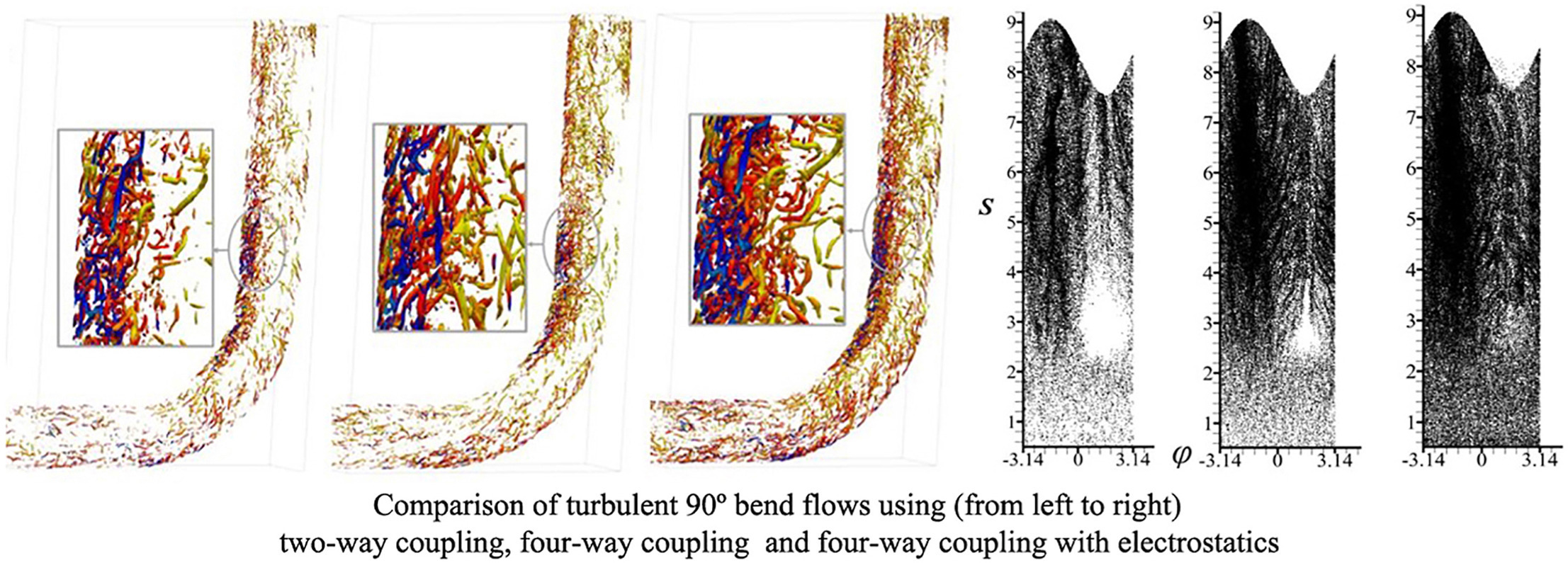
In this work, 90° bend particulate flows were investigated using direct numerical simulation coupled with Lagrange tracking technology. Three kinds of inter-phase coupling methods were used including two-way coupling, four-way coupling and four-way coupling with electrostatics. By 2-way coupling, the inertial particle introduces damping into the turbulent flow and leads to a decrease to large-scale coherent structures and an increase to small-scale turbulent coherent structures in the flow. By 4-way coupling, the turbulence intensity of the fluid is further decreased. The region of high-velocity streaks becomes smaller but has stronger energy, and the number of high-velocity streak stripes decreases. By 4-way coupling with electrostatics, due to combined effect of electrostatics and particle turbophoresis, electrostatics increases particle radial velocity of moving towards the wall as well as increases particle-wall and particle-particle collisions. It causes an increase of small-scale vortex structures and the number of ring-like turbulent structures. The high-velocity streak stripes of the fluid become smaller and narrower indicating that the number of low-velocity streak stripes increases greatly but hairpin vortex structures are less prominent in the bend. The frequency of particle-wall collision increases with particle-particle collision as well as electrostatics, while the impact velocity and angle of particle-wall collision decrease significantly. In addition, due to high particle concentration at the bend, particle-particle collisions prevent particles at downstream from approaching the wall as a “barrier”, which acts as “shielding effect” on particles.
Graphical abstract
Keywords
Electrostatics; 90° bend; Particle; Direct numerical simulation; Four-way coupling
文章导读