
期刊文章
过刊浏览
- Volumes 108-119 (2025)
-
Volumes 96-107 (2025)
-
Volume 107
Pages 1-376 (December 2025)
-
Volume 106
Pages 1-336 (November 2025)
-
Volume 105
Pages 1-356 (October 2025)
-
Volume 104
Pages 1-332 (September 2025)
-
Volume 103
Pages 1-314 (August 2025)
-
Volume 102
Pages 1-276 (July 2025)
-
Volume 101
Pages 1-166 (June 2025)
-
Volume 100
Pages 1-256 (May 2025)
-
Volume 99
Pages 1-242 (April 2025)
-
Volume 98
Pages 1-288 (March 2025)
-
Volume 97
Pages 1-256 (February 2025)
-
Volume 96
Pages 1-340 (January 2025)
-
Volume 107
-
Volumes 84-95 (2024)
-
Volume 95
Pages 1-392 (December 2024)
-
Volume 94
Pages 1-400 (November 2024)
-
Volume 93
Pages 1-376 (October 2024)
-
Volume 92
Pages 1-316 (September 2024)
-
Volume 91
Pages 1-378 (August 2024)
-
Volume 90
Pages 1-580 (July 2024)
-
Volume 89
Pages 1-278 (June 2024)
-
Volume 88
Pages 1-350 (May 2024)
-
Volume 87
Pages 1-338 (April 2024)
-
Volume 86
Pages 1-312 (March 2024)
-
Volume 85
Pages 1-334 (February 2024)
-
Volume 84
Pages 1-308 (January 2024)
-
Volume 95
-
Volumes 72-83 (2023)
-
Volume 83
Pages 1-258 (December 2023)
-
Volume 82
Pages 1-204 (November 2023)
-
Volume 81
Pages 1-188 (October 2023)
-
Volume 80
Pages 1-202 (September 2023)
-
Volume 79
Pages 1-172 (August 2023)
-
Volume 78
Pages 1-146 (July 2023)
-
Volume 77
Pages 1-152 (June 2023)
-
Volume 76
Pages 1-176 (May 2023)
-
Volume 75
Pages 1-228 (April 2023)
-
Volume 74
Pages 1-200 (March 2023)
-
Volume 73
Pages 1-138 (February 2023)
-
Volume 72
Pages 1-144 (January 2023)
-
Volume 83
-
Volumes 60-71 (2022)
-
Volume 71
Pages 1-108 (December 2022)
-
Volume 70
Pages 1-106 (November 2022)
-
Volume 69
Pages 1-122 (October 2022)
-
Volume 68
Pages 1-124 (September 2022)
-
Volume 67
Pages 1-102 (August 2022)
-
Volume 66
Pages 1-112 (July 2022)
-
Volume 65
Pages 1-138 (June 2022)
-
Volume 64
Pages 1-186 (May 2022)
-
Volume 63
Pages 1-124 (April 2022)
-
Volume 62
Pages 1-104 (March 2022)
-
Volume 61
Pages 1-120 (February 2022)
-
Volume 60
Pages 1-124 (January 2022)
-
Volume 71
- Volumes 54-59 (2021)
- Volumes 48-53 (2020)
- Volumes 42-47 (2019)
- Volumes 36-41 (2018)
- Volumes 30-35 (2017)
- Volumes 24-29 (2016)
- Volumes 18-23 (2015)
- Volumes 12-17 (2014)
- Volume 11 (2013)
- Volume 10 (2012)
- Volume 9 (2011)
- Volume 8 (2010)
- Volume 7 (2009)
- Volume 6 (2008)
- Volume 5 (2007)
- Volume 4 (2006)
- Volume 3 (2005)
- Volume 2 (2004)
- Volume 1 (2003)
Volume 113
Zhang, M., Xia, M., Guo, W., Xia, L., & Li, W. (2026). Robust particle size distribution recovery in ultra-dilute dynamic light scattering via bi-exponential refitting–guided generalized regression neural network. Particuology, 113, 1-11. https://doi.org/10.1016/j.partic.2026.03.008
Robust particle size distribution recovery in ultra-dilute dynamic light scattering via bi-exponential refitting–guided generalized regression neural network
Mingyang Zhang, Min Xia, Wenping Guo, Li Xia, Wei Li *
School of Optical and Electronic Information, Huazhong University of Science and Technology, Wuhan, 430074, China
10.1016/j.partic.2026.03.008
Volume 113,
June 2026,
Pages 1-11
Received 24 January 2026, Revised 3 March 2026, Accepted 5 March 2026, Available online 23 March 2026, Version of Record 31 March 2026.
E-mail:
weili@hust.edu.cn
Highlights
• Improves PSD recovery accuracy for ultra-dilute DLS where conventional inversion fails.
• Bi-exponential refitting stabilizes distorted ACFs and mitigates long-lag corruption.
• Refitting suppresses long-lag artifacts while retaining diffusion information in the slow term.
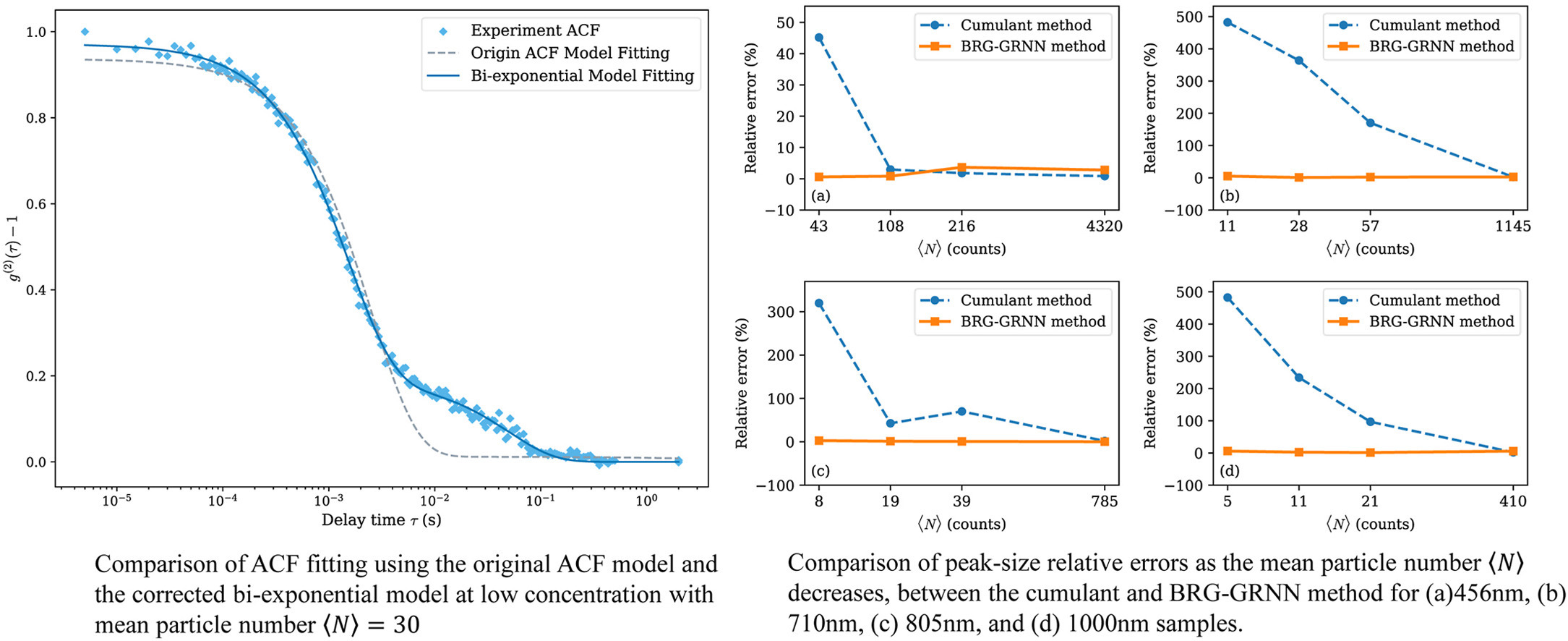
• GA-optimized GRNN yields stable PSD peaks down to single-digit ⟨N⟩ (max 6.39% error).
• Avoids cumulant overestimation and spurious large-particle peaks at low ⟨N⟩.
Abstract
Dynamic light scattering (DLS) is widely used for particle sizing; however, at ultra-low concentrations, limited acquisition time distorts the intensity autocorrelation function (ACF), and the reduced signal-to-noise ratio further compromises the reliability of particle size distribution (PSD) recovery. To address these challenges, we develop a low-concentration DLS analysis framework based on Bi-exponential Refitting–Guided Generalized Regression Neural Network (BRG-GRNN), where BRG denotes Bi-exponential Refitting–Guided. The measured g(2)(τ) is parameterized by a bi-exponential superposition of a Brownian-motion term and a number-fluctuation term, yielding a forward model that explicitly accounts for number fluctuations. This model is used to generate training data for GRNN, while a genetic algorithm (GA) is employed to automatically select the GRNN smoothing parameter σGRNN. Experimental results obtained from four samples (456, 710, 805, and 1000 nm) at three low-concentration levels demonstrate that the proposed method effectively mitigates the adverse impact of low concentration on PSD recovery. Compared with the conventional cumulant method, it achieves superior inversion performance. Moreover, the recovered PSDs are in close agreement with those obtained under conventional concentration conditions, with no noticeable discrepancies. Under low-concentration conditions, the maximum relative PSD recovery error is 6.39%, and it remains below 4% in most cases.
Graphical abstract
Keywords
Dynamic light scattering; Particle size distribution; Inversion model; Ultra-low concentration; Particle number fluctuation; Neural network
文章导读