
期刊文章
过刊浏览
- Volumes 108-119 (2025)
-
Volumes 96-107 (2025)
-
Volume 107
Pages 1-376 (December 2025)
-
Volume 106
Pages 1-336 (November 2025)
-
Volume 105
Pages 1-356 (October 2025)
-
Volume 104
Pages 1-332 (September 2025)
-
Volume 103
Pages 1-314 (August 2025)
-
Volume 102
Pages 1-276 (July 2025)
-
Volume 101
Pages 1-166 (June 2025)
-
Volume 100
Pages 1-256 (May 2025)
-
Volume 99
Pages 1-242 (April 2025)
-
Volume 98
Pages 1-288 (March 2025)
-
Volume 97
Pages 1-256 (February 2025)
-
Volume 96
Pages 1-340 (January 2025)
-
Volume 107
-
Volumes 84-95 (2024)
-
Volume 95
Pages 1-392 (December 2024)
-
Volume 94
Pages 1-400 (November 2024)
-
Volume 93
Pages 1-376 (October 2024)
-
Volume 92
Pages 1-316 (September 2024)
-
Volume 91
Pages 1-378 (August 2024)
-
Volume 90
Pages 1-580 (July 2024)
-
Volume 89
Pages 1-278 (June 2024)
-
Volume 88
Pages 1-350 (May 2024)
-
Volume 87
Pages 1-338 (April 2024)
-
Volume 86
Pages 1-312 (March 2024)
-
Volume 85
Pages 1-334 (February 2024)
-
Volume 84
Pages 1-308 (January 2024)
-
Volume 95
-
Volumes 72-83 (2023)
-
Volume 83
Pages 1-258 (December 2023)
-
Volume 82
Pages 1-204 (November 2023)
-
Volume 81
Pages 1-188 (October 2023)
-
Volume 80
Pages 1-202 (September 2023)
-
Volume 79
Pages 1-172 (August 2023)
-
Volume 78
Pages 1-146 (July 2023)
-
Volume 77
Pages 1-152 (June 2023)
-
Volume 76
Pages 1-176 (May 2023)
-
Volume 75
Pages 1-228 (April 2023)
-
Volume 74
Pages 1-200 (March 2023)
-
Volume 73
Pages 1-138 (February 2023)
-
Volume 72
Pages 1-144 (January 2023)
-
Volume 83
-
Volumes 60-71 (2022)
-
Volume 71
Pages 1-108 (December 2022)
-
Volume 70
Pages 1-106 (November 2022)
-
Volume 69
Pages 1-122 (October 2022)
-
Volume 68
Pages 1-124 (September 2022)
-
Volume 67
Pages 1-102 (August 2022)
-
Volume 66
Pages 1-112 (July 2022)
-
Volume 65
Pages 1-138 (June 2022)
-
Volume 64
Pages 1-186 (May 2022)
-
Volume 63
Pages 1-124 (April 2022)
-
Volume 62
Pages 1-104 (March 2022)
-
Volume 61
Pages 1-120 (February 2022)
-
Volume 60
Pages 1-124 (January 2022)
-
Volume 71
- Volumes 54-59 (2021)
- Volumes 48-53 (2020)
- Volumes 42-47 (2019)
- Volumes 36-41 (2018)
- Volumes 30-35 (2017)
- Volumes 24-29 (2016)
- Volumes 18-23 (2015)
- Volumes 12-17 (2014)
- Volume 11 (2013)
- Volume 10 (2012)
- Volume 9 (2011)
- Volume 8 (2010)
- Volume 7 (2009)
- Volume 6 (2008)
- Volume 5 (2007)
- Volume 4 (2006)
- Volume 3 (2005)
- Volume 2 (2004)
- Volume 1 (2003)
Volume 113
He, X., Wang, W., Chu, B., Xie, W., Wang, J., Ge, L., . . . Feng, Y. (2026). Morphological changes and migration accumulation of fluorine during the thermal reduction process of high-nickel ternary electrode materials. Particuology, 113, 12-21. https://doi.org/10.1016/j.partic.2026.02.030
Morphological changes and migration accumulation of fluorine during the thermal reduction process of high-nickel ternary electrode materials
Xueying He a, Wenzhe Wang a, Bu Chu a, Weining Xie a b *, Jie Wang a, Linhan Ge c *, Tao Zhang d, Shuai Wang a b, Yi Feng e
a School of Chemical Engineering, China University of Mining and Technology, Xuzhou, 221116, China
b Advanced Analysis & Compuration, Center, China University of Mining and Technology, Xuzhou, 221116, China
c Institute of Nuclear and New Energy Technology, Tsinghua University, Beijing, 100084, China
d Beichen Advanced Recycling Technology (Qingdao) Co., Ltd, Qingdao, 266041, China
e School of Minerals Processing and Bioengineering, Central South University, Changsha, 410083, China
10.1016/j.partic.2026.02.030
Volume 113,
June 2026,
Pages 12-21
Received 7 January 2026, Revised 6 February 2026, Accepted 18 February 2026, Available online 14 March 2026, Version of Record 31 March 2026.
E-mail:
5718@cumt.edu.cn; linhan.ge@hotmail.com
Highlights
• Fluorine migration and accumulation during crushing, screening and thermal reduction of high-nickel mixed electrodes.
• Fluorine in binders and electrolytes is quantified to show its migration in particles.
• Fluorine distribution and evolution are characterized to clarify its transformation during thermal reduction.
• Fluorine distribution and elemental states were analyzed by XPS and SEM-EDS for raw and optimally reduced samples.
Abstract
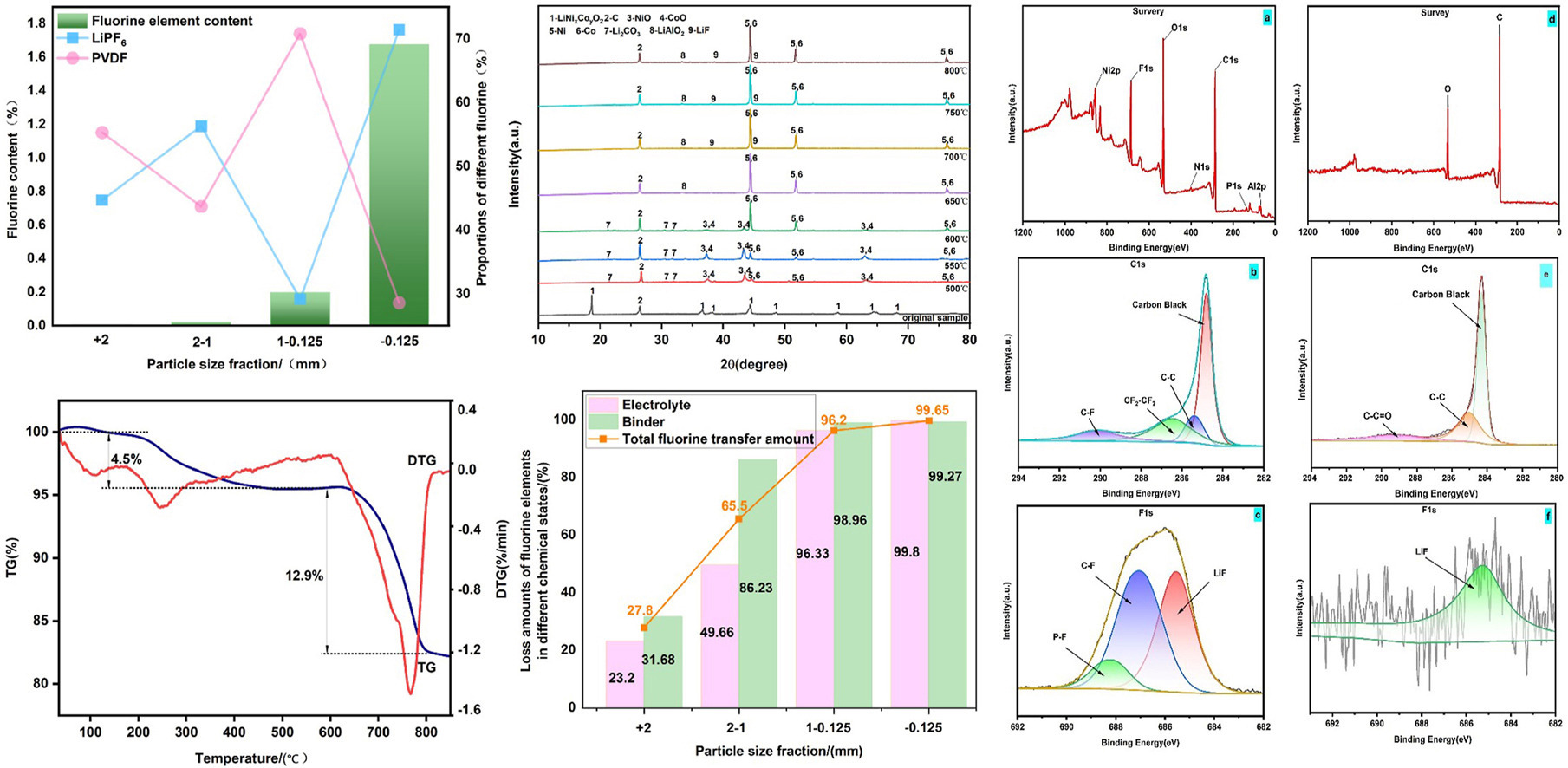
This study investigates the migration and distribution of fluorine in high-nickel cathode and anode mixed materials during crushing, screening, and thermal reduction. Crushing and screening results show that 78.76% of the particles are smaller than 0.125 mm, where fluorine (mainly from LiPF6 decomposition) and cathode materials are concentrated. Thermal reduction experiments indicate that 650 °C is the optimal temperature, at which cathode materials are deeply reduced to form water-soluble Li2CO3, and the lithium leaching efficiency reaches 75.6%. Lower temperatures result in insufficient reduction, while higher temperatures cause Li2CO3 decomposition and LiF formation, thus reducing lithium leaching efficiency. XPS and thermogravimetric analyses reveal that fluorine-containing intermediates react with metal oxides to form metal fluorides, which enrich in fine particles and increase fluorine content. Thermal reduction breaks P–F bonds and raises the proportion of Li–F, but only removes surface fluorine pollutants rather than internal fluorides.
Graphical abstract
Keywords
High-nickel lithium-ion batteries; Thermal reduction; Migration law of fluorine elements; Lithium leaching efficiency
文章导读