
期刊文章
过刊浏览
- Volumes 108-119 (2025)
-
Volumes 96-107 (2025)
-
Volume 107
Pages 1-376 (December 2025)
-
Volume 106
Pages 1-336 (November 2025)
-
Volume 105
Pages 1-356 (October 2025)
-
Volume 104
Pages 1-332 (September 2025)
-
Volume 103
Pages 1-314 (August 2025)
-
Volume 102
Pages 1-276 (July 2025)
-
Volume 101
Pages 1-166 (June 2025)
-
Volume 100
Pages 1-256 (May 2025)
-
Volume 99
Pages 1-242 (April 2025)
-
Volume 98
Pages 1-288 (March 2025)
-
Volume 97
Pages 1-256 (February 2025)
-
Volume 96
Pages 1-340 (January 2025)
-
Volume 107
-
Volumes 84-95 (2024)
-
Volume 95
Pages 1-392 (December 2024)
-
Volume 94
Pages 1-400 (November 2024)
-
Volume 93
Pages 1-376 (October 2024)
-
Volume 92
Pages 1-316 (September 2024)
-
Volume 91
Pages 1-378 (August 2024)
-
Volume 90
Pages 1-580 (July 2024)
-
Volume 89
Pages 1-278 (June 2024)
-
Volume 88
Pages 1-350 (May 2024)
-
Volume 87
Pages 1-338 (April 2024)
-
Volume 86
Pages 1-312 (March 2024)
-
Volume 85
Pages 1-334 (February 2024)
-
Volume 84
Pages 1-308 (January 2024)
-
Volume 95
-
Volumes 72-83 (2023)
-
Volume 83
Pages 1-258 (December 2023)
-
Volume 82
Pages 1-204 (November 2023)
-
Volume 81
Pages 1-188 (October 2023)
-
Volume 80
Pages 1-202 (September 2023)
-
Volume 79
Pages 1-172 (August 2023)
-
Volume 78
Pages 1-146 (July 2023)
-
Volume 77
Pages 1-152 (June 2023)
-
Volume 76
Pages 1-176 (May 2023)
-
Volume 75
Pages 1-228 (April 2023)
-
Volume 74
Pages 1-200 (March 2023)
-
Volume 73
Pages 1-138 (February 2023)
-
Volume 72
Pages 1-144 (January 2023)
-
Volume 83
-
Volumes 60-71 (2022)
-
Volume 71
Pages 1-108 (December 2022)
-
Volume 70
Pages 1-106 (November 2022)
-
Volume 69
Pages 1-122 (October 2022)
-
Volume 68
Pages 1-124 (September 2022)
-
Volume 67
Pages 1-102 (August 2022)
-
Volume 66
Pages 1-112 (July 2022)
-
Volume 65
Pages 1-138 (June 2022)
-
Volume 64
Pages 1-186 (May 2022)
-
Volume 63
Pages 1-124 (April 2022)
-
Volume 62
Pages 1-104 (March 2022)
-
Volume 61
Pages 1-120 (February 2022)
-
Volume 60
Pages 1-124 (January 2022)
-
Volume 71
- Volumes 54-59 (2021)
- Volumes 48-53 (2020)
- Volumes 42-47 (2019)
- Volumes 36-41 (2018)
- Volumes 30-35 (2017)
- Volumes 24-29 (2016)
- Volumes 18-23 (2015)
- Volumes 12-17 (2014)
- Volume 11 (2013)
- Volume 10 (2012)
- Volume 9 (2011)
- Volume 8 (2010)
- Volume 7 (2009)
- Volume 6 (2008)
- Volume 5 (2007)
- Volume 4 (2006)
- Volume 3 (2005)
- Volume 2 (2004)
- Volume 1 (2003)
Volume 113
Lobato, F. S., Fagundes, F. M., Damasceno, J. J. R., & Arouca, F. d. O. (2026). Monitoring drilling fluids using high-energy radiation attenuation with inverse modeling for constitutive parameter estimation. Particuology, 113, 22-35. https://doi.org/10.1016/j.partic.2026.03.009
Monitoring drilling fluids using high-energy radiation attenuation with inverse modeling for constitutive parameter estimation
Fran Sérgio Lobato *, Flávia Marques Fagundes, João Jorge Ribeiro Damasceno, Fábio de Oliveira Arouca
School of Chemical Engineering, Federal University of Uberlândia, Uberlândia, Brazil
10.1016/j.partic.2026.03.009
Volume 113,
June 2026,
Pages 22-35
Received 30 December 2025, Revised 25 February 2026, Accepted 13 March 2026, Available online 23 March 2026, Version of Record 31 March 2026.
E-mail:
fslobato@ufu.br
Highlights
• Solid sedimentation in drilling fluids reduces efficiency and poses safety risks in drilling operations.
• Numerical modeling is difficult due to discontinuous interfaces and multiple solids concentration regions.
• Batch sedimentation with gamma-ray attenuation was used to characterize drilling fluids.
• Convective flux parameters were estimated using constitutive models and interface-capturing methods.
• The method predicts sedimentation profiles and supports drilling fluid design and optimization.
Abstract
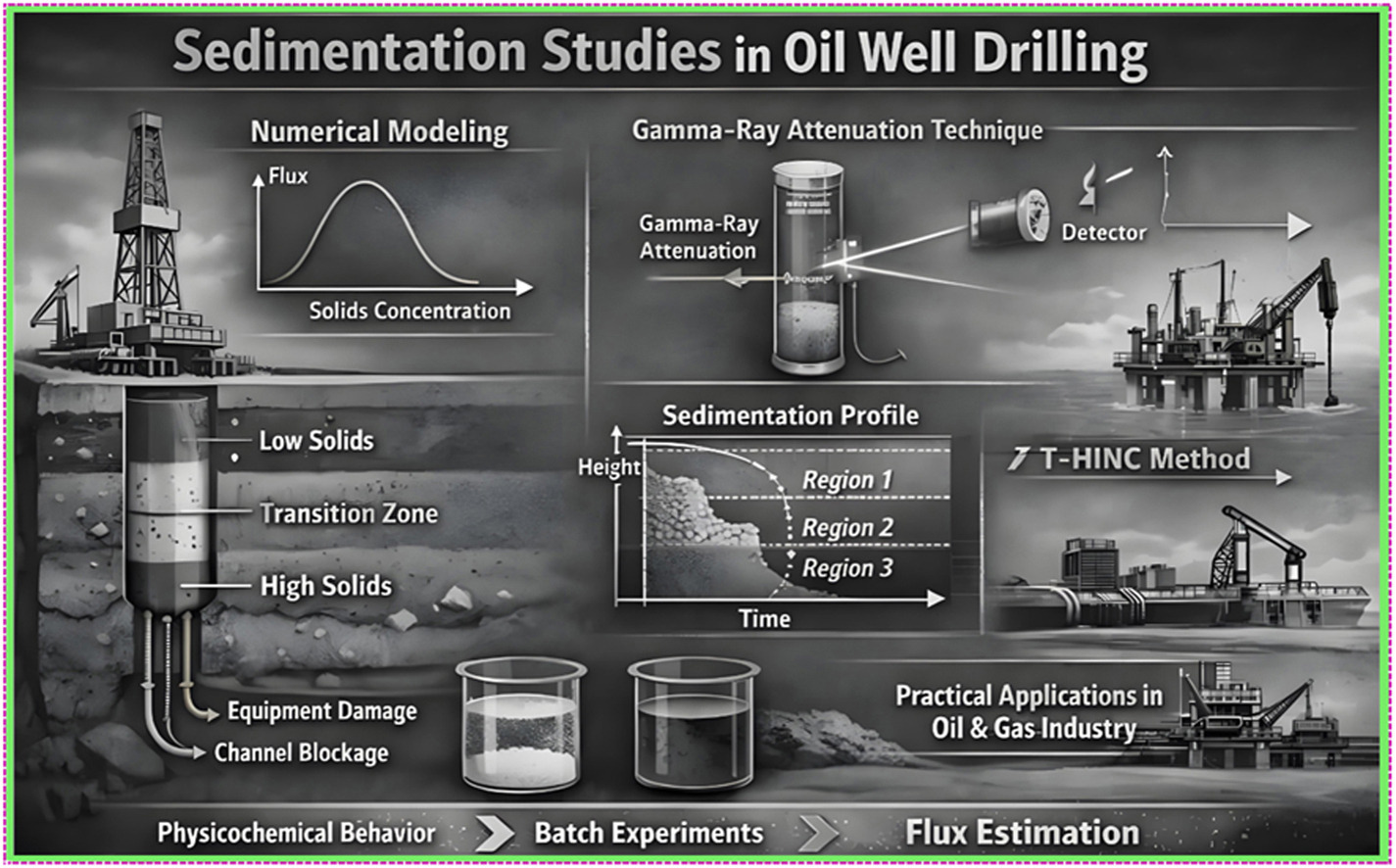
During oil well drilling operations, solid particles suspended in drilling fluids tend to settle, forming deposits that reduce operational efficiency and may cause equipment damage, channel obstruction, and safety risks. Understanding the sedimentation behavior of drilling solids is therefore essential for optimizing drilling fluid performance. This study characterizes drilling fluids and estimates the parameters governing the convective flux function in the governing equations using experimental data from batch sedimentation tests. The Gamma-ray Attenuation Technique and constitutive models were applied to analyze an aqueous calcium carbonate suspension and a real drilling fluid. The mathematical model was solved using the Tangent of Hyperbola Interface Capturing (THINC) method. The results demonstrate that the proposed methodology accurately estimates convective fluxes and reproduces sedimentation profiles across the column. The comparative numerical analysis shows that THINC outperforms the classical Finite Difference Method (FDM) by providing higher accuracy in capturing sharp interfacial discontinuities, preserving solution boundedness and monotonicity, and maintaining nearly constant total variation and stable interface thickness, indicating effective control of numerical diffusion and dispersion. Additionally, THINC exhibits lower and more stable computational processing times, highlighting its numerical robustness and potential applicability in drilling fluid design and optimization for the oil and gas industry.
Graphical abstract
Keywords
Drilling fluid; Phenomenological model; Gamma-ray attenuation technique; Differential evolution; Tangent of hyperbola interface capturing method
文章导读